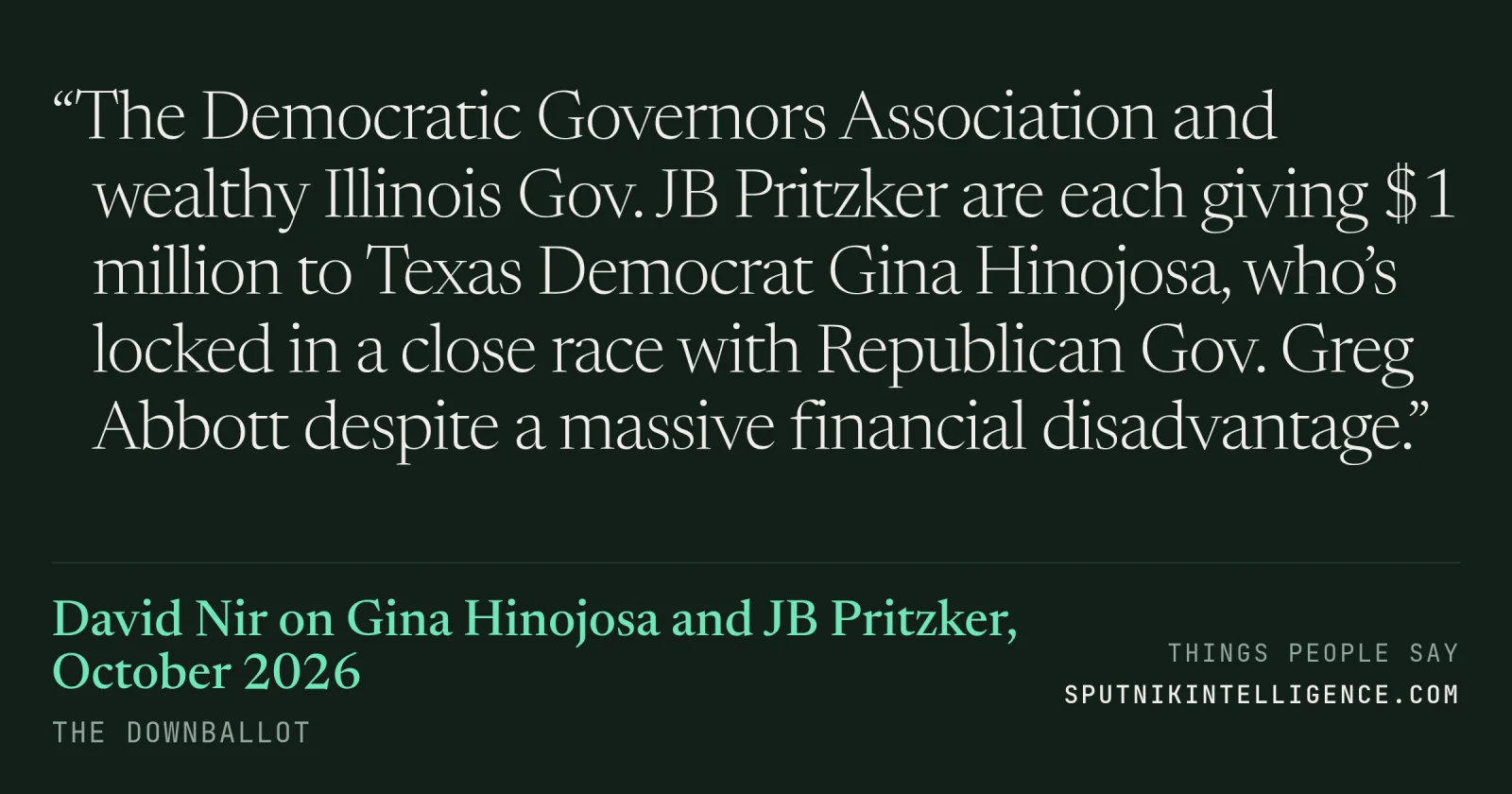
David Nir said about JB Pritzker, in The Downballot on October 8, 2026.
Nir was reporting on campaign spending in the Texas governor's race.
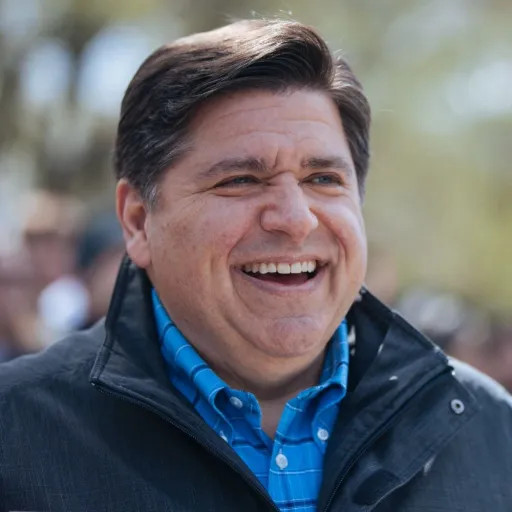
JB Pritzker
JB Pritzker is the Democratic governor of Illinois. He was unopposed in the March 2026 Democratic primary and was the Democratic nominee for reelection that year, with Christian Mitchell as his running mate.
David Nir said about JB Pritzker, in The Downballot on October 8, 2026.
Nir was reporting on campaign spending in the Texas governor's race.
Ted Cruz said about JB Pritzker, in The Ben Ferguson Podcast on September 21, 2026.
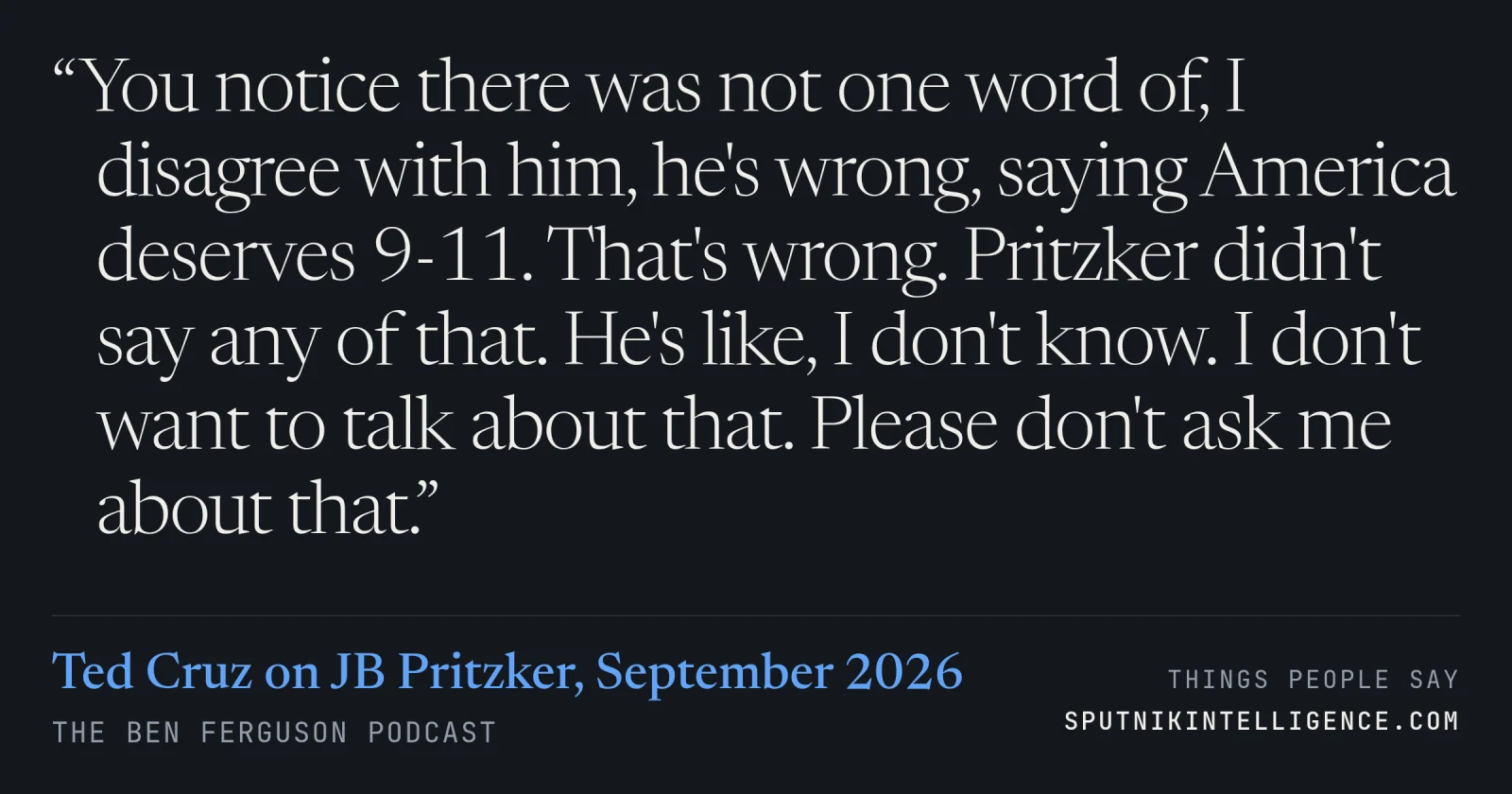
Ted Cruz on his Verdict podcast with Ben Ferguson, reacting to a clip of Pritzker on ABC's This Week declining to denounce streamer Hasan Piker, who has appeared alongside Michigan Senate candidate Abdul El-Sayed. In the clip, Pritzker said he was not focused on streamers and wanted to talk about stopping Donald Trump.
Doesn't mean anything to my election.
That's one heck of a way of describing it and throwing someone under the bus there, right?
Well, look, he, he spoke accurately when he says he doesn't want to talk about him. He really doesn't want to talk about him, but, but, You know, Jonathan Karl doesn't press him at all. I mean, these powderpuff interviews, I can't imagine what it's like to be a Democrat and just have all of these reporters basically acting like your press secretary. You know, he doesn't press him. Well, I get that you don't want to talk about him, but are you troubled that your party's nominee in Michigan is campaigning alongside him, welcomes him? Look, without Hassan Pike or Abdul Al-Sayed probably doesn't win the nomination. And Al-Sayed repeatedly refuses to distance himself. And by the way, Al-Sayed said many of the same things. Do you support him? Are you troubled that Chuck Schumer is supporting him? Those would be the questions that would be asked of a Republican if the tables were turned. But, you know, from Pritzker's perspective, and this is true of every Democrat, they welcome these America-hating radicals, or at least they…
I mean, a lot of the energy in the Democratic Party right now is clearly on the left, far left. I mean, Democratic Socialists of America, DSA, you've had a number of their candidates winning in these Democratic primaries. Are you concerned about that? That that's like a message that may work in…
Look, there haven't been very many of those, at least DSA candidates who are winning. It's true that there are progressives that are winning.
Around the country. We're going to have trouble in the House. A few.
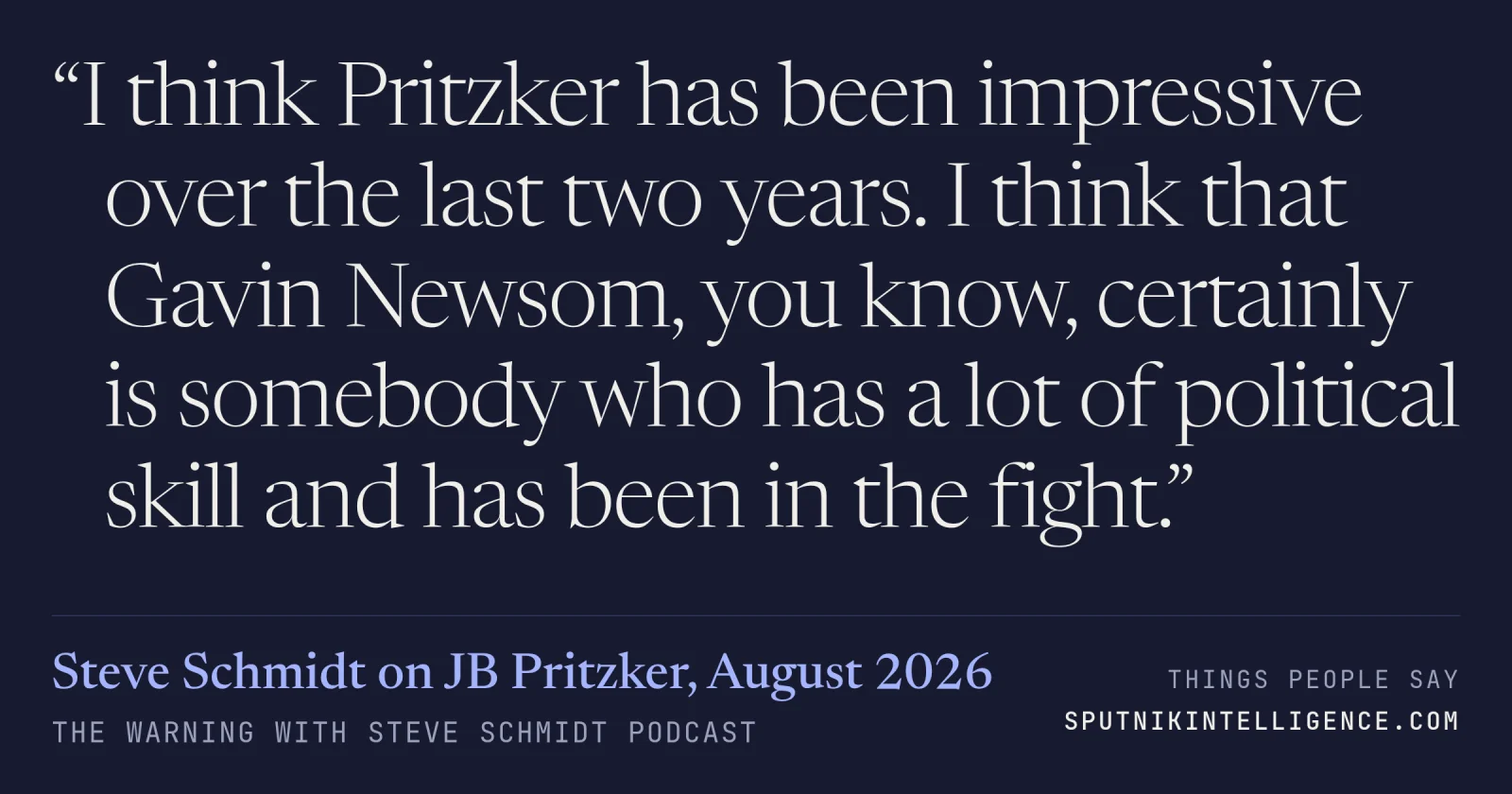
Steve Schmidt said about JB Pritzker, in The Warning with Steve Schmidt on August 6, 2026.
Steve Schmidt on The Warning, talking with former Washington Gov. Jay Inslee about who might run for the Democratic presidential nomination in 2028.
I think Pritzker has been impressive over the last two years.
Uh.
I think that Gavin Newsom, you know, certainly is somebody who has a lot of lot of political uh, a lot of political skill has been has been in the fight. Who are who are some of the other people that when when you look out and and you you see his prospective candidates not not looking for an endorsement, you know that that share. You know, what I would say is Carbal's position, my position, which is run. I hope Ramammanuel will run. I think that's an important voice in the in the in the party. I hope Jason Crowe uh, the Colorado congressman uh will run.
Uh.
I'd like to see a really a really big field anybody else out there that that you look at and say, I'd like to see them as a candidate, see what they got.
Well. I would encourage anybody who has a and credibility to run this year because it's an open field to run, right, So if you're an open field runner. There's a lot to run on, and I think that that you have candidates that who may be you know, in the two or three percent polling right now, It…
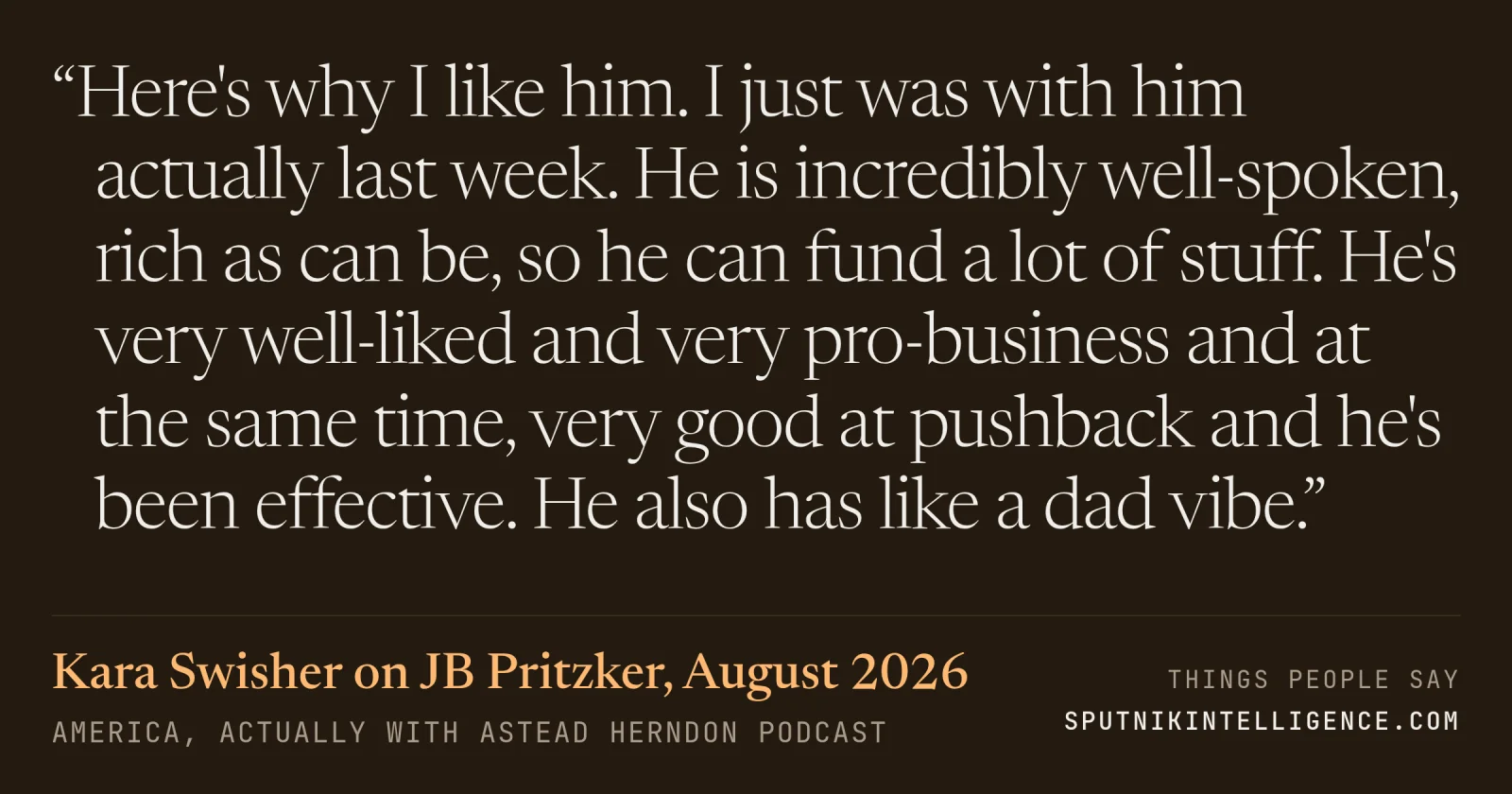
Kara Swisher said about JB Pritzker, in America, Actually with Astead Herndon on August 1, 2026.
Kara Swisher on America, Actually with Astead Herndon, during a fantasy draft of 2028 presidential contenders. She was explaining why she picked Illinois Gov. JB Pritzker for her Democratic team.
you leave him out?
That was bad on my part. I was actually thinking about that right now. We're going to say Governor J.B. Pritzker of Illinois was almost certainly running, has a whole bunch of money behind him. I say I
would have put him before Ramando. Here's why I like him. I just was with him actually last week. He is incredibly well-spoken, rich as can be, so he can fund a lot of stuff. He's very well-liked and very pro-business and at the same time, very good at pushback and he's been effective. He also has like a dad vibe.
But he's like a normal.
He's not like a rich
guy. He's got a dad. He's
JB Pritzker writes JB Pritzker , writes The Briefing with Jen Psaki , writes Find Out Podcast , writes The Rachel Maddow Show and writes The Best People with Nicolle Wallace . They have also been a guest on The Prof G Pod with Scott Galloway , Prof G Markets , Question Everything , This is Gavin Newsom , The Parnas Perspective , Mixed Signals from Semafor Media , Decoder with Nilay Patel , The Daily (NYT) , Volts and Pivot (Kara Swisher & Scott Galloway) .
Recently: “Trump Erupts on Reporter When Asked About Abuse!” on The Parnas Perspective (October 2026); “JB Pritzker thinks AI could help us live to 100 — or threaten us like nukes” on Decoder with Nilay Patel (October 2026); “Roe Failed. The Fight Isn’t Over.” on JB Pritzker (June 2026); “JB Pritzker on the Fight Over AI, Housing, and Taxes” on Prof G Markets (June 2026); “Illinois Will Hold the Trump Administration Accountable” on JB Pritzker (May 2026); “A Blow to our Democracy from a Broken Supreme Court” on JB Pritzker (April 2026).
Pritzker at a live taping of Prof G Markets, asked how Illinois should handle AI data centers given local opposition and their strain on electricity and water.
…How are we going to get it fast enough? And of course, we've expanded all the renewable energy sources that we can as fast as we can. But nuclear is the best way to get baseload energy that we need. So to your. So to your point, though, data centers are sucking a lot of the electricity and
water. And it's not just Illinois data centers. There are data centers all over the country that are doing this, and particularly the AI, big AI data centers that are going up. And, you know, you saw like in Pennsylvania, they're restarting Three Mile Island just for
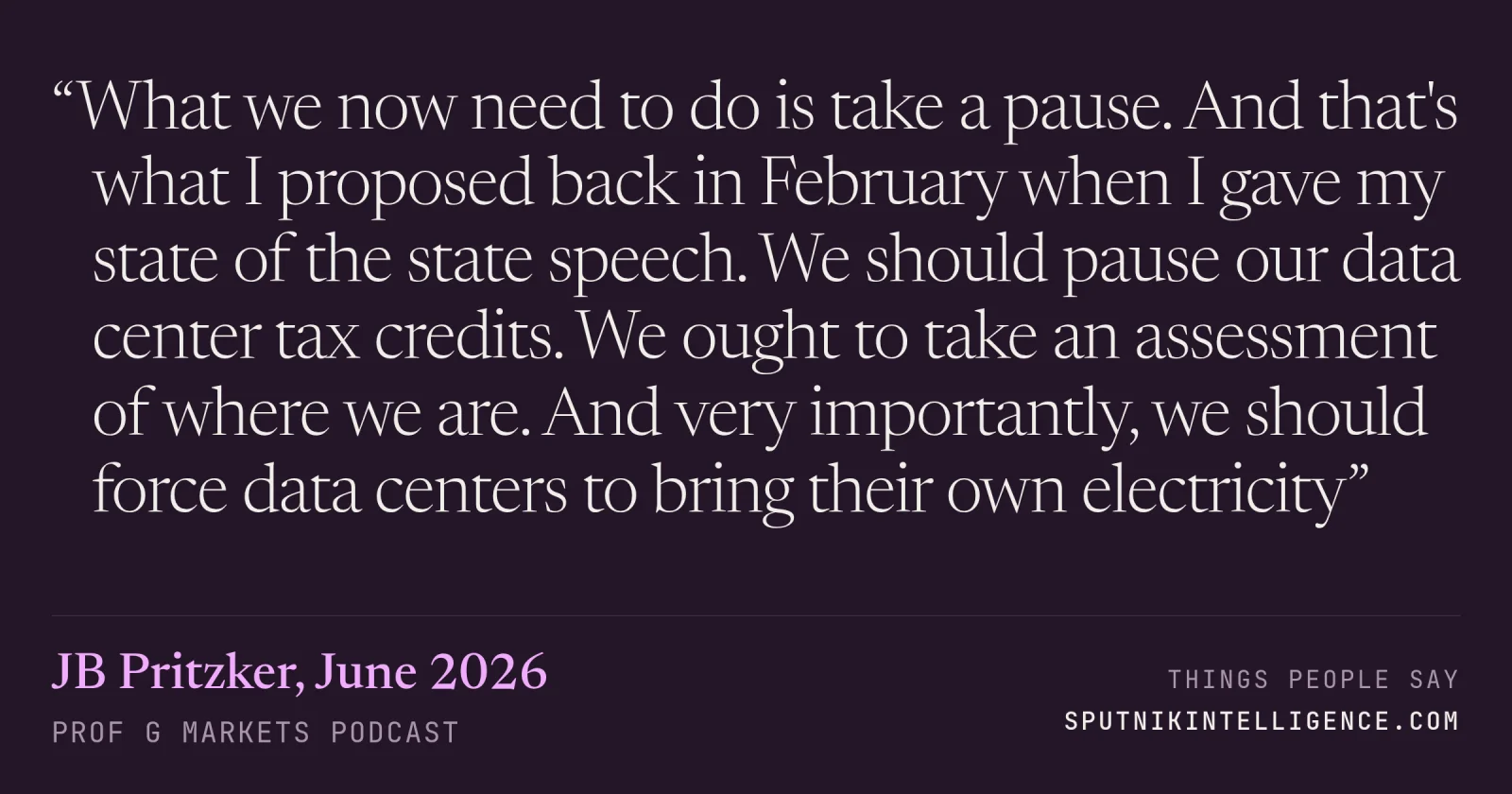
a data center. And I think that my guess is that's going to be a reasonably unpopular thing to have done. What I've done here, and I proposed it back in February, is that we, you know, we had, just like we do in a lot of industries, we had tax credits available for people to build data centers. I do want to point out that data centers are really great job creators in the construction side of things. But once they're built, they really don't employ a lot of people. What they do do is pay property taxes in the local area, which brings down property taxes for others. I'm going through all this because what we now need to do is take a pause. And that's what I proposed back in February when I gave my state of the state speech. We should pause our data center tax credits. We ought to take an assessment of where we are. And very importantly, we should force data centers to bring their own electricity and make sure that they're
paying their fair share if they're coming to the state of Illinois.
We agree on that. I just want to ask you about housing. So you recently had a proposed bill called the Build Plan. And the idea was to bring down housing prices by essentially giving the state the power to override these local zoning policies, if I'm getting that right. And the bill didn't pass.…
I'm glad you asked because, you know, when I ran for office, my slogan for my campaign was think big. Now, some of that was because, but it was also because we needed big change in the state. And I talked about some of the challenges that we had. And I have not stopped thinking big or acting in a…
Pritzker at a live taping of Prof G Markets in Illinois, answering a policy lightning round that included a question about taxing high earners and wealth taxes.
Last one on the policy side, alternative minimum tax on anyone making, say, over $10 million of 50%.
…tax, just because this seems to be the direction in a lot of ways that the Democratic Party is heading. California, they've proposed the wealth tax. We've just seen a federal proposal. I mean, alternative minimum tax is also interesting, but given wealth tax is so popular, what do you make of that?
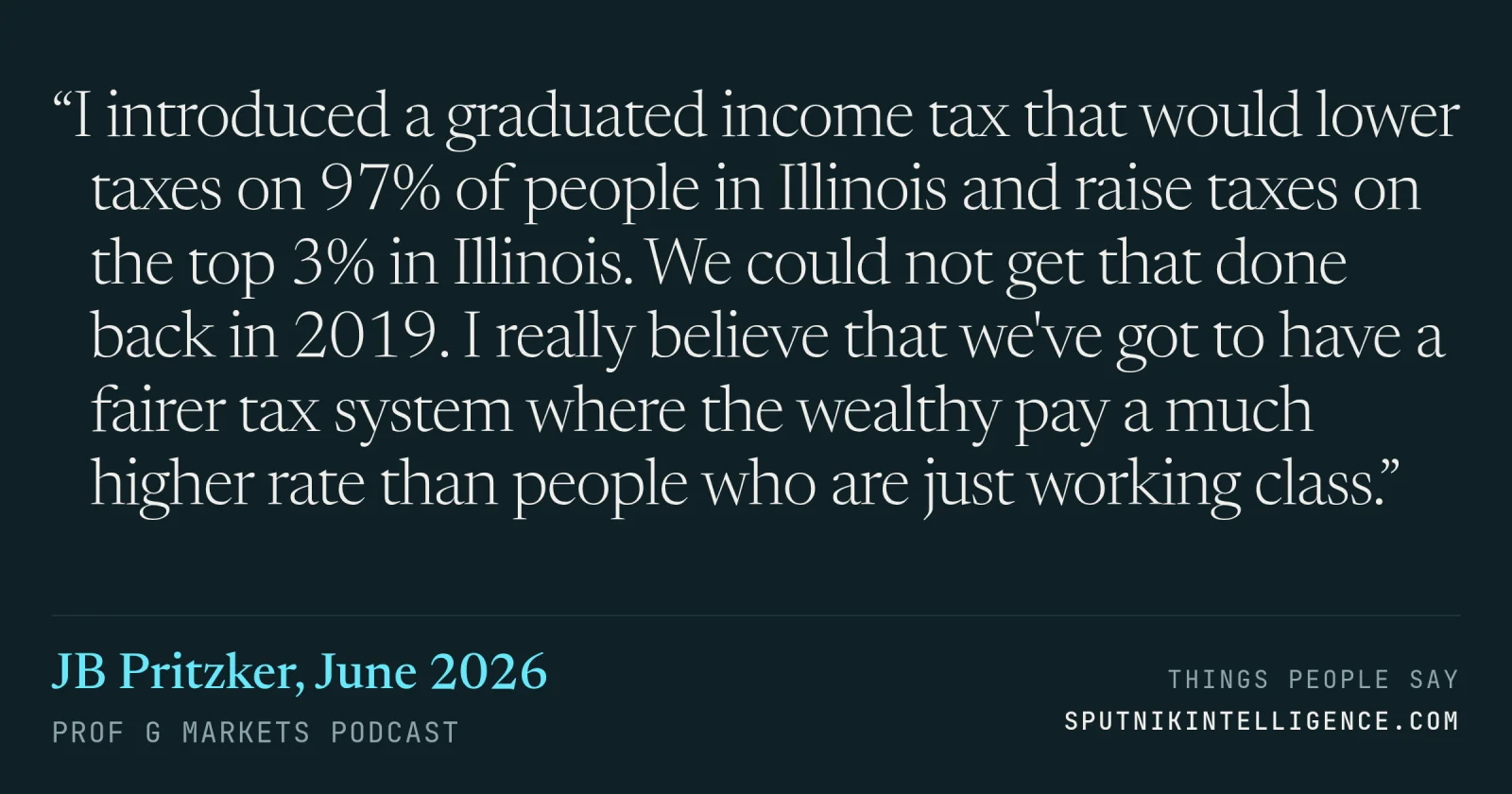
You may not know that I introduced the graduated income. We have a flat tax in the state of Illinois. I introduced a graduated income tax that would lower taxes on 97% of people in Illinois and raise taxes on the top 3% in Illinois. We could not get that done back in 2019. I really believe that we've got to have a fairer tax system where the wealthy pay a much higher rate than people who are just working class. In fact, most people shouldn't have to pay. A lot of tax. And indeed, there shouldn't be the same tax rate that is applied to someone like you, Scott, as compared to a nurse or someone who's working at McDonald's.
So, I'm sorry, did you have something?
Yeah, I mean, the wealth tax in particular, because this seems to be one of the issues that is going to divide people. Some would say that the wealth tax is going too far. Maybe it would disincentivize investment. Maybe it's too anti-business. Like, where do you land on this ultimately?
Like I said, I think the wealthy, and we've talked about a millionaire's tax here in the state of Illinois as an alternative to a graduated income tax. By the way, do you know who introduced the graduate income tax in the United States? Abraham Lincoln.
Pritzker on Decoder, arguing for AI guardrails and privacy rules rather than industry self-regulation. He described Illinois as one of three states with AI safety legislation and said Congress has not acted.
…and don't forget, AI is, as you're suggesting, I mean, talk about a collision. This focus on privacy is warranted and long overdue, to be honest with you. I understand what you're describing about COVID, but I think something that came out of COVID got accelerated and that was conspiracy theories.
Yes.
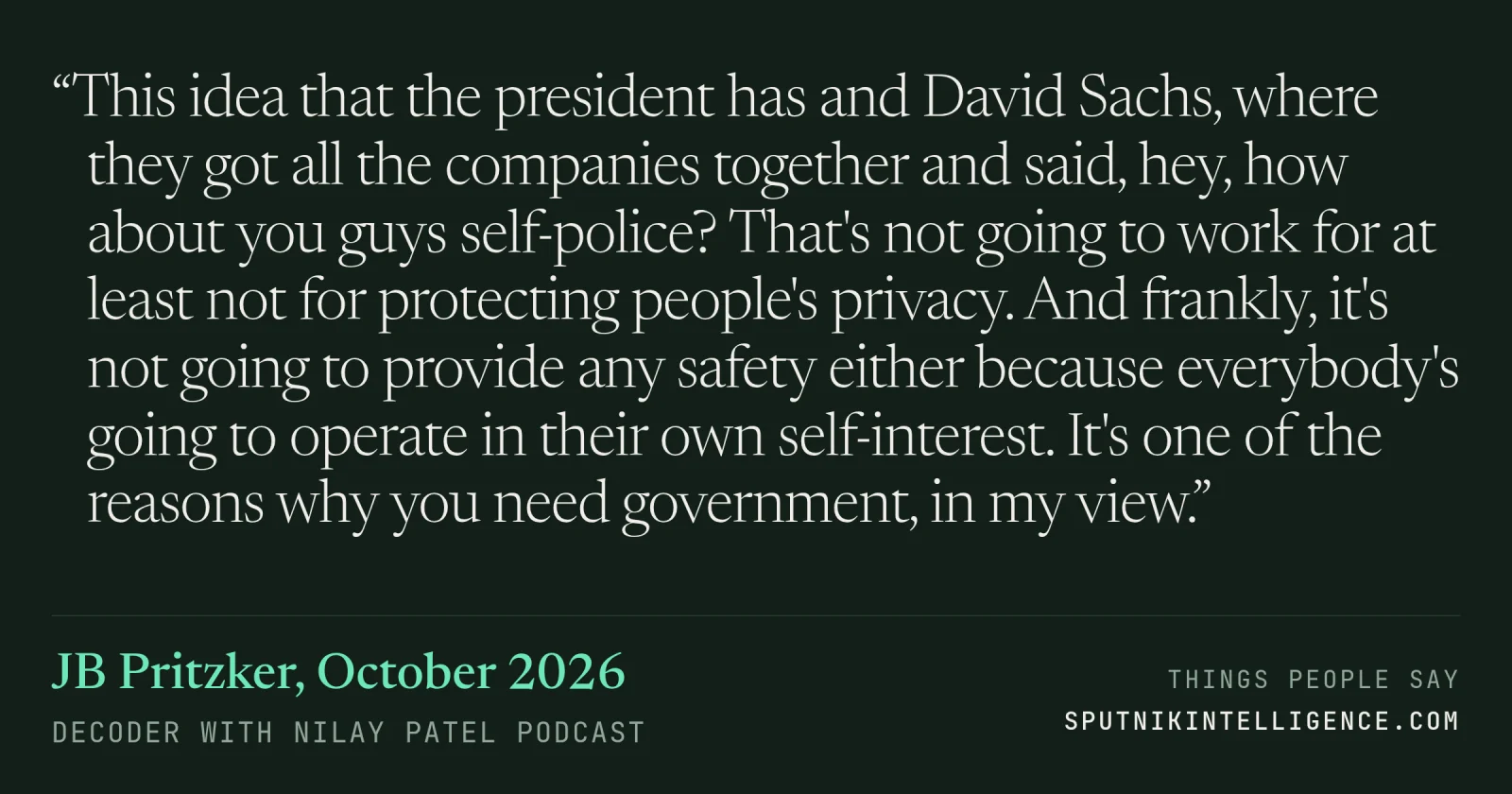
…what I think is that we are having to solve multiple problems at the same time. And AI is coming. Let's just go to AI for a second. It's here. I mean, I say it's coming. It's here. It's not going to stop. We're not going to become Luddites and there's not going to be any AI. So the question is, like in the context of privacy, what guardrails are we putting on AI? And how are we managing it? This idea that the president has and David Sachs, where they got all the companies together and said, hey, how about you guys self-police? That's not going to work for at least not for protecting people's privacy. And frankly, it's not going to provide any safety either because everybody's going to operate in their own self-interest. It's one of the reasons why you need government, in my view. I'm not suggesting government is any smarter than these companies, but one of the reasons you have any kind of collective action of government is because separately, as you know, people operate because they operate in their own self-interest. I mean, you could have like a Hobbesian world where people are killing each other and there are no rules about it. So I think we've got to use government…
going to say focus on privacy for one second. And I understand what you're saying about AI. I think part of the privacy debate around flock cameras, for example, is, well, sure, you can have one license plate reader in one intersection. And if the cops had to go there and pull the SD card out of it…
I think we should every year be looking at that question. I'll give you an example of it. We passed it, and again, I'm back to AI because I think what you're describing, I thought was a perfect way to say it. You know, if it was an SD card that they had to go grab and then analyze, you know, back…
have them all. How will AI revolutionize your business? AWS AI is how. Support for the show comes from CrowdStrike. AI is already fundamentally changing how companies build products and run their businesses. If you listen to the show, you probably already know this. But while AI drives innovation…
Pritzker on Decoder, discussing how AI could change employment in the United States and what governments should prepare for.
…that's already possibly taking office this November. I'm 61 years old, but I think of myself anyway, having come out of the tech world and as somebody who has been a fighter for progressive values, that, yeah, we got to become more aggressive and make sure we're standing up for our people.
…these companies, thinking about the dynamic between the government and the biggest companies in the world. I'll just ask the question, I guess, more directly. Do you think Newsom was right to give in to Paramount, or do you think he should have made them make good on that threat to leave?
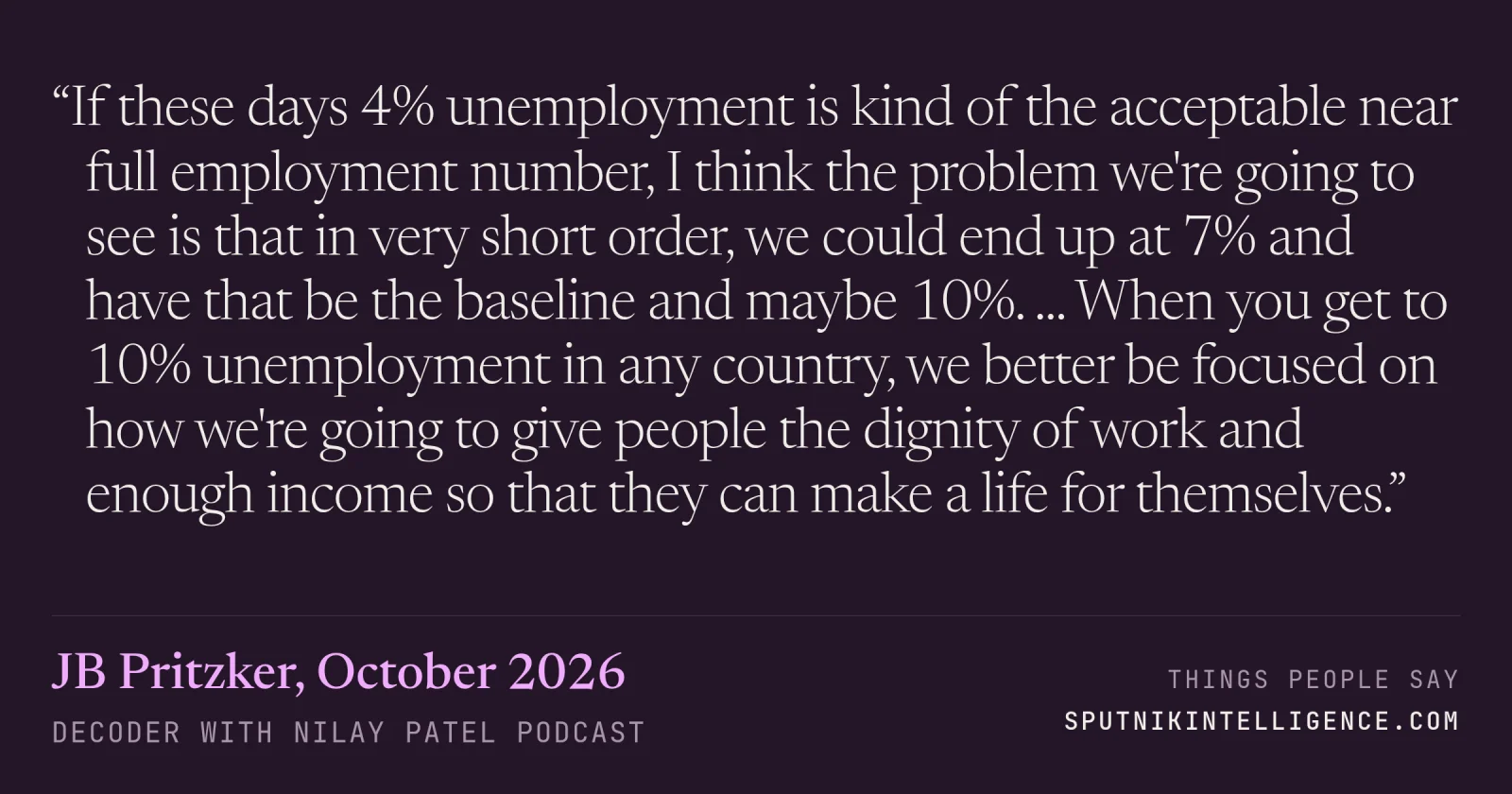
I can't speak to the Paramount situation well enough to give you an answer. And so it would be unfair for me to do so. I can say once again that our orientation today, and I think about the big AI companies and the big social media companies as well, our orientation really has to be like, wait a minute, too much power in too few hands. And particularly when we talk about AI, where it's potentially existential, but certainly transformative is probably a kind way to say it about the economy, that we're going to have to get very engaged. Guardrails, of course, on both parts, but also addressing what I think on the AI front is potentially a significant change in employment in the United States. And, you know, I'm not somebody who necessarily is convinced that we have to see a whole bunch of job loss, but that does feel like that's the direction this is going. And so what I'm suggesting is we better be prepared and we better be protecting people who are going to lose their jobs, or at least it appears they're going to lose their jobs. And I'll just give you this thought. If these days 4% unemployment is kind of the acceptable near full employment number, I think the problem we're going to see is…
And I wanted to start with some of the brinksmanship we have seen in the negotiations between particularly states and the big companies, because that brinksmanship is real. The threat is we will leave. We just covered, I don't know, Kevin O'Leary in Utah talking about data centers and the people of…
We are in competition. We just are. Because it isn't bipartisan, at least if you ask me. Unless there is a change in the government, I'll pick on Texas for a second. And there is a chance that you'll see a new governor in Texas as of November 3rd. In fact, a good chance. But if you look at Texas as…
want to ask those questions just to set the baseline. I really do think something is happening, right? A lot of young people are dissatisfied with the status quo. A lot of people in general are dissatisfied with what big tech companies are trying to do with AI, with the potential for job loss. And…
Pritzker on The Verge's Decoder, recorded during the 2026 midterm campaign while he was running for reelection. Host Nilay Patel asked whether a generational political realignment is changing how government deals with big business and tech.
That is not our intention. We are, in fact, in discussions with the Bears and the NFL about keeping the Bears either in Chicago or in Arlington Heights, but in Illinois.
…the lawsuit. The next day, the Ellison family is like, we never, we're from California. We would never leave. I see a parallel here with the Bears that is connected to that larger realignment about how government and business should interact. Do you see that parallel? Do you feel that realignment?
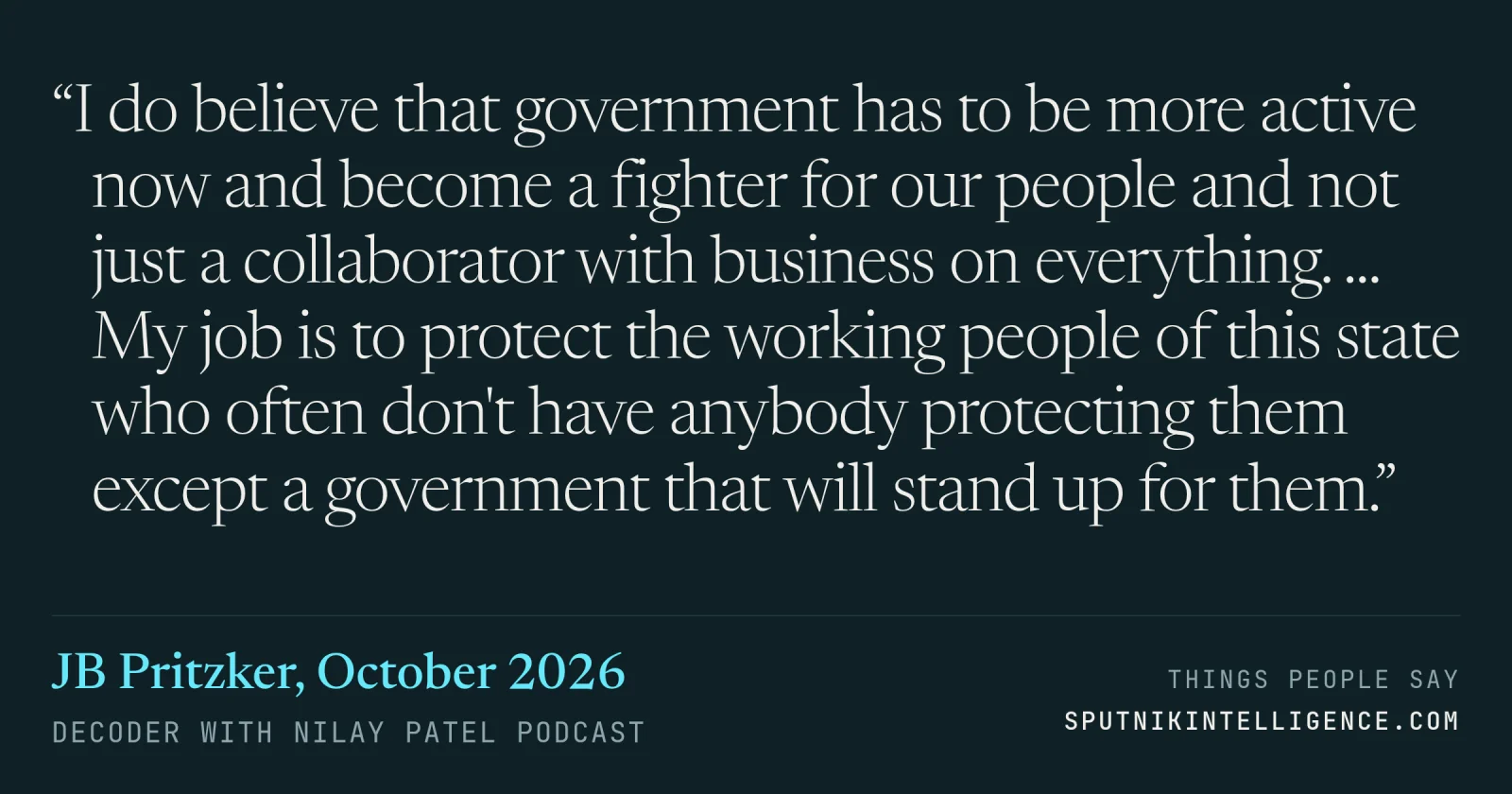
…in Chicago and Illinois. And that's really what we're in the midst of now with the Bears. But I understand your point about realignment. I mean, there is a generational change, and I think it's also an attitudinal change about protecting taxpayers, protecting people who frankly are among the most vulnerable to all the. The technology that's overtaking people's lives and invading people's homes. I do believe that government has to be more active now and become a fighter for our people and not just a collaborator with business on everything. And so I'm not, you know, I'm a businessman, as you know, before I became governor, but I also know that the people of Illinois anyway, my job is to protect the working people of this state who often don't have anybody protecting them except a government that will stand up for them. That's kind of the realignment that I see. And that generational shift, I agree with you. It's partly a Democratic…
There are two places where I see the realignment in particular. One is data centers. One is privacy, right? And you just see that as a bipartisan backlash to those things. I would actually add a third, right? Which is antitrust broadly. It's weird if you go into Silicon Valley. David Sachs lately…
I can't speak to the Paramount situation well enough to give you an answer. And so it would be unfair for me to do so. I can say once again that our orientation today, and I think about the big AI companies and the big social media companies as well, our orientation really has to be like, wait a…
And I wanted to start with some of the brinksmanship we have seen in the negotiations between particularly states and the big companies, because that brinksmanship is real. The threat is we will leave. We just covered, I don't know, Kevin O'Leary in Utah talking about data centers and the people of…