 Nilay Patel
Editor-in-chief of The Verge, which he co-founded in 2011, covering consumer technology, platforms and the policy around them.
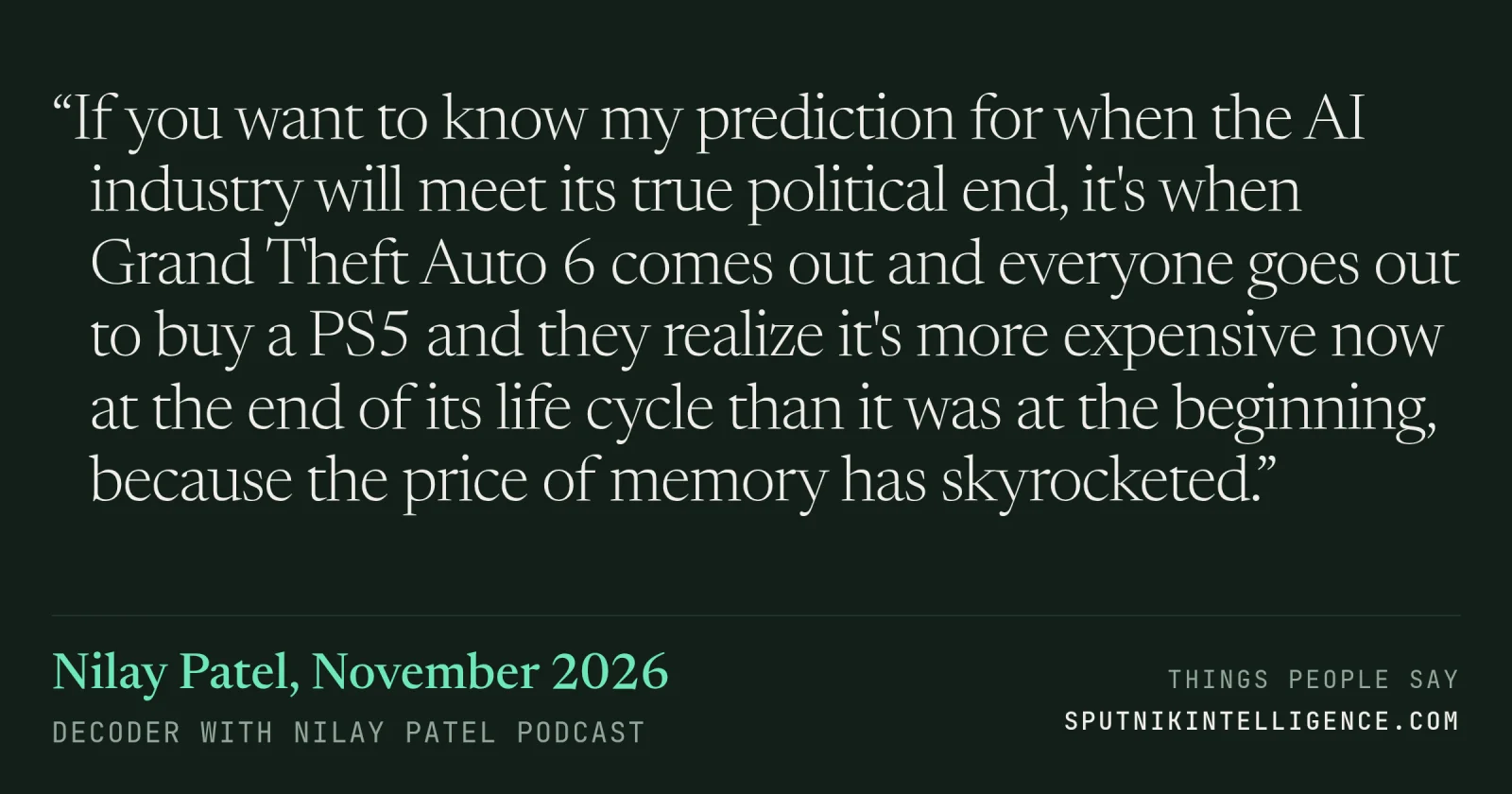
“If you want to know my prediction for when the AI industry will meet its true political end, it's when Grand Theft Auto 6 comes out and everyone goes out to buy a PS5 and they realize it's more expensive now at the end of its life cycle than it was at the beginning, because the price of memory has skyrocketed.”
Decoder with Nilay Patel · Tech Strategy & Big Tech · November 2026
Context
Supply-chain scholar Willy Shih had just described how demand for memory chips far outstripped capacity, so consumers face higher prices. Patel turns the AI-driven memory shortage into a prediction about where consumer backlash against AI will finally land.
Transcript
…wanting every scrap of RAM that the whole world can produce. And so now there's not going to be inexpensive cell phones, right? Like what it will push the system over the breaking point? Because globalization has seemed generally resilient to a bunch of people who kind of want it to be over.
…rise. Now, in the case of memory chips, that's a different problem because the demand, you know, far outstripped the capacity. You know, I used to always buy memory cards on Black Friday. Forget that this year. You know, it's like, I'm just glad I stocked up on a previous Black Friday. Okay. Look,
if you want to know my prediction for when the AI industry will meet its true political end, it's when Grand Theft Auto 6 comes out and everyone goes out to buy it a PS5 and they realize it's more expensive now at the end of its life cycle than it was at the beginning because the price of memory has skyrocketed.
Yeah, no kidding, right? And we're talking about huge amounts. But, you know, that's the same thing. We're in a phase where we see all these tactical actions from, you know, taken by the government, okay, very transactional, very tactical, without necessarily understanding the interconnections and…
know at least some of our audience is going to be listening to this conversation. And you're steeped in global trade. You wrote a book to educate our government about how it works from the basics, which I think is sorely needed. But a lot of the promise for young people in our politics lately is we…
Well, I see we will, I think what's more likely is we will see efforts, as you describe. I mean, I would love to sit down with people and say, okay, we want to move this type of production back to the U.S. Let's take a more strategic, a more nuanced approach, understanding that bigger picture, what…
More from Decoder with Nilay Patel