 Ed Elson
Co-Host of Prof G Markets and author of Simply Put.
Ed Elson
Co-Host of Prof G Markets and author of Simply Put.
“I don't think that we necessarily have an AI bubble right now that is infecting the totality of markets. ... But we do have an AI lab bubble where there seems to be too much excitement and too much enthusiasm about Anthropic and about OpenAI because they're new, they're sexy, they're doing interesting things.”
Prof G Markets · Money & Markets · October 2026
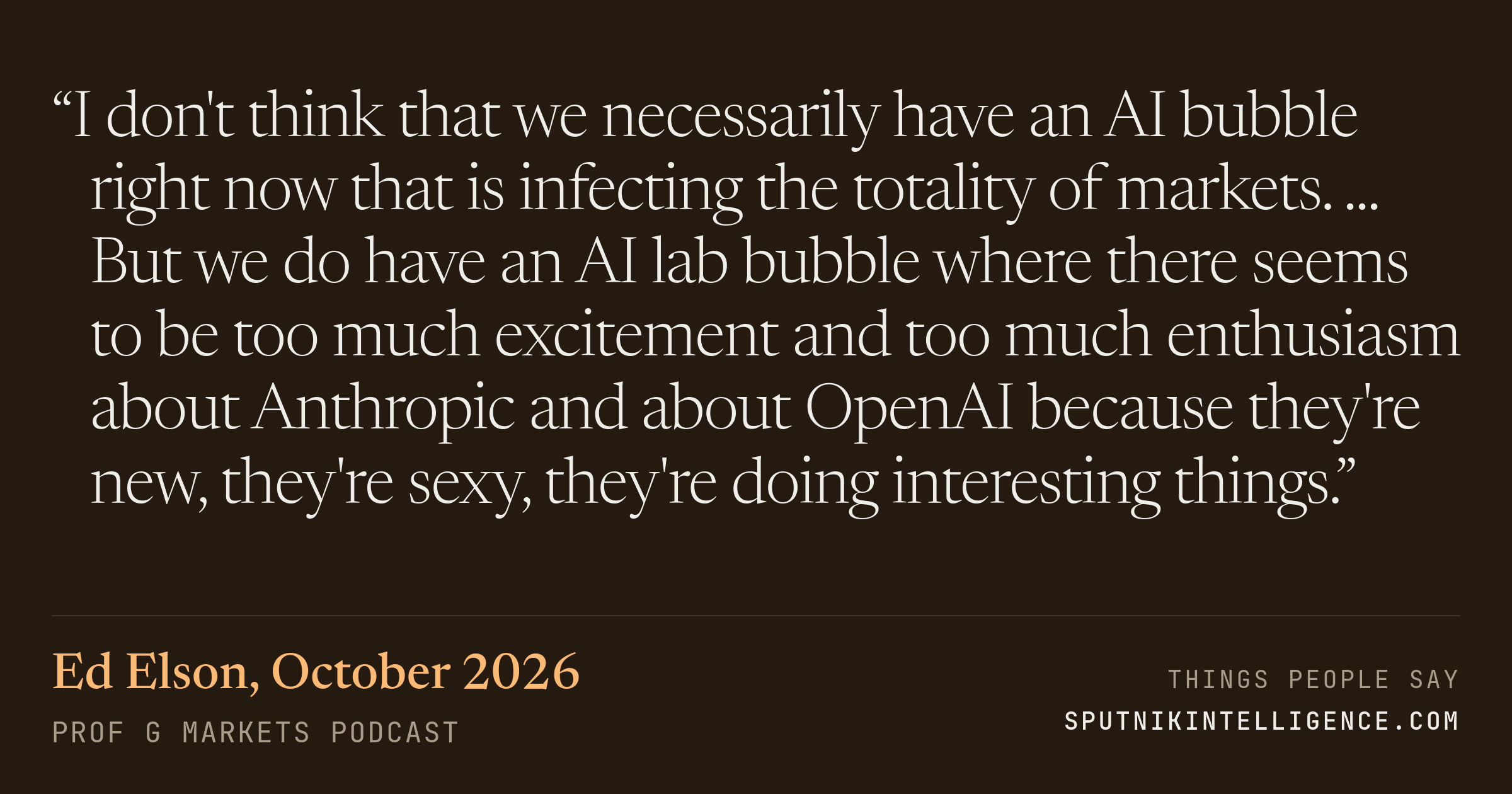
Elson and Galloway are going through reported figures from Anthropic's S-1, including heavy customer concentration and a large operating loss. Elson's objection is to the price being asked, not the company. He goes on to say the labs still haven't figured out their business models.
Transcript
Now is the time to fly. I hope you have plenty of the wherewithal. Washington is starting to take a closer look at the AI industry. Last week, the FTC opened an investigation into OpenAI and Anthropic over potential safety and consumer protection concerns. The news came during an already chaotic week for both companies. OpenAI announced that it would not release its latest Astra model due to safety concerns. And Reuters reported details from Anthropic's S1, which show that the company racked up an operating loss last year of $8 billion. So, Scott, a lot of AI news to dig into here, which is going to be extremely important for the public markets going forward. I think a decent place to start would probably be the Anthropic S1, which, as you mentioned, we dug into last week with Paul Kodrowski, and he had some interesting things to say. But I would like to get your take. Revenue last year grew 12x to nearly $4.6 billion, but their operating loss has widened to more than $8 billion last year. To be clear, we don't know what their financials look like right now in 2026. And that obviously matters a lot. But we did get some clarity on what financials looked like last year. And the reality is, as we have suspected for a long time, that the losses are enormous in the same way that they're enormous at OpenAI. Not as enormous when it comes to Anthropic, but still very, very large. And this is very relevant considering this company is imminently going public. Supposedly, it's going to happen right after the midterms. Scott, what did you make of these leaked, revealed financials? Who knows if they were actually leaked or if it was a setup? I don't know. What do you make of them?
They were leaked by Anthropic, would be my guess. There's the valuation itself, and we'll come back to it. But what Paul said yesterday on, I was going to say your show, but our show, it was that really the number that jumped out to him, and I didn't recognize it, was I believe about 40% of their revenue is coming from just two clients. A quarter, not 40%. Excuse me, a quarter. We always used to worry. I've always run small companies. I've never been able to scale to a big company. And we always had, and I've always been in B2B services, right? Strategy analytics. And we always had this problem of too much concentration across the small. Nike was like 22% of our business at one point. PNG was 15%. LVMH was like SD Law. The five companies were like 60% of our revenue. And I used to say, okay, that's a problem, but it's a good problem. It means these iconic brands are spending a shit ton of money on a small company and getting the types of contracts that only big companies get. But when you're asking for a $2 trillion valuation, you need to look more like Meta. And that is, remember all of these, and I'm guilty of this, attempts to boycott Meta where people were so upset of Meta. I think it was like five years ago. They said, let's start a boycott. And Meta has something like 300,000 clients and no one is more than a third of a percent. That is what you call robust. And robust is a really interesting term in business because it indicates fragility. Let's talk about the economy. Banking industry is not robust. If JP Morgan finds out it had some rogue whale trader that figures out a way to short circuit or get around some of their internal controls and makes an enormous bet on the debt market in Germany and it turns against him and they end up down $700 billion somehow using leverage and derivatives that got past their compliance or risk department and Jamie's about to get flipped upside down. If he calls Donald Trump, Donald Trump has to bail him out. JP Morgan has become too big to fail. And they put in place a bunch of capital constraints and ratios in Sarbanes-Oxley that are supposed to limit the likelihood of that. But the banking industry in America is not a robust business. There's a lot of small banks, but a disproportionate amount is concentrated amongst some of the bigger banks. They would argue back that that creates strength, creates operating leverage, better customer service, lower interest rates. And those banks do an amazing job. And JP Morgan right now is worth more than the biggest 12 banks in Europe, just that one bank. So there's this capitalism versus regulation, but back to the notion of robust versus fragility. The fast food industry is really robust. It's not fragile at all. If the biggest player, McDonald's, went out of business, you could just still find really cheap caloric intake that puts you on a path towards diabetes really early, really easily. There's a ton of substitutes. And the reason why you want a robust industry is it not only results in a lack of systemic rest to the system if one goes out and consumers start bailing it out. The problem when you're too big to fail is you start taking stupid risks because your downside is limited because you know you'll get bailed out, right? And also the advantage of a really robust industry is there's more competition, which ultimately lowers rents and transfers capital back from the shareholders to the consumer, which is absolutely what we need more of. Long-winded way of saying the most frightening thing about this is I don't think you've ever seen a company ask for $500 billion in market capitalization that had a fraction of the client and revenue concentration that Anthropic highlights or articulates in its S1. I want to get your reaction to that, and then I want to talk a little bit about the valuation.
Oh, I can 100% agree with you. I think the problem here isn't necessarily the company per se. It's a startup. It's a relatively new company that is trying to figure out how to get clients, similar to the thing that the dynamic you're describing that you dealt with when you were starting your businesses. Some will say, well, that was last year. You're looking at the customer concentration from last year. But what we know based on the ramp spending data, which has been extremely informative, is that 80% of both OpenAI and Anthropic's enterprise revenue is coming from 1% of customers. And so the question that you have to ask yourself, sure, that they're getting a lot of revenue. And let's be clear, the revenue numbers are incredible. I mean, supposedly OpenAI is coming up on $70 billion ARR. ARR is a little bit of a bullshit number, but let's put that aside and recognize that these are tens of billions of dollars in revenue that these companies are raking in. And that is impressive. But there is extreme customer concentration risk here. And I've been going back and watching Mad Men, which is the greatest TV show of all time. And I am reminded of exactly this dynamic because I don't know if you remember, but Sterling Cooper Draper Price in that TV show, they have a similar problem where they're extremely dependent on Lucky Strike. And then one day, the CEO of Lucky Strike has a meeting with Roger Sterling. He says, sorry about this. I know we've been together for 25 years, but it's time to move on. At which point, Roger Sterling says, you're going to kill me. And that's essentially what happens. It completely collapses the business. And this is what happens in business. If you become too reliant on a handful of customers, things can go wrong. And suddenly your business is no longer sustainable or structurally sound. So they are at immense risk of that. And that's okay. That happens. But they are asking for a $2 trillion valuation, which would make them more valuable than Meta, more valuable than Saudi Aramco, more valuable than Broadcom, more valuable than Berkshire Hathaway, more valuable than Eli Lilly, more valuable than JP Morgan, more than twice as valuable as JP Morgan. And so for me, the problem here, as usual, is that we're having price problems. We're having an issue of the valuation. And I don't think that the valuation is properly pricing in the massive risks here. And I've said this before, but I'll say it again. I don't think that we necessarily have an AI bubble right now that is infecting the totality of markets. We can see that in, say, the The NVIDIA valuation, which has actually come down quite significantly. But we do have an AI lab bubble where there seems to be too much excitement and too much enthusiasm about Anthropic and about OpenAI because they're new, they're sexy, they're doing interesting things. But let's be very clear, they still haven't figured out their business models by all accounts. And from what I'm seeing, they are still not profitable. In fact, they're very unprofitable, some of the most unprofitable businesses of all time. And the risks are still systemic. So I think that needs to be priced in. But the question is: will investors care about it? Or are these businesses just too sexy that it's not going to matter? I'm not sure. But over the long run, I think it will matter. I'm
just impressed I was able to find a protege that was more glass half that you're like glass is broken and you're gonna it's gonna sever your thumb
I'm not I'm not just on these two companies again it's for me it's all about price just remember about me I also bought meta I also bought Microsoft this year I bought the SaaS company so I'm not everything's I'm not a perma bear
I've never seen a more important distinction or what will be a greater effort in IR history to for people for everyone to start talking about four 12 months revenues versus trailing because the thing that is staggering about this company is its growth rate and if it were to it's supposedly it's 10xing again this year and if it 10x is next year then all of a sudden its multiple on revenues goes from 435 to 7 at 435 you know de Modern accurately called it said that the math says Anthropic needs the entire AI market to nearly 4x just so one company can hit its number which isn't you know which isn't a forecast it's a monopoly fantasy wearing a spreadsheet you know needing 74% annual growth for 10 years straight to justify your price tag you know you're asking investors to bet on a streak no company including nvidia has ever thrown so that this valuation built into that valuation is this will be the most enduring fastest growth company in history
More from Prof G Markets