 Ivan Zhao
not now, my bread's in the oven
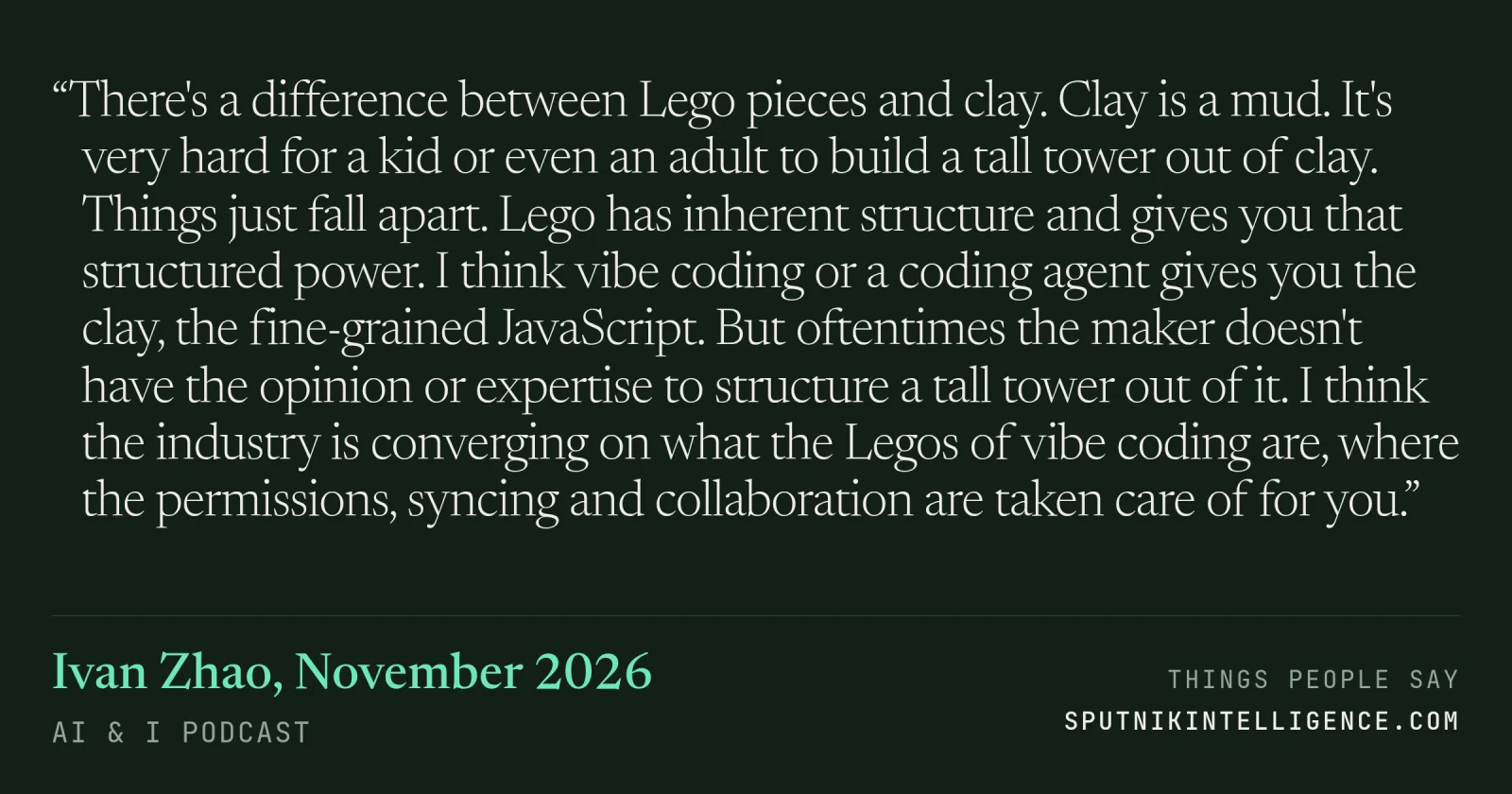
“There's a difference between Lego pieces and clay. Clay is a mud. It's very hard for a kid or even an adult to build a tall tower out of clay. Things just fall apart. Lego has inherent structure and gives you that structured power. I think vibe coding or a coding agent gives you the clay, the fine-grained JavaScript. But oftentimes the maker doesn't have the opinion or expertise to structure a tall tower out of it. I think the industry is converging on what the Legos of vibe coding are, where the permissions, syncing and collaboration are taken care of for you.”
AI & I · AI Builders · November 2026
Context
An audience member asked how Notion thinks about moving from structured building blocks to the unstructured, token-level world of AI. Ivan answers with the Lego-versus-clay analogy and says the middle ground is what Notion is building toward.
Transcript
Sorry.
I'm not going to answer it. I just think it's a great question.
I think it's a great question, too. So, Notion logo is a cube, right? It's a toy. Kids can build up a cube. Actually, Lego is an even better example. There's a difference between Lego pieces versus a clay. Clay is kind of like a mud. It's very hard for a kid or even an adult to build up tall clay. Things just fall apart. Lego, easier to pick up their hand, has inherent structure. It's not as unstructured, it's not as fine-grained as a clay, but give you that structured power. Have some opinion injected. I think vibe coding or coding agent is more give you the clay, give you the JavaScript, give you the fine-grain thing. But oftentimes, the maker doesn't have the opinion or expertise to structure a tall tower out of it. I think there is a sweet spot. I think the industry is merging towards what are the Legos of Vibe coding. So the fundamental permissions, syncing, collaboration are taken care of for you. Yes, you can still express your business logic and intent, but the pieces are there. In fact, that's what we're doing.
And what does that mean? Like, what would be an example of a vibe coding building block that it's not necessarily clay, but it's maybe more manipulable than a Lego brick because you have an agent to help you do it?
Well, the basic is you get an agent to help you set up your Notion, or the more powerful version of it is, we actually released this, I think it's become public now. Notion pattern libraries open up to all the agents and can read from Notion databases, guarded against by the Notion system…
And the pattern library is like it's an open source library, so an agent can implement it in your own apps.
More from AI & I