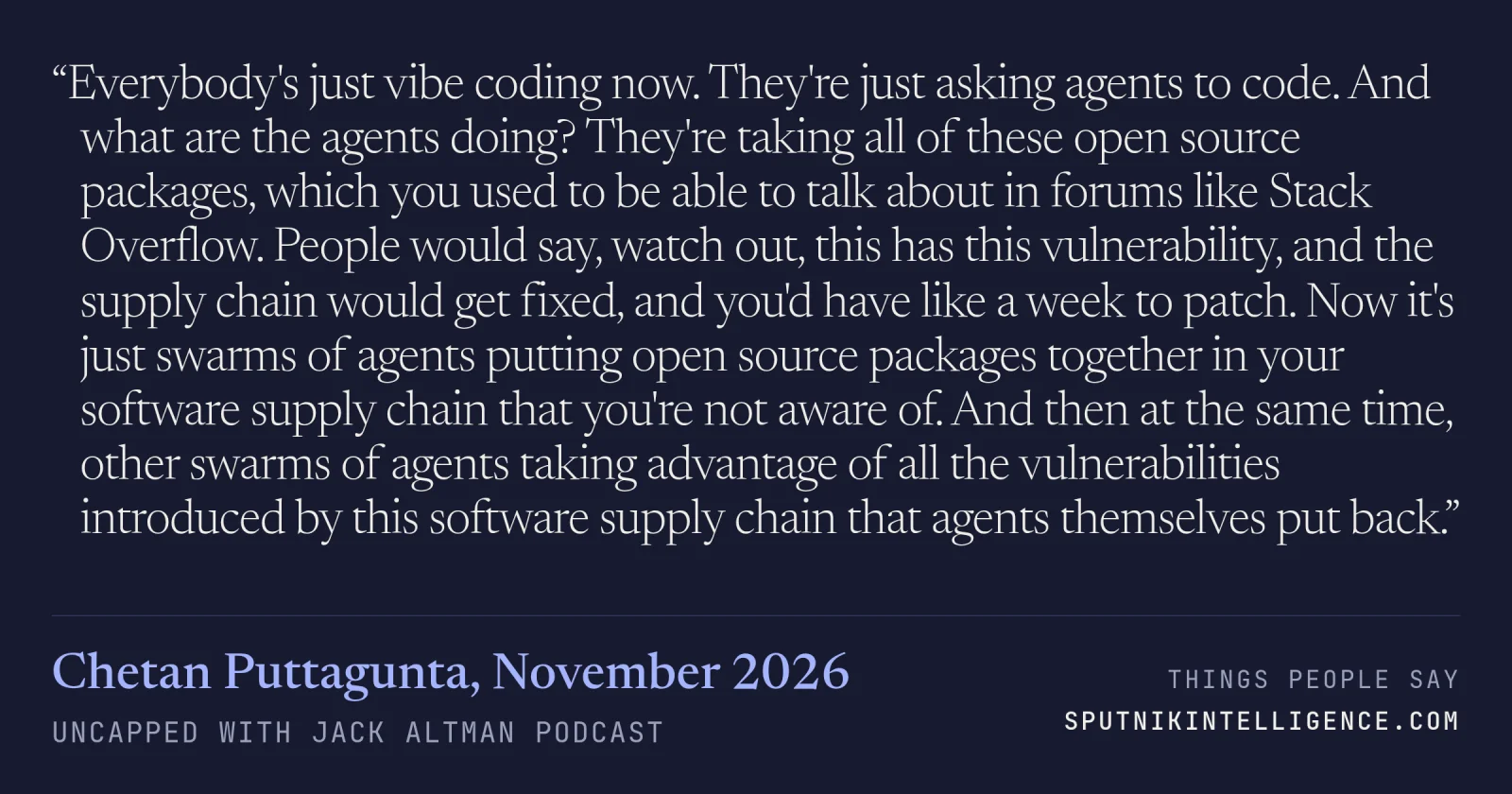
“Everybody's just vibe coding now. They're just asking agents to code. And what are the agents doing? They're taking all of these open source packages, which you used to be able to talk about in forums like Stack Overflow. People would say, watch out, this has this vulnerability, and the supply chain would get fixed, and you'd have like a week to patch. Now it's just swarms of agents putting open source packages together in your software supply chain that you're not aware of. And then at the same time, other swarms of agents taking advantage of all the vulnerabilities introduced by this software supply chain that agents themselves put back.”
Uncapped with Jack Altman · Startups & Venture · November 2026
Context
Asked what the recent wave of outages means for security investing, Benchmark's Chetan Puttagunta explains why vibe coding makes software supply-chain attacks worse.
Transcript
…like, observe and flag it. And now it's like, fix it. And I think that's just like a much, in a way, that seems much more important. It means cyber could be much bigger if that's really where it's going, is like actually doing the defense rather than just like telling you, hey, you got a problem.
That's right.
It forces you to step back and think of two things. One, I think model fragmentation is here to stay. And we've had many of our healthy debates with our friends in crossovers and hedge funds who talk about, well, I'm just going to bet all in on a single model company, and that's just going to have all the answers for all the problems. And I just don't see it. And the reason is, is that there's going to be sort of a giant friction for the diffusion of this technology. And the companies that are able to go help the end user solve today's problems, custom to their needs, has so much value in the world today. And this is, yeah, huge shout out to Yash, Rhythm, and Linden because this is exactly what Applied Compute lets you do, which is there's some frontier capability. You look at that frontier capability and you say, well, how do I get access to it other than making API calls? How do I make it my frontier capability? And you need some people that really understand how this technology works and help you build it for yourself. And so I think the Palo Alto Network announcement with Applied is just a brilliant, brilliant move. It's because everybody's looking out here and saying, this is incredibly frightening. And you've had this happen just on, it's like the follow-up wave of coding, which is everybody's just vibe coding now. And it's just, they're just asking agents to code. And what are the agents doing? They're taking all of…
thing about like, you know, if you break glass and then you fix the glass, does the GDP actually go up? Yeah,
the broken glass fallacy. That's literally what it's called.
Okay. All right. That's enough.
More from Uncapped with Jack Altman