 Connor Leahy
AI safety researcher and entrepreneur who co-founded EleutherAI and Conjecture and speaks and writes about the existential risks of artificial superintelligence...
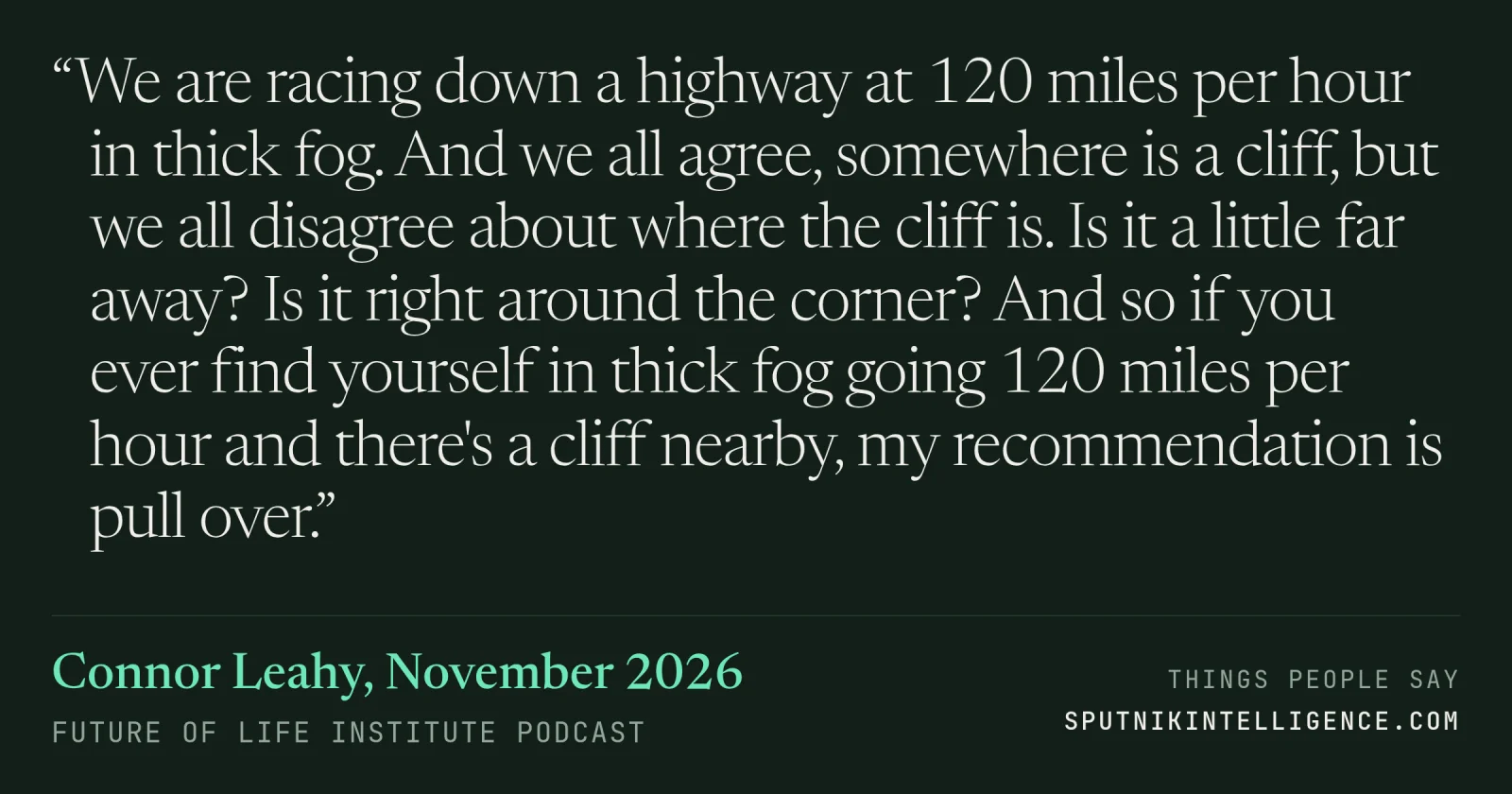
“We are racing down a highway at 120 miles per hour in thick fog. And we all agree, somewhere is a cliff, but we all disagree about where the cliff is. Is it a little far away? Is it right around the corner? And so if you ever find yourself in thick fog going 120 miles per hour and there's a cliff nearby, my recommendation is pull over.”
Future of Life Institute Podcast · AI Research & Frontier Labs · November 2026
Context
Asked whether AI is really changing the economy yet, he argues it doesn't matter whether superintelligence is one year or ten years away: the uncertainty itself is the reason to stop.
Transcript
…saying and it's just not true. People say like it hasn't changed the economy. This isn't true. The entire U.S. economy is currently based on AI. Like, I don't know what to tell you, right? Like, just like anyone who says, like, AI is not an influenced economy. I'm like, what are you talking about?
I'm thinking unemployment rate. I'm thinking inflation. Yeah, but
…on track. Like, if it just continues on this track of how much robots are getting better per year, we will get to human replacing robots in a couple of years. Maybe it's going to take five or 10 years, which is longer than superintelligence is going to take, but we will get there. And then there's the third thing. A third thing is that a lot of how I think about the world as is right now is that we are racing down a highway at 120 miles per hour in thick fog. And we all agree, somewhere is a cliff, but we all disagree about where the cliff is. Is it a little far away? Is it right around the corner? And so if you ever find yourself in thick fog going 120 miles per hour and there's a cliff nearby, my recommendation is pull over. And that's what I think needs to happen here. Is that fundamentally it doesn't matter. If superintelligence is 10 or nine years away or one or two years, it doesn't matter. Pull over. Stop. Do not build super intelligence. It doesn't matter. If two out of three doctors tell you this medication that you're about to give your daughter is definitely going to kill her. And the third doctor who has…
One problem here is that we don't have good insight into what's happening internally at the company. So we don't actually know what the frontier is of capabilities.
Which is why we need to stop.
Yes.
More from Future of Life Institute Podcast