 Tyler Austin Harper
A staff writer at The Atlantic who previously taught environmental studies at Bates College, with a research background in how literature and film treat human e...
Tyler Austin Harper
A staff writer at The Atlantic who previously taught environmental studies at Bates College, with a research background in how literature and film treat human e...
“Academia is one of the only businesses, if you want to call it that, in this country, the enterprise of which is truth-telling.”
Plain English with Derek Thompson · August 2026
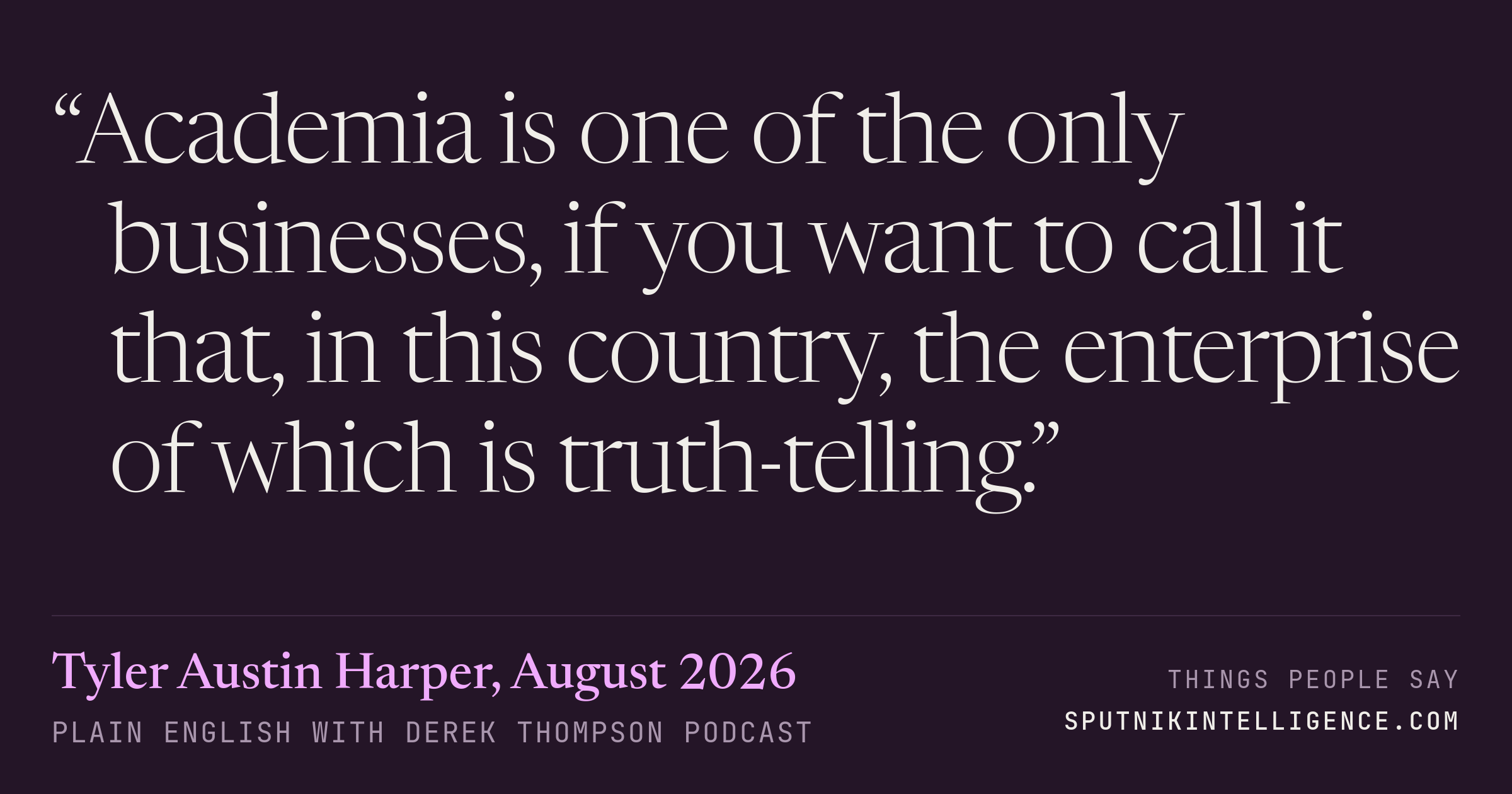
Harper's defence of why universities deserve harsher scrutiny than other institutions, not gentler: a bank that shades the truth is being a bank, but a university that does it has broken the one promise that justifies its existence.
Transcript
I think a lot of the complaints of wokeness that you read, many of these are diagnoses I agree with, or the basic set of problems, like, yes, I agree those are problems. They're idealistic in nature, by which I mean they start from the presupposition that there were bad ideas, aka wokeness, safetyism, political correctness, et cetera. The bad ideas won in these elite universities, and we just need to restore the good ideas and then things would go back to normal. And I'm a materialist, right? I'm a person of the left, and I reject those kind of battle of ideas explanations. In fact, I think the ideas that govern society are downstream from political, economic, and material conditions. And so I think one of my goals in writing this piece is to try to correct the argument I see unfolding, which is just that like, okay, we just need to get back to the better ideas. We need more conservatives. We need more viewpoint diversity, et cetera. It's not that I disagree with any of that. I would love to see more viewpoint diversity in the American Academy. But I think the response we have seen post, let's say, the election of Donald Trump, the corrections we've seen have been, okay, let's hire some conservatives. Let's start some civic centers. Let's do some free thinking task forces, et cetera. And my view is that this leaves the fundamental problem, which is the business model intact. And you are just substituting a different kind of political program, right? For another kind of political program I didn't particularly like, which was wokeness, but leaving this festering issue untouched. I mean, if I can be permitted a brief Marxist digression, the French Marxist Louis Authorsaire has this really interesting observation where he says institutions, or as he calls them apparatuses, but I won't to avoid confusion. He says institutions have primary ideologies and secondary ideologies. The primary ideology comes from the society at large, and that's what determines how the institution is organized, its labor practices, what it looks like as a bureaucracy. The secondary ideology are the ideas that emerge from the institution itself organically. These are the stories an institution tells about itself, its values, its mission statements, its culture, and so on and so forth. I think the mistake conservatives and sort of center left critics of the university have made and libertarians have made is that they think the primary ideology of universities is wokeness, right? And if you just correct that, things will be fine. My view is that the primary ideology is rapacious corporate capitalism, right? The secondary ideology is wokeness, which was a way to try to obscure some of the problems caused by the primary ideology. And that has basically failed. But the thing that I think folks on the left don't always like about my particular critique is I think a lot of professors, quote unquote, woke professors, see themselves as the kind of Zapatista territories in Mexico, where you have these like places on campus like the English department that are places where there is progressivism and good things happening. And yes, the university is this rapacious corporate structure, but wokeness or progressivism or whatever you want to call it, right, is like a countervailing pressure within that corporate ecosystem. And my argument's the exact opposite, is that the progressivism is in a symbiotic relationship with the corporate university model, right? That these two things are hand in glove because the progressivism allows the public, at least did for a while, to be distracted from these simmering labor crises that are crises that are festering within the university. So I really just, I really think the debate we're having right now is solely about these sort of superficial problems of what ideas do we want on campus without solving what is, in my mind, a labor crisis, a tuition crisis, an exploitation crisis.
And you are on-ramping right into my next question, which is, I think, the necessary follow-up. What are the symptoms of... Rapacious corporate ideology as you see it within higher education. We're talking tuition, debt, adjunct pay levels, decline in tenure professors. Unpack this one for us.
Yeah, so I think the most acute one, at least that bears on the educational mission or causes problems for the educational mission, is the adjunctification of faculty and the move from a professoriate in the 20th century that was almost overwhelmingly tenure stream, right? Tenured or on the tenure track, to a professoriate that is overwhelmingly not tenure stream and is overwhelmingly contract workers who can be fired more or less at will. Academia is one of the only businesses, if you want to call it that, in this country, the enterprise of which is truth-telling. And the point of the tenure system was to secure the ability of academics to say what they think without fear of the hammer coming down on them or their employment being made vulnerable, right? It is not a coincidence. If you look in the mid-20th century, it was not just the high point of tenure on American campuses. It was also the high point of intellectual diversity on the American campuses. A lot of people think of the 60s and 70s as these like radical moments in American life and on universities. That is true to an extent. But even in the mid-70s, about a third of American professors identified as conservatives, a third identified as moderates, and then about 40% identified as liberal or left, right? So certainly a left slant, but plenty of institutions have some selection bias in a left or right slant. That's not that abnormal, right? But today we've gone from a world in the mid-20th century where most academics were tenure stream and 30% were conservatives to a world in which most academics are not tenure stream and single-digit percentages at many elite universities are conservatives, right? And the case I'm trying to make is those two things are related. You could line up the graphs of the collapse in tenure density, in other words, the collapse in the percentage of faculty who are tenure stream and the collapse of faculty diversity on campus, and those graphs would just overlap and basically be identical, right? And obviously, correlation is not causation, but I am trying to say it is not surprising when you have a labor force that is casualized, proletarianized, terrified of being fired at any moment. Fired not only mean, by the way, I'll need a new job and I'll need new health care. I'll probably have to pick up my family and move to a different state to become a visiting professor somewhere else, right? So the stakes are even higher than just losing a regular job, right? It is not surprising in a world where most faculty are laboring under those conditions that you would have group think that people would be afraid to rock the boat when they're not wearing a life vest and so on.
For adults with Crohn's disease or ulcerative colitis symptoms, every choice matters. Tremphaya offers self-injection or intravenous infusion from the start. Tremphaya is administered as injections under the skin or infusions through a vein every four weeks, followed by injections under the skin every four or eight weeks. If your doctor decides that you can self-inject Tremphaya, proper training is required. Tremphaya is a prescription medicine used to treat adults with moderately to severely active Crohn's disease and adults with moderately to severely active ulcerative colitis. Serious allergic reactions, increased risk of infections, or lower ability to fight them, and liver problems may occur. Before treatment, get checked for infections and tuberculosis. Tell your doctor if you have an infection, flu-like symptoms, or need a vaccine. Explore what's possible. Ask your doctor about Tremphaya today. Call 1-800-526-7736 to learn more or visit tremfireadio.com.
This message is brought to you by AppleCard. Shave ice by the beach, a trip to the state fair, and a throwback flick at the local drive-in. They're more than just items to check off the summer bucket list. They're also opportunities to earn 2% daily cash back when you use your Apple Card with Apple Pay. Apply for Apple Card now and use in minutes with Apple Pay. Subject to credit approval, Apple Card is issued by Goldman Sachs Bank USA, Salt Lake City Branch, terms, and more at applecard.com. Did you know Uber has a range of safety features for riders, like the Share My Trip feature that lets you send your live location to the people who matter most, your spouse, your kids, your best friend, so they can track your ride and make sure you get where you're going. But the safety doesn't stop there. Uber requires every driver to pass a thorough background check before they can start driving. This consists of a multi-step screening process that checks for impaired driving or criminal offenses, followed by annual background checks each and every year moving forward. Share My Trip and annual driver screenings are just a few of Uber's many safety features that put safety at every turn. Learn more at uber.com/slash safety. Annual driving history reruns do not apply in New York City. So you're offering a Marxist interpretation. of wokeism and diversity politics. And I want to offer at least one alternative interpretation that I've seen. Not necessarily one I believe, but just one that I think is important to have on the table. I think someone more sympathetic to diversity politics would say, this is not a politics that emerges from either a craven administration or necessarily even one that emerges from economics. It emerges from other things happening in the world. It comes from triggering events like Ferguson, from anger and exhaustion with racism and sexual hierarchy. And it's been supercharged by the internet, which has a flattening ability to put oppressors and the oppressed on the same platform, on the same feed, where the public can speak truth to power. And that's really where diversity politics, that's really where wokeism comes from. It comes from observations of oppressor dynamics in the world, which are communicated through a platform that allows the oppressed to go viral against the oppressors. So what do you say to that explanation of why the so-called great awokening happened when it did?
Yeah, I think social media certainly turbocharged it, right? And I would include technological change as a Marxist under the set of like material conditions that are changing in society, right? And I think that the rise of social media creates an atmosphere in which not only, yes, can the marginalized plead their case, but we're also online mobs can be assembled, right? Sometimes for very good reasons, it should be noted, right? Like in the Me Too moment when you did have an extraordinary amount of tension put on really, really bad behavior that needed to see the light of day, right? So the online mobs aren't always a bad thing, right? Sometimes they address problems that have long simmered, but sometimes you also have online mobs that get way over their skis, right? And I think this bleeds back into the problem I'm mentioning on college campuses about you have a labor force that is casualized and the equivalent of the academic equivalent of Uber drivers, right? Because not only do you have to worry that your administration might be upset if you say, disagree with a requirement they want to pass, right? You also have to be worried, is this going to end up on social media, right? Just to give you an example, one thing I describe in the piece is the final meeting where this vote was passed, right? Students were brought in apparently as sort of props to cheer for the requirement. It seems to be what was going on. Faculty previously had been somewhat lukewarm on this requirement. In fact, in a faculty poll a year earlier, actually most faculty opposed the RPPC legislation. But you have these students in the room, and then magically, all of the sudden, 73% of faculty at Bates, I think that's the correct number, end up voting in favor of passing the legislation, right? And would those people have passed the legislation? Were they not worried about one, losing my job, but two, am I going to vote this down? Are we going to vote this down in front of students? And then this ends up on social media. And then we're being pilloried from both the left and the right for what we did, right? And so I think the technological change creates an additional layer of paranoia on top of like, now not only do I have to worry about ramifications within my institution, I also have to be deeply paranoid about things happening without my institution, that I will become one of these professors who's quote unquote heterodox or who is anti-woke or who gets yelled at all the time. And I think it's worth noting just very briefly, it is not only non-tenure track faculty who are not speaking up. It is also tenured faculty, right? I cannot tell you how many times I would oppose something on campus or make a comment and someone would approach me later and say, I'm so glad you said something. I've been thinking this. I'm so glad you said it. And my response in my head, at least, I usually didn't say this to the person was, you have tenure. You could have said it. Why do I have to say it? I'm just on the tenure track. You have tenure. You could speak up. And the reality is that are they afraid of losing their jobs? Probably not. They can't lose their jobs, but they are afraid of getting yelled at, right? And I think they're afraid of getting yelled at at their institution. But I also think in some cases, they're afraid of getting yelled at online. So I do think the social media piece of this has exacerbated the problems caused by the labor crisis. But I would argue that it's not social media alone that is the point of the spear in terms of the problems within academia and why this kind of progressive extremism prevailed.
More from Plain English with Derek Thompson