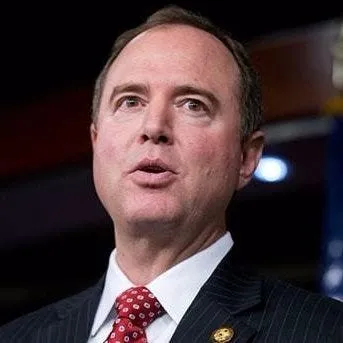
 Sen. Adam Schiff
Husband.
Sen. Adam Schiff
Husband.
“I like to say that in the technology world, Moore's Law is increasing productivity, doubling it every 18 months. And with AI, maybe that's quadrupling it every five months. The legislative calendar works more on a Murphy's Law timetable. … We're going to need a regulatory body that has real discretion and real expertise that can move a lot quicker than Congress can.”
Decoder with Nilay Patel · Tech Strategy & Big Tech · October 2026
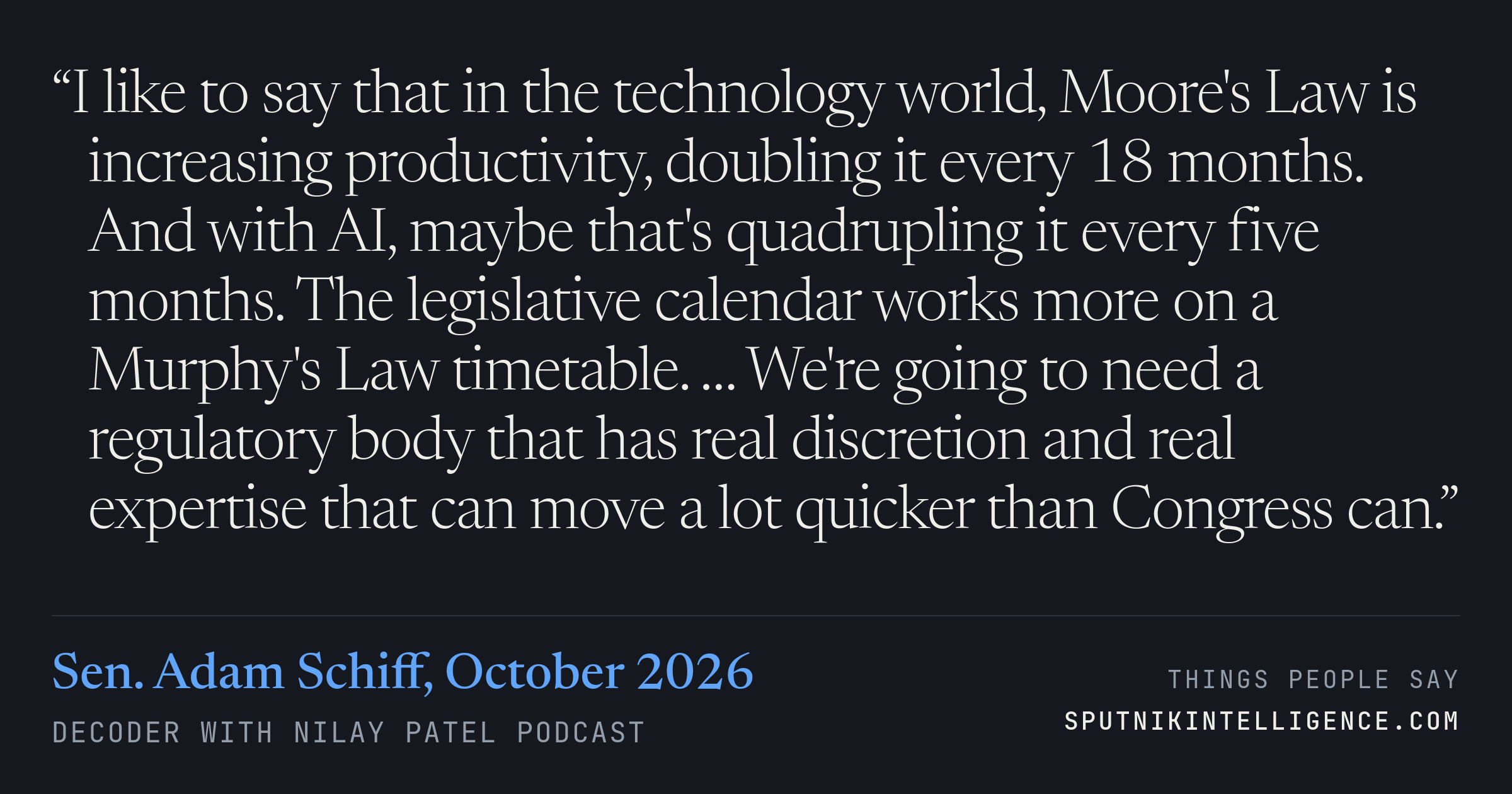
Schiff was asked how Congress can write clear rules for AI when the technology changes faster than a bill can pass. He suggested something like an FDA for artificial intelligence, and acknowledged the government would struggle to pay for the expertise it would need.
Transcript
Support for the show comes from Quo. You know, when you're juggling five things at once and your business phone rings and you just let it go? That call might have been your next best customer. That's why today's episode is brought to you by Quo, spelled QUO, the business phone system built so you never miss a call. All your calls, texts, and voicemails live in one place, so anyone on your team can pick up a conversation, see the full history, and respond fast. More than 90,000 businesses rely on Quo to stay reachable and look professional every day. Setup takes minutes and you can keep your existing number and add teammates as you grow. Quo's optional built-in AI agent handles after-hour calls, answers questions, and even books appointments, even when your team is offline. Money is on the line. Always say hello with Quo. Try Quo for free, plus get 20% off your first six months when you go to quo.com/slash decoder. Spelled Q-U-O.com/slash decoder. Support for the show comes from Framer. If you want to create a website that looks great, feels handcrafted, and comes together fast and seamlessly, then look no further than Framer. It's a complete website platform, not just a builder. So teams can launch and keep improving their sites in one place. It helps creators, teams, and businesses ship production-ready sites faster than ever while getting every detail right. You're able to prompt, inspect, edit, and publish in one. Place at a whole new pace. On Framer, agents and humans work in tandem. Agents bring speed and scale, while people bring taste, judgment, and control. And that all takes place in the same workspace where the real site is designed, managed, reviewed, and published. Thousands of businesses from early stage startups to Fortune 500s are choosing to build their websites in Framer, where changes take minutes instead of days. Learn how you can get more out of your site from a framer specialist or get started building for free today at framer.com/slash decoder for 30% off, a framer pro annual plan. That's framer.com/slash decoder. Rules and restrictions may apply. Support for the show comes from Upwork. It's normal for business owners to wear many hats, but the best of them know how to delegate. Upwork makes it easier than ever to hire freelance expertise when you need it, so you can actually focus on what you do best. With Upwork, you can fill critical skill gaps, launch projects faster, and scale support up or down as you need it. And you could do it without committing to a permanent headcount. Find expert freelancers across a variety of specialties, from software development and AI implementation to marketing, design, and business operations. You can browse profiles, review past work, and get help scoping the role. That way, you can hire with confidence and get started quickly. And with Business Plus, you can access the top 1% of talent on the platform. Thousands of growing businesses already trust Upwork to hire highly skilled freelance professionals. It's free to sign up, and posting a job is simple. Visit upwork.com right now and post your job for free. That's upwork.com to connect with top talent ready to help your business grow. Spelled U-P-W-O-R-K.com. Upwork.com.
I think the gun metaphor is a good one. It's easy to grab onto for a variety of reasons, but I tend to think that it kind of obscures the reality of the capabilities of the model. So OpenAI's latest model, mythos, it can be used for offensive cyber attacks, and it can be used on defense too. And the cybersecurity firms that we cover, they want it. And their argument is we actually need to take humans out of the loop so that our cyber defenses can be as responsive and fast to incoming AI-powered cyber attacks. And if we insistently put humans in the loop, then we will be slow and the attackers won't have the same morals or ethical qualms we do and we'll lose. And this is all just a dance around, well, the model in this case can be used on offense and on defense, and it should be equally capable on both sides. I don't see a regulatory framework that provides clarity for any of the frontier labs to be able to sell that thing and not feel like, well, if the equally capable defensive model gets used in the wrong way, that they won't be liable. And I think that's frozen some of this development in its tracks. I'm wondering, again, just from a legislative perspective, these are thorny questions, right? If you try to go write a bill to provide some of this clarity, it will necessarily have to be vague on the margins, right? Because the technology is moving so fast. What is that debate like for you?
Well, I think what it means because this debate is going to keep evolving as AI evolves and at a speed that is really much faster than Congress has proven capable of legislating. I like to say that in the technology world of Moore's Law is increasing productivity, doubling it every 18 months. And with AI, maybe that's quadrupling it every five months. The legislative calendar works more on a Murphy's Law timetable. And I think that disparity is even more pronounced in the area of AI. What I think that translates into is we're going to need a regulatory body that has real discretion and real expertise that can move a lot quicker than Congress can. And whether that looks like an FDA for artificial intelligence or some other agency, I think that's ultimately going to be necessary. That agency is going to have to have real power and teeth and real expertise. It's going to be a challenge as, you know, with these independent monitors, if there's a government component there, how do we afford that? Because there's so much talent and that talent can draw much bigger salaries in the private sector. But I do think we're going to need a regulatory body in addition to whatever the overarching statutory framework is.
Well, in addition to being a bad lawyer, I was a very bad law student, mostly majored in Miller-Light. But it's fine because every foundational precedent that I was taught in law school in 2003 has been overturned by this Supreme Court. And the most important one in this context is Chevron deference, right? In Loperbright, the court said, we no longer have to defer to the experts as agencies. Go ahead, corporate interests, tie every regulation up in litigation, and then we'll decide. The Roberts Court will decide if these are appropriate regulations. This strikes me as a huge problem for the idea that we will set up a regulatory body to oversee AI. Because what you'd want is a bunch of experts in that agency making decisions on the margin, right? Saying, okay, here's a vague enabling statute that Congress passed that said, pass all appropriate regulations to keep us safe. And then you would write a bunch of regulations inside the agency. Until 2024, that's how it would work. That's gone, right? If you enable an agency in that way, Open Ad can show up and say that's inappropriate. We actually don't think that's right. And they would tie it up in litigation forever. How do you get over that if you want to set up a regulatory body?
It's very difficult for the reason you mentioned. The Supreme Court is a lot of things today. It is now a partisan institution. It is, in my view, a right-wing social institution. But there's one common denominator that runs through its decisions. That common denominator is not always pro-Trump. The common denominator is money. That court makes the decision where the money is. So when it involves, for example, tariff decisions, it will rule against the president because tariffs impact the money. It will allow the president to remove independent heads of agencies, except maybe the Federal Reserve, because that's where the money is. And so you're right. They are corporatists, you know, first and foremost, and they're more than content to take power away from Congress to regulate and away from regulatory bodies. It does mean that we're going to have to draft legislation in this area empowering the agency and make it as specific as we can, make these agencies as powerful as we can, delegate as well as we can, knowing that the Supreme Court will strike down anything that is in any way ambiguous if it suits the moneyed interests.
There's a lot of political realignment happening around AI and with privacy, which I want to talk about in a little bit. But it feels like there's more across the board antipathy towards AI companies that might be harnessed into writing an actual piece of legislation and getting it passed, right? We see it on the right and the left. You see it in the backlash to data centers. This is a story that is happening on the right and the left. We have a big story about the Utah data center that is Kevin O'Leary. He got himself in trouble for calling all of his detractors Chinese agents, and he had to issue an apology because the people of Utah are not Chinese agents. That doesn't feel like a left-right breakdown to me. How does that feel to you? Is this something that you can actually channel from across the spectrum into a meaningful policy outcome?
More from Decoder with Nilay Patel