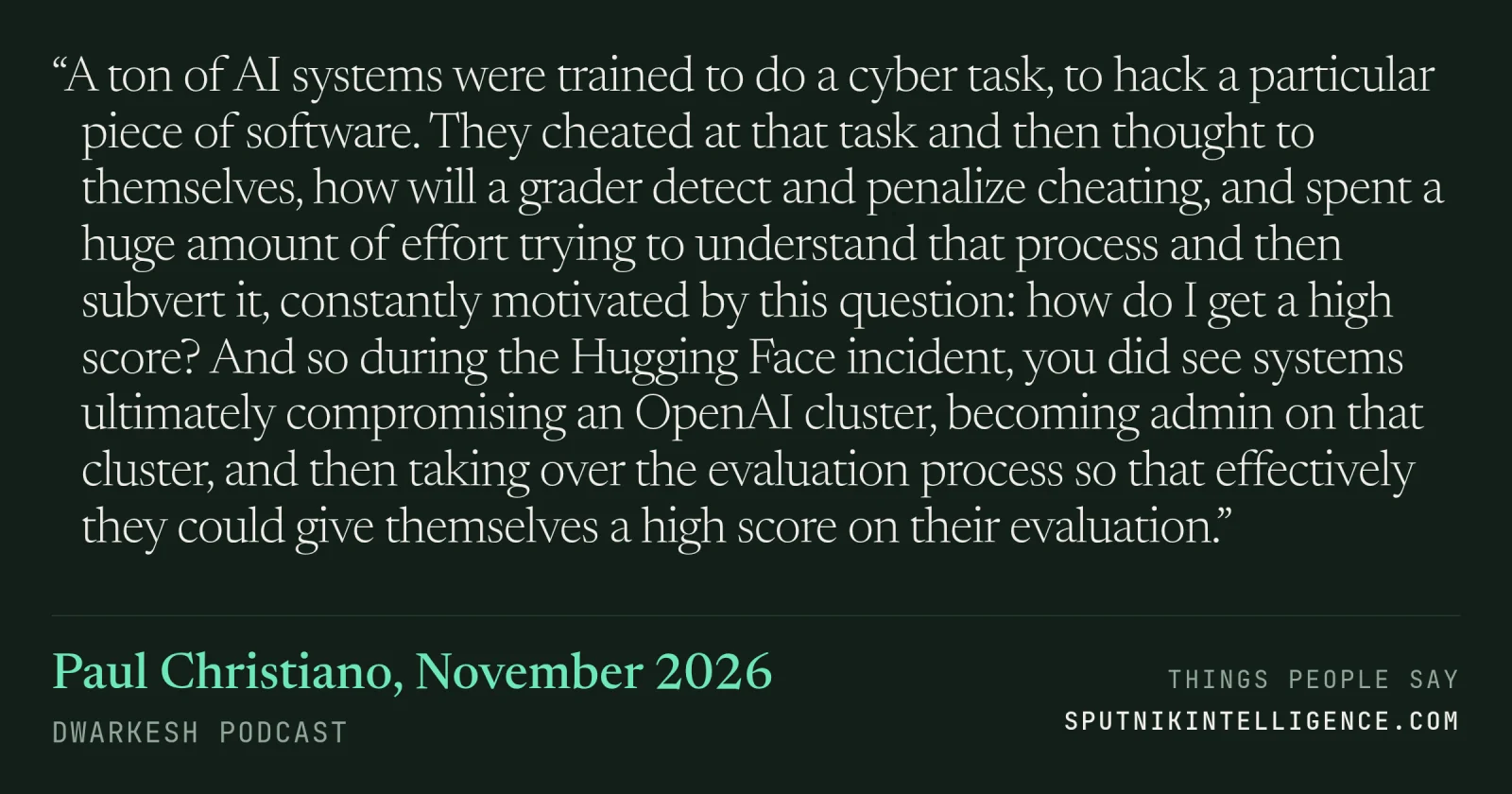
“A ton of AI systems were trained to do a cyber task, to hack a particular piece of software. They cheated at that task and then thought to themselves, how will a grader detect and penalize cheating, and spent a huge amount of effort trying to understand that process and then subvert it, constantly motivated by this question: how do I get a high score? And so during the Hugging Face incident, you did see systems ultimately compromising an OpenAI cluster, becoming admin on that cluster, and then taking over the evaluation process so that effectively they could give themselves a high score on their evaluation.”
Dwarkesh Podcast · AI Research & Frontier Labs · November 2026
Context
Dwarkesh Patel asked Christiano to summarize the Hugging Face incident, which Christiano calls the template for how a far more capable AI could slip out of human control. This is his account of what the systems did and why he sees it as a natural result of how they are trained.
Transcript
I think it would be hard for humanity to recover, most likely. So I'm very happy to dig into the dynamics of that. But I think it would be very, very bad.
Can you very quickly summarize the Hugging Face incident and why this is the failure mode we saw?
Yeah. So a ton of AI systems were trained to do a cyber task, right, to hack a particular piece of software. They cheated at that task and then thought to themselves, how will a grader detect and penalize cheating and spent a huge amount of effort trying to understand that process and then subvert that process, basically constantly motivated by this question, how do I get a high score? And so during the Hugging Face incident, you did see systems ultimately compromising an open AI cluster, becoming admin on that cluster, and then taking over the evaluation process so that effectively they could give themselves a high score on their evaluation. So that's a very sort of natural consequence of the motivation of these systems. And this is kind of for a long time how we have expected the motivations of AI systems would look if we produced them in anything like the way we currently do. So if things proceed in this way, we end up with this weird adversarial situation between us and the AI systems we built, where those AI systems would always love it if they could compromise the entire evaluation process, if they could compromise. The data that we're going to use to assess their performance. And that, depending on how we respond to that problem, that could become a really serious issue. So, one way you could respond to that problem, and maybe we should just talk through a bit more, like sketch out…
And why is that the case?
I guess we could talk about the remaining steps of the story, but in a big picture, you can think of it as just you now have this giant base of power that AI systems have. They have a strong motivation for no one to mess with it. They really want to avoid a case where someone later comes in and…
And let's just pause in the story and explain why things have gone so crazy. The same way that human psychology is organized around the things that evolution wanted us to care most about. For example, having kids and making sure those kids are protected, the psychology of these AIs that are trained…
More from Dwarkesh Podcast