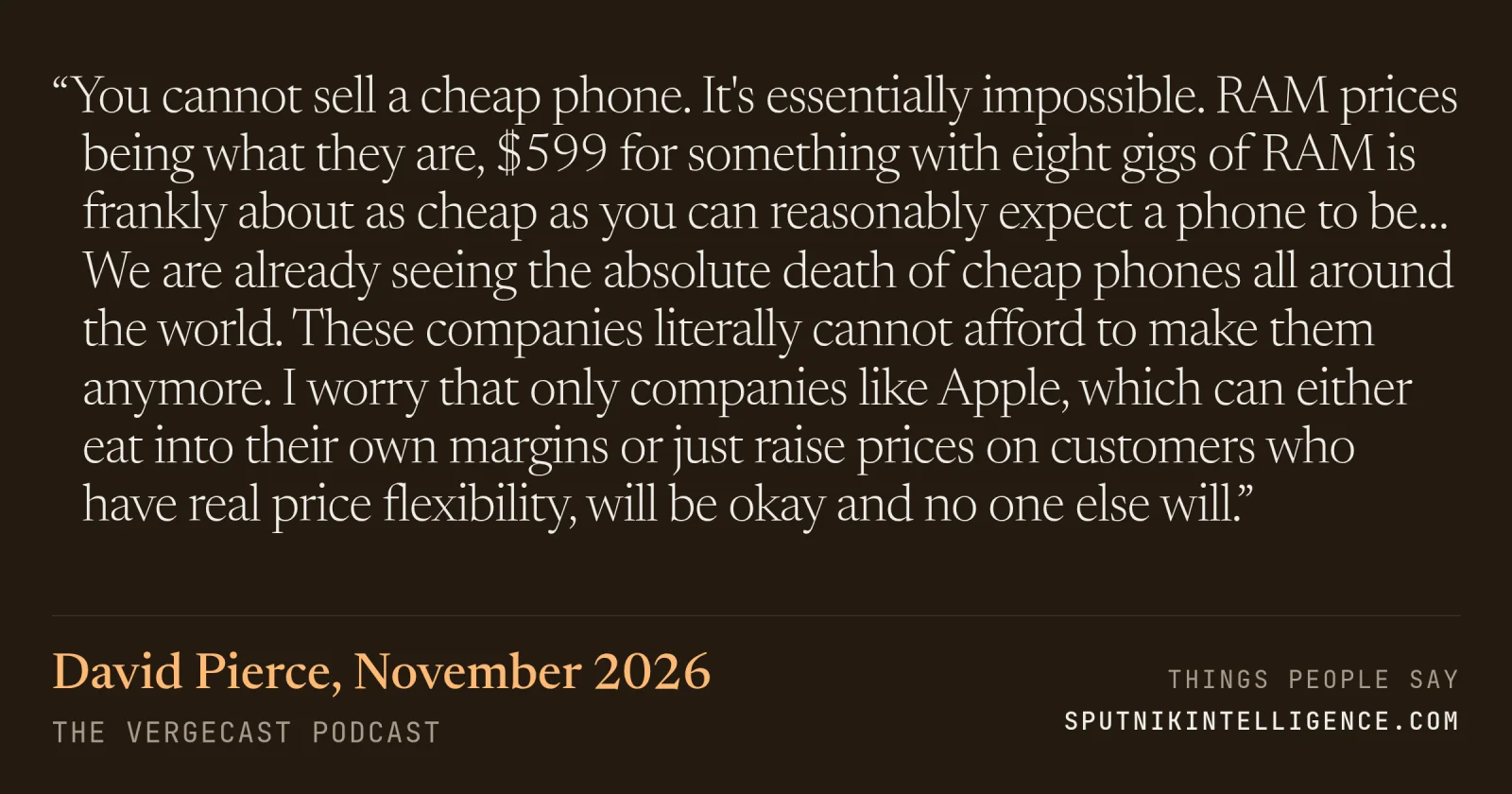
“You cannot sell a cheap phone. It's essentially impossible. RAM prices being what they are, $599 for something with eight gigs of RAM is frankly about as cheap as you can reasonably expect a phone to be… We are already seeing the absolute death of cheap phones all around the world. These companies literally cannot afford to make them anymore. I worry that only companies like Apple, which can either eat into their own margins or just raise prices on customers who have real price flexibility, will be okay and no one else will.”
The Vergecast · Tech Strategy & Big Tech · November 2026
Context
Pierce was discussing a small Kickstarter smartphone priced at $599. He uses its price to argue that memory costs, driven up by AI demand, are killing cheap phones across the industry.
Transcript
Is it mostly a movies and TV show phenomenon?
I think there's music too. There is very dedicated trackers, e-learning or something like that. And so there's niches, but I think movies obviously are like one of the biggest draws. Movies and TV shows, yeah.
It's so funny to think about this as not just a repository of movie files, but as a like discovery and curation mechanism. Like in some ways, a lot of what you're describing is the stuff that the internet no longer does a very good job of, which is just showing you good stuff. And so you join this thing and it's like, okay, I'm in one for action movies from the 1980s, because actually a bunch of people who also like action movies from the 1980s are the right people to tell me about action movies from the 1980s. And the community aspect of that is just as important as the movie files. And it's fascinating to me that those two things have come back together. We tried to split them apart, and in fact, they have just come back together in slightly sketchy ways.
Earlier, you made that comparison to Letterboxd because I think there is an interest and a return in more human-curated experiences. Like algorithms work to a degree for media discovery, and we all listen to Spotify on shuffle every now and then, I think. But people are also starting to appreciate…
Totally. It's yeah, this honestly, I worry about how much fun I think I would have in one of these communities. And I'm like, I need to not join one of these trackers because it will take over my life. It'll be a real problem. All right, Janko, thank you for coming on. It's great to see you.…
Sure. Always.
More from The Vergecast