 Steve Klabnik
Programmer and writer who spent a decade working on Rust and co-authored The Rust Programming Language.
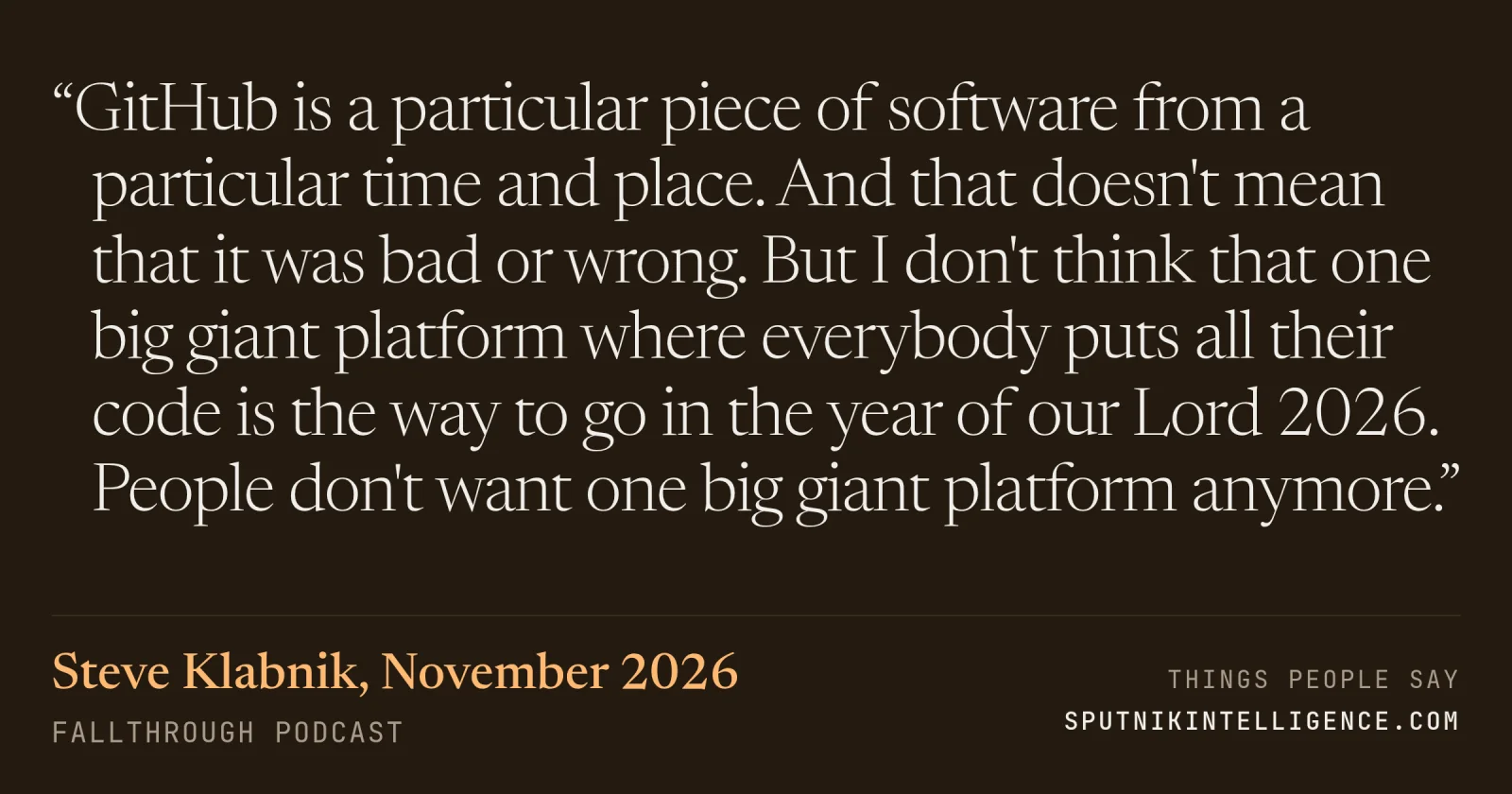
“GitHub is a particular piece of software from a particular time and place. And that doesn't mean that it was bad or wrong. But I don't think that one big giant platform where everybody puts all their code is the way to go in the year of our Lord 2026. People don't want one big giant platform anymore.”
Fallthrough · Hands-On Engineering Podcasts · November 2026
Context
Matt asked Steve about his post saying it may be time to leave GitHub, in a segment on centralization and the recent run of outages. People had been asking who would build the GitHub replacement, and Steve says the answer isn't one new platform.
Transcript
Yes, that's why I said to wrap up. Yeah, yeah, totally. Like 10 minutes.
…anything specific about the outages to talk about, but I do maybe want to provoke Steve Klabnik minute and say that I agree with his unbundling approach that I think you gave the example on Blue Sky about maybe it's time to like leave GitHub from a bundling perspective. Is that correct? Or am I?
Yeah, people were like, where's who's building the GitHub replacement? And I think the thing is that GitHub is a particular piece of software from a particular time and place. And that doesn't mean that it was bad or wrong. But I don't think that you like, I don't think that one big giant platform where everybody puts all their code is the way to go in the year of our Lord 2026. And, you know, like that's people, people don't want one big giant platform anymore. And there's like good reasons for that. But I think that's like the case, essentially.
Yeah. And the reason why I bring this up is because, Chris, to your point about like other outages, a lot of the commonalities here and why these outages are so widespread is that they are centralized places for people to put their data, right? Your money, your photos or whatever files for Apple…
I also think that like there's a little bit of irony in there because at least for two of those systems you mentioned, email and banking, they are quite decentralized systems. And the problem is like that one of them is so massive, right? Like Outlook goes down. That's most businesses' email…
This kind of gets back to a slightly older thing, which is like resilience versus fragility. So like the overall system is more resilient, but that's partially because it can tolerate partial outages as part of the system. But you end up having like in, you end up having different organizations…
More from Fallthrough