 Aaron Levie
Co-founder and CEO of Box, the cloud content management company, who talks about enterprise AI adoption, AI agents in enterprise software and how work changes a...
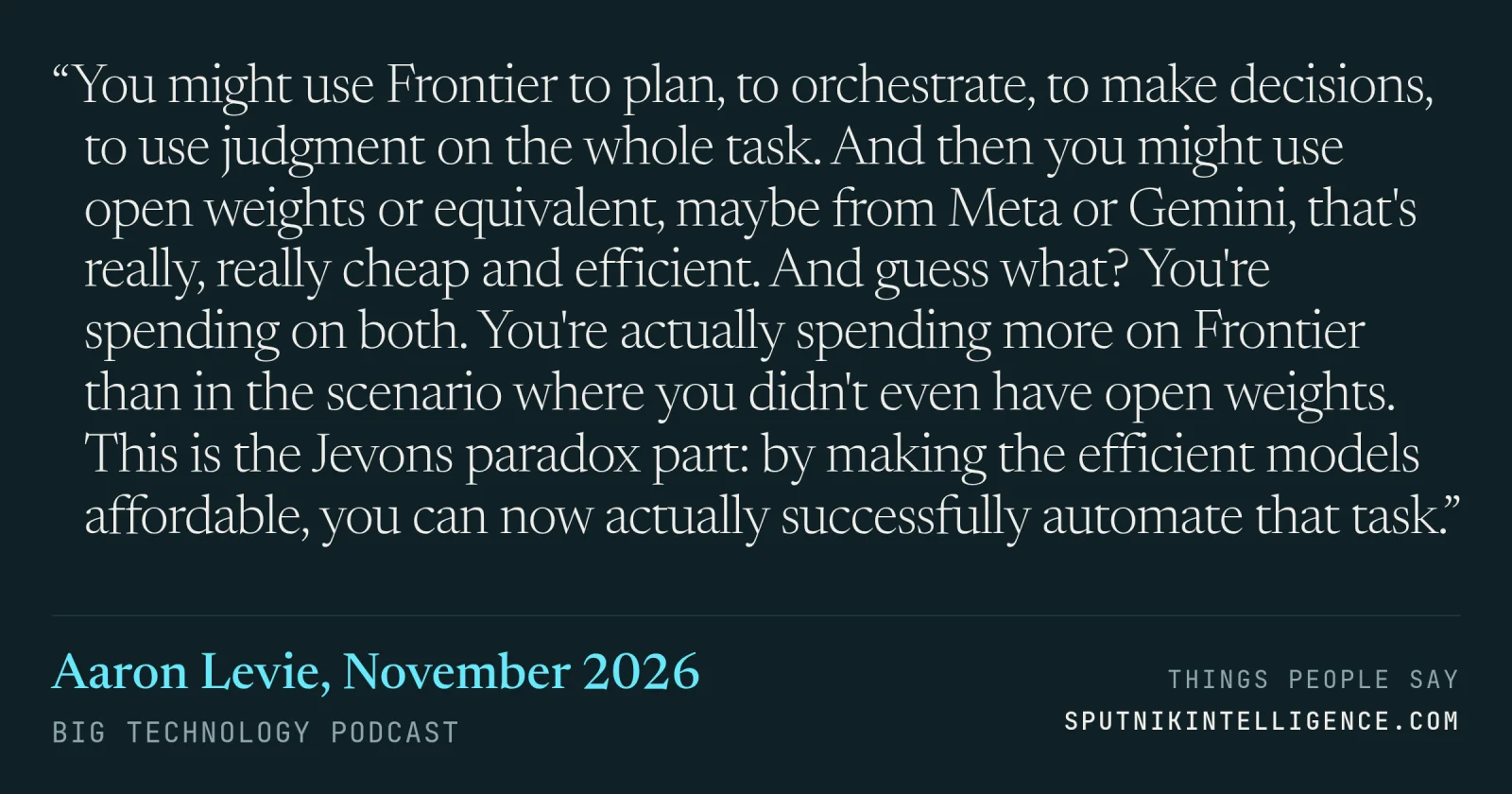
“You might use Frontier to plan, to orchestrate, to make decisions, to use judgment on the whole task. And then you might use open weights or equivalent, maybe from Meta or Gemini, that's really, really cheap and efficient. And guess what? You're spending on both. You're actually spending more on Frontier than in the scenario where you didn't even have open weights. This is the Jevons paradox part: by making the efficient models affordable, you can now actually successfully automate that task.”
Big Technology · Tech Strategy & Big Tech · November 2026
Context
Alex Kantrowitz raised the critics' worry that routing tools will send work to cheaper models and commoditize labs like Anthropic. Levie argues cheap models make new tasks affordable and so raise spend on frontier models too.
Transcript
…pretty attractive. They generate cash. It works. Now, you have to obviously bet that that continues to sustain and that they don't get kind of like completely commoditized. But I would be, you know, I'm more in the camp of like, no, like the frontier still remains very attractive at the moment.
…people will learn how to do these things with the Frontier models and they'll use a routing tool to say, okay, I want you to do it now, but just use a much more efficient model. And then therefore, if you're an Anthropic, you're commoditized and you're on the outside looking in. Your thoughts.
Well, first of all, the good news is we actually have enough, we have probably at least a year of evidence of what that should look like. Like there's been enough sort of, we've had pretty good open weights models. Maybe we're like nine months into that. We've had routing for maybe about that long. We've had open router for a couple years. And generally speaking, what I'd say is the data is showing that kind of everything is rising. It's a rising tide lifting all boats kind of scenario where basically you kind of use the frontier to figure out the next use case that now becomes possible for the long tail of work in that use case where you're just cranking through tokens. You're just like, I got to process every document. So that way the model can like make a decision about something going on in this audit that the company has. But to do that, I need all of the underlying structured data from these documents. This is sort of a use case that would show up in the box world. You might use Frontier to plan, to orchestrate, to make decisions, to use judgment on the whole task. And then you might use OpenWaits or equivalent, maybe from Meta or Gemini, that's really, really cheap and efficient. And guess what? You're spending on both of these platforms or kind of ecosystems. You're…
your Anthropic spend is going up.
In that scenario, 100%.
But in that scenario or a gross, like overall?
More from Big Technology