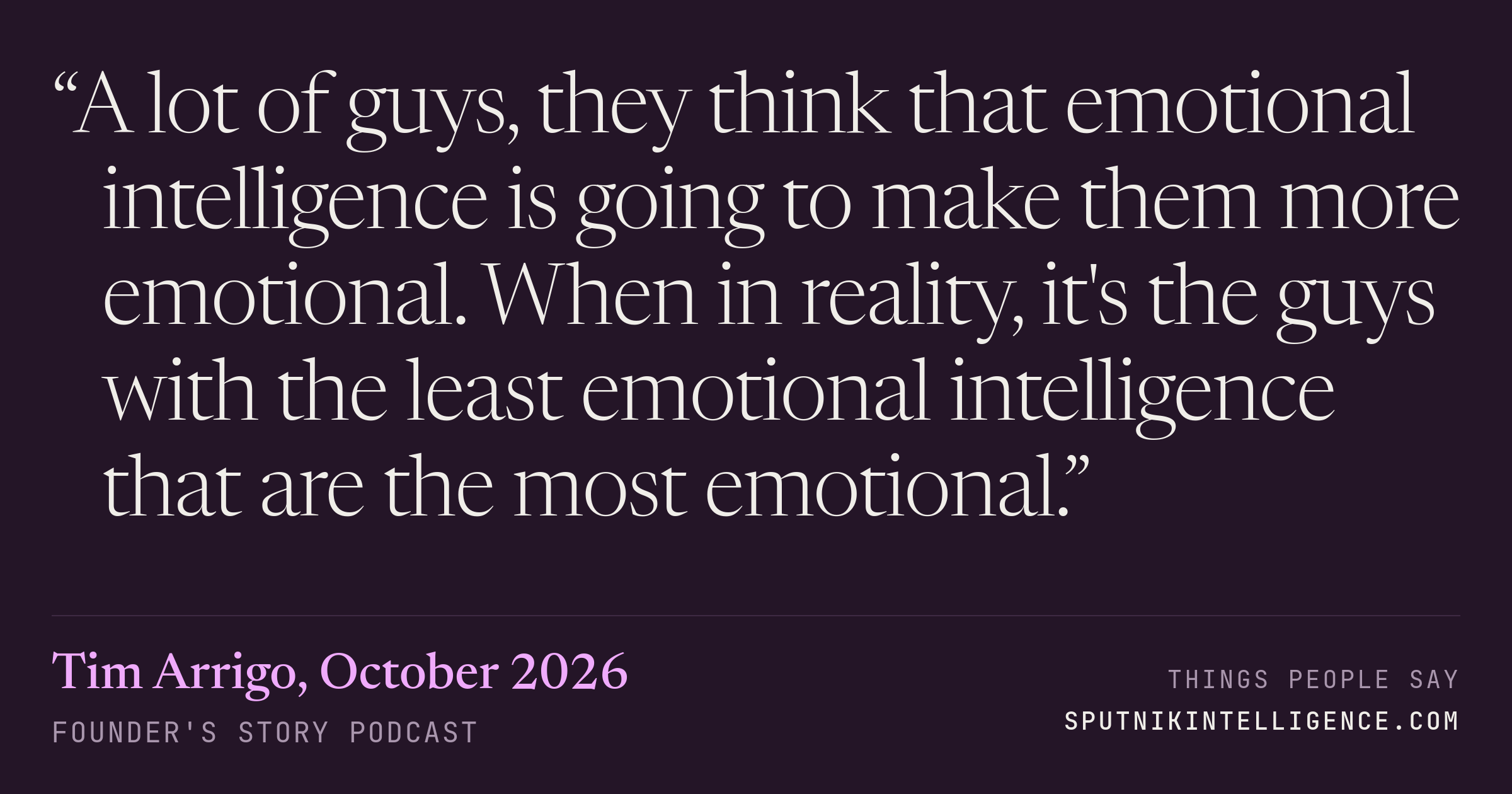
“A lot of guys, they think that emotional intelligence is going to make them more emotional. When in reality, it's the guys with the least emotional intelligence that are the most emotional.”
Founder's Story · October 2026
Arrigo, who counsels couples, is asked whether founders can build a business without wrecking their relationships. He argues that entrepreneurs fuse their identity with the business, and that real mastery is learning not to react to every problem.
Transcript
I would say that's a lot of guys' experience. And I personally had low T as well. And I think those things are important to treat. I mean, you can't, so many guys are trying to work through an issue psychologically when it's physiological or biochemical, right? And if you're having these deficiencies inside your blood work, that's why I recommend every man get blood work and get labs done. You have to know. Some guys I talk to, they haven't got labs done in 10 years and they've Gotten generic labs, right? Go get your lab work done, right? Optimize your physiology. Look at your hormones, exercise, right? It's the four domains: it's the psychological, it's the physical, right? It's the social and the spiritual. And all those, all those facets of life, they all work together synergistically, right? To create that harmonious life. And there's always usually, if you look at a guy's life, you know, he can overcomplicate why his life is the way it is or why he feels the way he does. But if you really strip it back, sometimes it's that he's just not doing the most simple of things.
That was, that was me. It's crazy. I wanted to look to what's the most complicated, but I have to say the most successful people that we talk to, they've gotten there, but at the expense of their relationships. I would say 95% of the people that we talk to, their business and how they treated their business caused them to get divorced or their kids don't want to talk to them. Now, post-divorce and post-maybe business sale, they're trying to go backwards. Do you think it's possible to have a harmonious life while you're building all these things simultaneously?
Well, it's difficult. I'll tell you that because we know that, right, all those cliches work harder than everybody, right? You have to be willing to make all those sacrifices. And that is very real, right? That is very real. But I think a lot of entrepreneurs, I think, can agree to the fact that, you know, a lot of us, the place that we started in, right? I think a lot of us, the place that we started in, you know, a lot of entrepreneurs operate with a chip on their shoulder. They have something to prove, right? And I think that we're not the greatest followers. We're great leaders. And so as a result of that, I think that unconsciously, our business success can get directly enmeshed with our identity. And now I can't delegate anything in my business because I'm not delegating things in my business. I'm delegating my identity. And so those things have to be separate, right? The business, it's like, why did I start the business? Well, I started the business so I could actually enjoy the fruits from it, right? I didn't start the business to be a slave to the business, not be able to delegate anything, have my emotional state dictated by the ups and downs, which are obviously all businesses, right, are volatile. Depending on the market you're in, they're all the ups and downs of business is very real. And there becomes a certain level in business too, where there are so many problems because that's all business is solving problems all day long, right? And there's so many problems that are occurring. You get to this point where you start realizing real mastery is learning how to not react to those things, right? Real mastery is learning how to remain stoic. And that's why a lot of guys, they think that emotional intelligence is going to make them more emotional. When in reality, it's the guys with the least emotional intelligence that are the most emotional, right? And when we have emotional intelligence, we're able to be stoic, not react to what we feel, right? Just because you feel like something bad's going to happen and you're catastrophizing doesn't mean something bad could happen or even is happening. Just because you feel guilty doesn't mean you did something wrong, right? So feelings aren't facts. And so if we learn to separate those worlds and learn to separate our identity from the business itself, we can begin to see, well, who am I without this business? It's like professional athletes have a really hard time separating their identity from sports. And I've worked with Olympic athletes in the past. I've worked with very successful athletes who have a very hard time with who am I? Outside of what I've done, I don't even know who I am. And that's really where the work begins, right? To discover us. And men, as men, we need to have a sense of purpose. And that business gives us a lot of purpose, right? It gives us a lot of drive. Our entire reward system is completely wired around the business, right? I look at a problem. I analyze it. I identify it. I formulate a plan. I begin solving it. And there's KPI around the whole thing. Right. Whereas my marriage, okay, I'm attracted to my wife. I court her. I date her. You know, we get married. We're intimate. Right. We have kids. We buy a home. And then all of a sudden I fall off this proverbial cliff because I'm not wired. There's no KPI in my marriage. There's nothing to achieve. It's just, hey, I'm here. And now I fall into the monotony and the mundane every single day where it's Groundhog's Day in my marriage, but yet there's all these changes occurring in my business. And that's why I think as entrepreneurs, too, it's so important to be in a space with other entrepreneurs who can relate to what you're dealing with because it's very hard. I mean, let's face it, right? The average person who doesn't own a business is not dealing with the things that we're dealing with, right? They're not facing the things that we're facing. And it's very real. Your circle gets smaller and it can be a really lonely road. They say it's. Lonely at the top. And so I think it's critical for guys if when they're building a business, especially in the height of that business blooming and exploding, it's so important that they separate their identity from the business itself. And they recognize that a lot of it is just fear-based, right? It's it, it's, I'm afraid the bottom is going to fall out, right? I have to deal with competitors or whatever it is, or AI taking over. And man, technology, the market's changing. And a lot of it is just, it's, it's fear, right? Fear rearing its ugly head into the marriage, into my personal life that's causing me to burn myself out and not be able to prioritize the relationships with my wife and kids, even my friends and family the way I want to.
I think you describe me in many ways. Not in the good ways. How can I increase my emotional intelligence?
First thing, increasing your emotional intelligence is being able to name exactly what it is that you're feeling when it's happening. So let's say you're triggered. It's being able to say, hey, I'm triggered. Having the awareness to not say, this is making me feel this way, right? Because I could be standing on a street corner with two friends. A car could drive by with people in a convertible. They could point in our direction and laugh. Well, I might have thought they were laughing at me and I feel ashamed, embarrassed, and angry and I want to chase after the car, right, to yell at them, right? The guy next to me might have thought they were laughing at something behind us and he just feels indifferent towards the whole situation and keeps walking down the street. The guy next to him might have thought they thought he was handsome and he's all excited and he wants to go meet the people in the car and get their number. Right. So it's important that we recognize how our perception affects how we feel, right? How, and a lot of this is just habitual. So the first step as a man, get yourself a feeling wheel and begin simply when something comes up for you, identify it with a name, right? Hey, I'm feeling guilt. This is guilt, right? For a lot of guys, it's hungry, angry, lonely, tired, right? Or the fourth one, horny, right? It's very hard for guys to identify what it is that they're experiencing. And so if you can't name it, you can't tame it, right? And if we don't have awareness about what's coming up for us, just a simple ability to say, hey, I'm activated or hey, I'm overwhelmed or hey, I'm emotionally flooded or hey, I'm taking this personal right now or hey, I'm allowing this person's behavior to say something about me that it doesn't. As men, you know, I worked with so many men who in the first week, I'll ask them a question and almost instantly they'll, by default, just say, oh, I don't know. It's like, hold on a second. You expected the answer to be right there. Okay. You do know. Because if you don't know, then who knows? Let's stop right here. Close your eyes. Let me ask you the question again. I don't want you to think about it. I want you to just feel and experience it, right? What comes up for you? What's the very first thing that comes up for you without you intellectualizing it, right? Because a lot of guys will intellectualize our feelings, right? We'll minimize what's going on with us. And when they do that, right? What they'll find is when they can remove all the mental barriers, the answers are right there. It's all right there. And as we begin to do that, we build more self-awareness. And self-awareness is synonymous with empathy, right? In order to, sympathy is feeling bad for somebody. Empathy is understanding what they're feeling. So to understand what you're feeling and to attune to you emotionally, I have to understand what I'm feeling and be able to attune to myself. What's coming up for me right now? And that's the question I'll ask guys when guys are moved to tears. I'll just sit in that space and just ask them, hey, man, what's coming up for you right now? And a lot of times it's, hey, this is coming up for me. And this is something I've been, I've been holding on to and I didn't know what to do with it or where to take it. Right. And I'm, it's a lot of times it's sublimation, right? Guys will take a feeling and they'll put it into something where the world is okay with them showing that feeling in that's in that scenario. For example, like if a guy has anger issues as a kid and he takes it into football and he becomes the greatest linebacker and expresses it through anger and football, it's like he gets validated for that. Right. And I think that there's a lot of places that men take feelings where it's good and cathartic for them to express it, but it might not be the best vehicle for them to do that. Right. Why so many guys fall into addictive patterns? Guys fall into addictions, self-destructive tendencies, because they're looking for an outlet to cope with what it is that they're feeling. And they feel like there is no outlet for them other than these behaviors, right? But those are just coping, right? Those are just coping behaviors, right? If you're using pornography, or you're using even work itself, right? Work addiction is the one addiction you can have where everybody calls you a success, right? And if you're using these things as a vehicle, well, all these are is coping behaviors and you can replace those behaviors in time with different habits that you can install, but you. You change through experience, right? So let's have a different experience this time. Let's try something different. Let's implement that and see how you feel with it. So I think the first step is really for guys to be able to name what it is that's occurring internally and sometimes even just the simple, the simple ability to just acknowledge it and say that it's happening.
Wow, the inside out method. Tim, Arrigo, I think we'll have a better place. If people were more healed, I feel like the world would be in a better place, or maybe not even just healed, but just understanding, having better emotional intelligence. But Tim, thank you so much for joining us today. I'm enlightened. I feel like I went to like a Tony Robbins event just now.
More from Founder's Story