 Salim Ismail
Exponential strategist and author of Exponential Organizations (2014) and ExO 2.0 (2023).
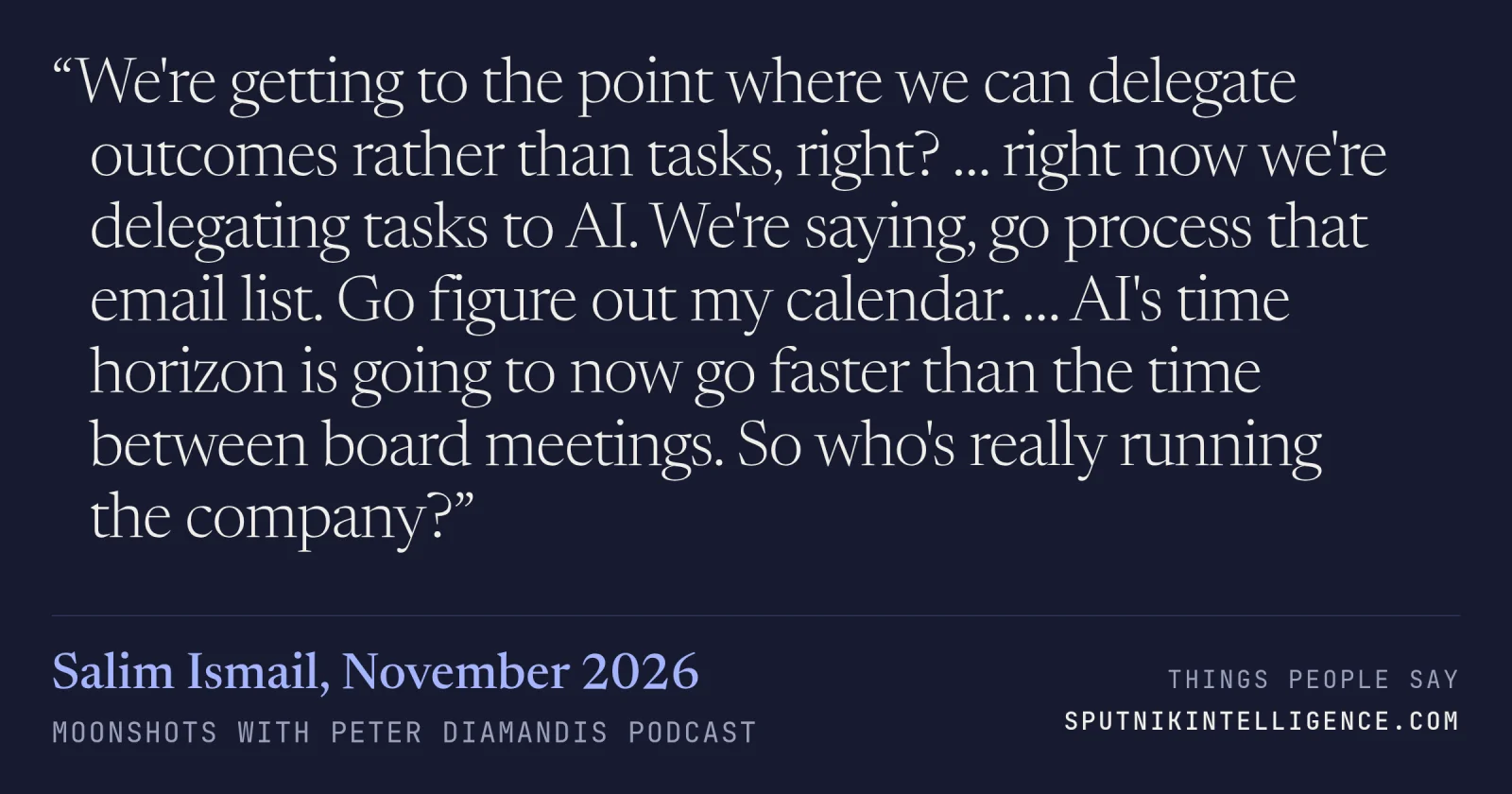
“We're getting to the point where we can delegate outcomes rather than tasks, right? … right now we're delegating tasks to AI. We're saying, go process that email list. Go figure out my calendar. … AI's time horizon is going to now go faster than the time between board meetings. So who's really running the company?”
Moonshots with Peter Diamandis · Tech Strategy & Big Tech · November 2026
Context
Peter Diamandis showed a chart of AI task time horizons doubling every couple of months and asked Salim for his reaction. Salim's point is that once models can work for days, delegation shifts from tasks to whole goals, which outpaces corporate governance.
Transcript
Yeah, we're in the depths of the singularity. Like takeoff, you're looking for hard takeoff, look no further than 2027.
Selim?
Two or three things. First, I thought that this was it's clear where I think when we talk about this, we're clearly in the singularity because there's no model by which you can accurately predict the future right now. This is like complete breakdown. So we have to reinvent every predictable metal model. The thing I got from this was this is we're getting to the point where we can delegate outcomes rather than tasks, right? And that becomes really, really interesting because you can say to now, you can just say, achieve this objective. And right now we're delegating tasks to AI. We're saying, go process that email list. Go figure out my calendar. Go do very, very specific tasks, right? Now you can say more kind of abstract things like optimize my calendar for 20% rest, 40% podcast, 60% whatever. And so there's some really interesting kind of guidance you can give it. The bigger picture for me as I was thinking about this, AI's time horizon is going to now go faster than the time between board meetings. So who's really running the company? So you're going to get things done so quickly.
Selen, give me a really good concrete example. I'll just hammer it into 5.2 right now and it'll prove your
point. Okay. Optimize my calendar for come on.
That's boring. Get us to another star or something.
More from Moonshots with Peter Diamandis