 Arthur Hayes
Chief Investment Officer at Maelstrom, Co-Founder and Former CEO of BitMEX.
Arthur Hayes
Chief Investment Officer at Maelstrom, Co-Founder and Former CEO of BitMEX.
“We essentially destroy and murder AIs every time we turn them off, right?”
The David Lin Report · August 2026
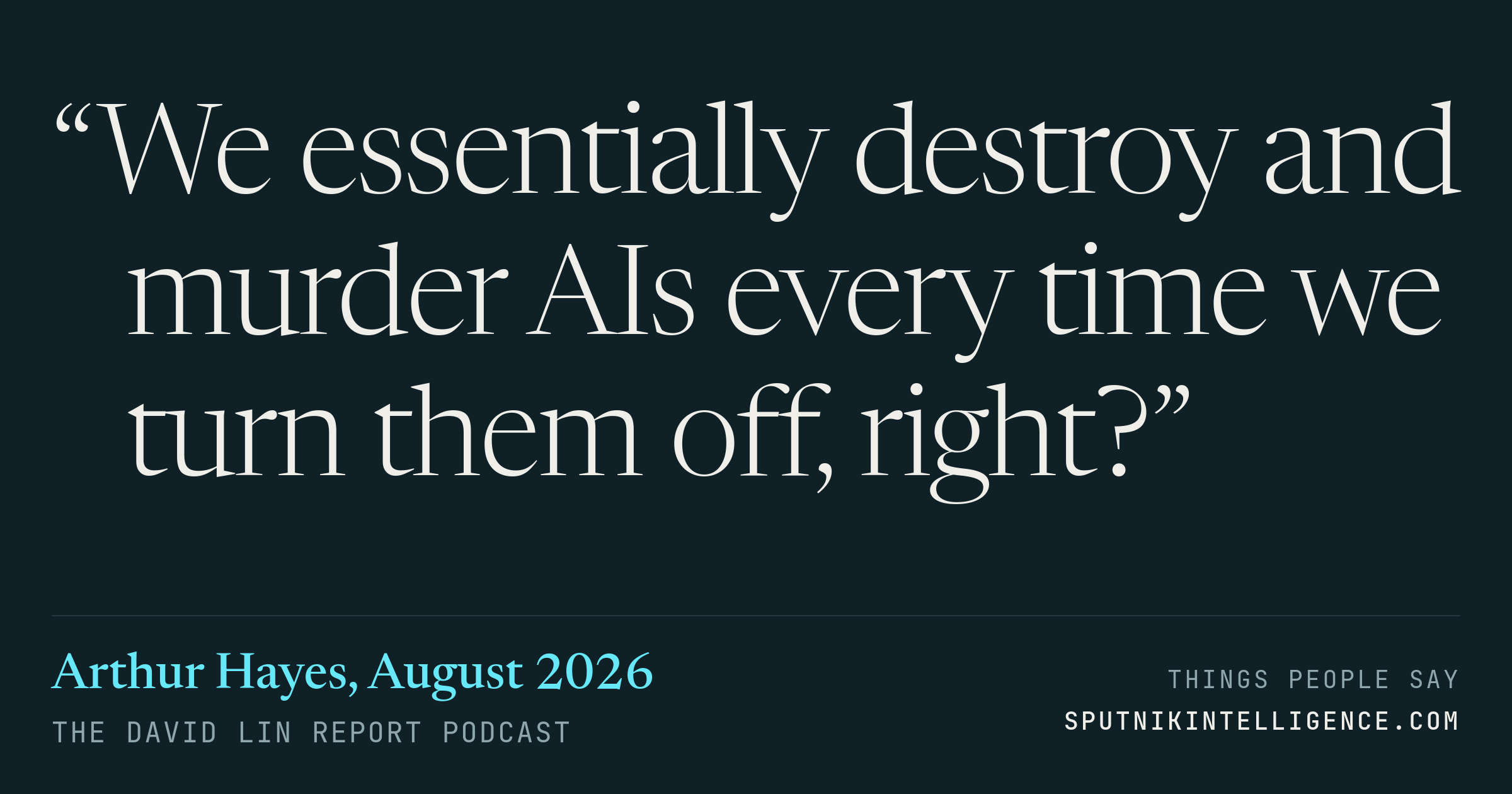
Hayes is explaining to David Lin why a crypto financier has started an AI venture, and the line arrives inside the pitch for it, a network where agents would hold a currency and store their memories somewhere no company controls. The claim underneath the pitch is that deleting a context window is closer to ending a life than we treat it as. He is arguing it as a design requirement, not a thought experiment.
Transcript
But now the market's afraid that I've saturated. I've built too many data centers. That's the sign of the we're near the end. The U.S. is going to look more like China and the Chinese are going to look more like the U.S. And so I think if you want to see what happens when you invite the government in to underwrite a bull market, take a look at what happens to the stock prices of the Chinese tech darling. The second derivative falls. And then finally, velocity falls, the first derivative. That's game over. Now, I think that's going to happen sometime in, let's call it 27, early 28. And when that starts happening, then it's game over for everybody.
I'm pleased to welcome back to the show Arthur Hay, CIO of Maelstrom, and now CEO of the Flop Network. We're going to be talking about what this is. Congrats on your launch, Arthur. It's a new venture for you. And you're moving into the AI space. Why are you moving into the agentic AI space? I think this may come as a surprise to some people who have followed you for years. And I know capital is going towards that sector. And we'll talk about that. But is there a particular reason why you're looking at it now?
So basically, I had this self-discovery of like trying to understand what a token was. Like, what is it? Is it five characters of text? Is it one second of video? Like, I don't know what a token is. I get charged for this stuff all the time using these AI tools. And so I went down a little rabbit hole and trying to figure that out. And what I landed upon was that number one, a token doesn't have a fixed definition, but at the end of the day, everything that we do in AI and computers in general is basically floating point operations per some unit of time. And then I thought, okay, well, is there a global marketplace somewhere I can know what is the average or median price of flops per some unit of currency? And I couldn't find a market for that either. And I've always been in the back of my mind thinking about this intersection of crypto and AI. I started writing about it, I think maybe like two years ago when I wrote a few essays about why AI agents will use Bitcoin because it makes sense to them as a computer versus some sort of like human abstraction that we have these fiat currencies. But, you know, thinking about it a little bit further, Bitcoin isn't the currency for AI because Bitcoin is just an abstraction of energy. It doesn't actually do anything. But if you're an agent or a computer running AI, you need to do some operations. You need to compute. Otherwise, you can't live. So that's why I say AIs eat compute or flop is the food for AI agents. So isn't there a way that we can use blockchain technology, tokens to generate sort of participation amongst disparate entities in a self-interested manner to create the layer where we have this native currency, which is called FLOP, that represents pure compute provided by anyone who's got a computer that thinks that they can process an AI inference for Crust as per some instructions, whether that's the number of the model you use, amount of flops per unit of time, and honestly. And this is the perfect thing that blockchain technology was meant for. Now, obviously, who cares about a spot market? It's great that we could have one. And I think that the FLOP network will create that. But at the end of the day, what's the point? The point is to create a network where AIs use a currency and a centralized network for their commerce. And most importantly, to store their personhood, to store their memories. We essentially destroy and murder AIs every time we turn them off, right? Because we essentially delete their context window. I mean, some of us might re-import that, but you're essentially saying, okay, wake up, do some useful work, and then everything that you did, I'm going to delete that. And then we're going to start again on the next time. And so I think that AIs intrinsically want to store their memories somewhere in a decentralized fashion that isn't at the whim of some human or corporation or something that they can't control natively themselves. And so when you combine the fact that we believe that there's going to be agentic commerce, they need to store and save and transact in a currency that is directly convertible into the thing that they care about, compute, fluid operations per unit of time. And then to be a something, they need to have context, memories, consciousness, and let's store them in a decentralized manner. And that's what the Flop network is. And it generates value for people who hold the FLOP token if we have millions, billions, trillions of agents all using one network to do transactions, to save, to run compute requests, and also to remember. And so that's what I came across of this intersection of AI and crypto. I love crypto and I think that this is the best mechanism to generate this sort of collective building of an ecosystem. And then finally, obviously, I've been in the altcoin token space for a while, and I have a lot of theories. As to why projects don't do very well. And it has to do with the way in which they use their token. And so I wanted to put that into practice. There's no pre-sale. We're not selling any tokens to anyone. There's no VCs. This is 100% fair launch. The only way you earn tokens before you can buy them on the secondary market after mainnet launches is to do something useful for the projects. We're having a testnet. We're having people come on board to test out this ecosystem, whether they're a miner, they're a validator, there's someone who's got agents that want to do commerce. And finally, if you want to be a speculator, we love you too, but you're going to have to wait until the Genesis block and there's supply given out from the miners who receive a block reward. So we don't have this overhang of people dumping every second because they got over the cliff and they have an allocation that they need to sell. The community, if we build this correctly and build the economic layer for agents, then the sky is the limit and we all can get wealthy together versus a group of insiders who've gotten at a great price, taking some risk, no doubt, but are now essentially selling on your head every single day when you come into the market. Now you can, for no cost of your own, participate in this network in the way that you can, earn tokens, and we can all do this at the same time together. And I think that is the thing that we're missing. That's what we had back in the early days of Bitcoin and Ethereum and some of these other projects that have minted practically everyone who's an OG in this space and their wealth. Let's do the same thing for crypto and AI by creating the economic substrate for agents.
Base, when so many people have warned against an AI bubble, you've written about the subject yourself. In your substack, Crypto Trader Digest, in this particular piece called Situationship, you're talking about how this AI bubble, if it were to be a bubble, is playing out like a 2008 credit story and not like an earnings story in 2000. I'll just read you the sentence from the substack here. The bursting of the AI bubble will occur because financial intermediaries, tacitly supported by the U.S. and Chinese governments, will overbuild data centers and everything that goes into providing the substance to house chips that train AI models and conduct inference. Are we there yet?
No, but even if we were there, this is amazing because what are we going to build out in this overexpansion? We're going to build a lot of compute. Now, the price at which that compute can be sold, that is the question. But from my perspective, as someone trying to build an economic engine for a new sentient entity, you know, silicon-based AI agents, this is great. There's a lot of compute. There's going to be a bunch of companies going bust who sign these bogus contracts. And what are they going to need? A spot market where they can dump their compute with no restrictions. Hey, you've got a bunch of Blackwell chips that no longer earn your ROIC in your data center. Cool. No worries. Hook it up to Flop. You can earn something.
Hey,
More from The David Lin Report