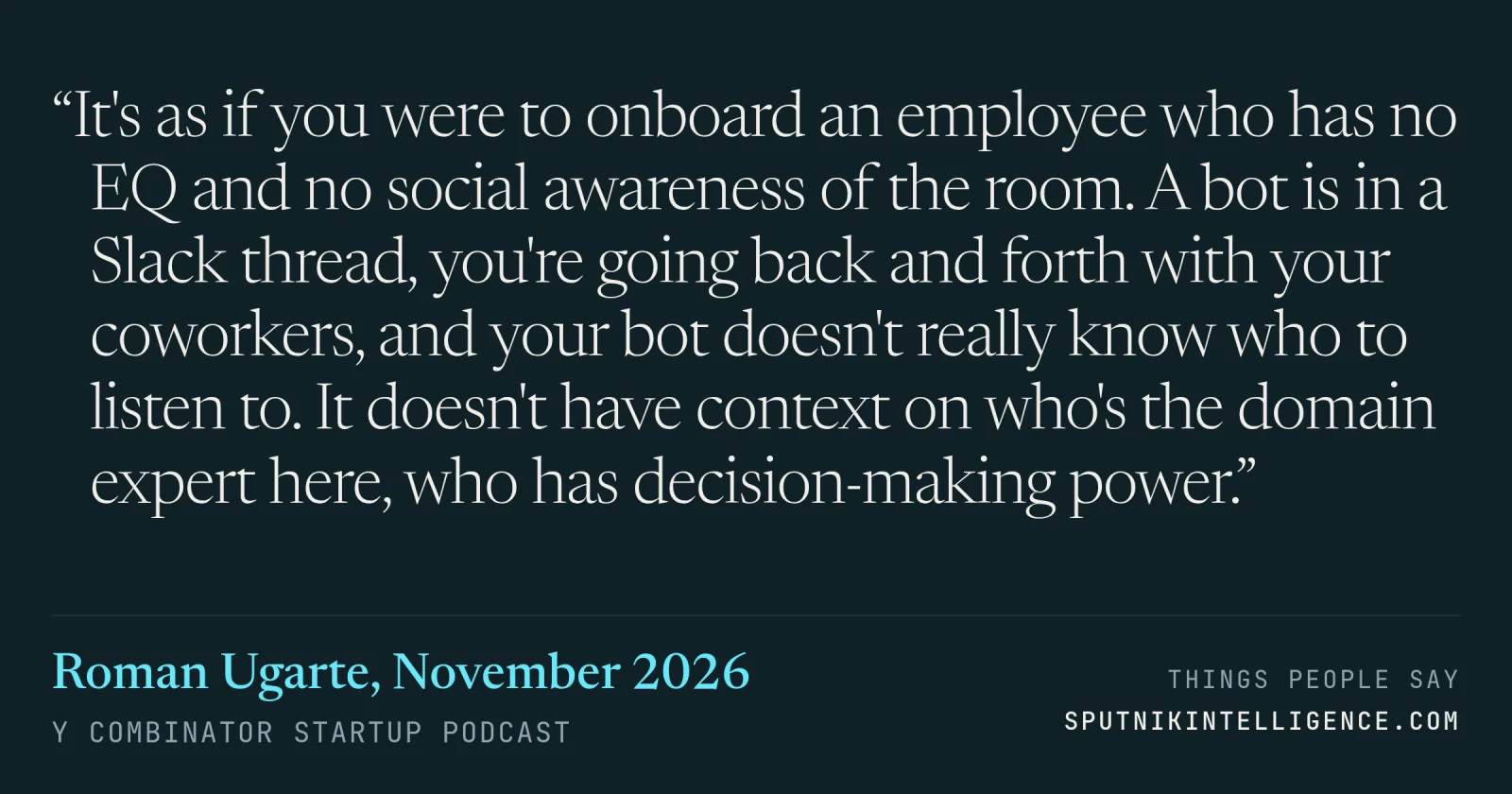
“It's as if you were to onboard an employee who has no EQ and no social awareness of the room. A bot is in a Slack thread, you're going back and forth with your coworkers, and your bot doesn't really know who to listen to. It doesn't have context on who's the domain expert here, who has decision-making power.”
Y Combinator Startup Podcast · Startups & Venture · November 2026
Context
A host had just said agent collaboration is the next step beyond single-player prompting. He lists what is still unsolved about putting AI teammates into shared team chat: the models and harnesses weren't built to read a room.
Transcript
…smart team bots that incorporate all of the best practices that our sales team has. We have something similar for engineering purposes as well. We have like engineer bots that take a lot of the principles, the skills that we've developed and use them. And everybody benefits from these team bots.
…mean, I think that's like the more advanced version of like talking about a software factory. And software factory is someone's in there just like still, you know, kind of doing this thing. And I think human beings will still do that. But it's much, you know, using these bots feels very different.
And there are so many unsolved problems still in making bots multiplayer, just making AI multiplayer in general. I mean, we face this on a constant basis, where now that Grokbots have entered our Slack workspace, they join our meeting. You know, we're really trying to see how far we can push this AI teammate thing. There are some weird situations that you run into where a bot is in a Slack thread. You're going back and forth with your coworkers, and your bot doesn't really know who to listen to. It doesn't have context on who's the domain expert here, who has decision-making power. It's as if you were to onboard an employee who has no EQ and like no social awareness of the room. Just the models weren't trained that way. The harness wasn't built that way. And so I think this next era of AI will be, you know, these bots really need to learn those things. And we need to teach that at the product level, at the harness level, at the model level. And I think it's going to be really interesting next few years. I mean,
it could probably look at who the owner is in, you know, in its metadata and say, well, you know, I know that Lauren's the one I need to listen to. Like, run everything by Lauren or something like that. We do have the concept of like,
you know, you have a, like, there's the owner of the bot and the manager, and you can invite collaborators as well. I guess if we really want to think of bots like employees, then we need to think about the identity problem, relationships, permissioning, you know, authentication, authorization.…
do you think of that? How do you think of permission and auth and access?
More from Y Combinator Startup Podcast