 Ben Bajarin
CEO and Principal Analyst at Creative Strategies, a technology research firm, covering semiconductors, AI infrastructure and product adoption.
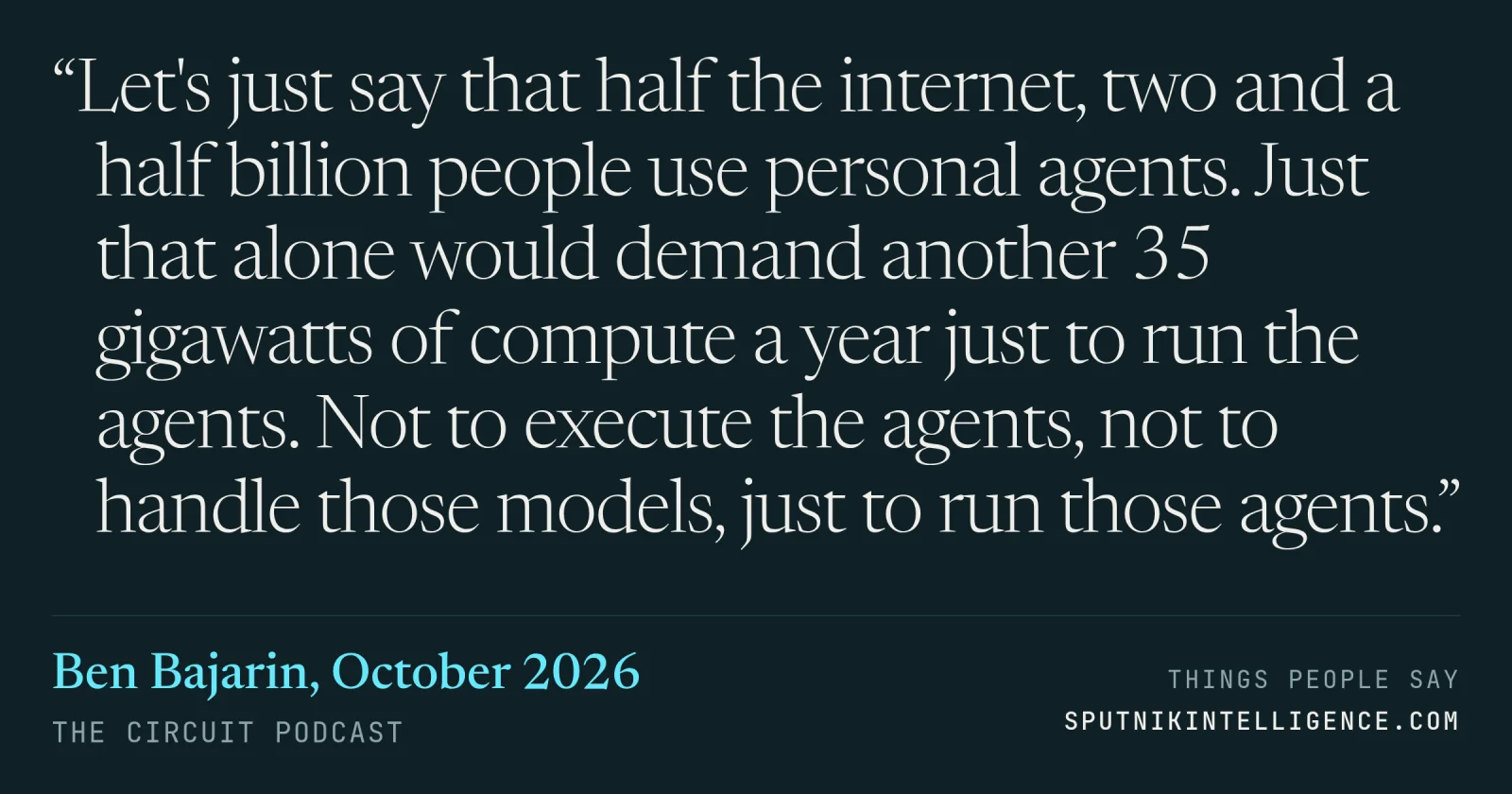
“Let's just say that half the internet, two and a half billion people use personal agents. Just that alone would demand another 35 gigawatts of compute a year just to run the agents. Not to execute the agents, not to handle those models, just to run those agents.”
The Circuit · Tech Strategy & Big Tech · October 2026
Context
Bajarin's back-of-envelope math on personal agents, prompted by Meta's Muse, which gives each user something like their own virtual machine. He estimates one person's agent could cost $50 to $100 a year to serve, and says companies that own their infrastructure, like Meta, can keep that cost lower.
Transcript
…is directly relative to how quickly you can make new, more capable models and variants of those models with different economics and capabilities. And so again, I just say all that to bring it back to the importance of the infrastructure to do this, to have competitive advantage for your models.
…they haven't been as vocal, but they're absolutely, I think they've been spending pretty heavily. And I mean, they just did that big equity offering a few months ago to keep it going. But I think your point is right, is owning your own infrastructure and having your own models matters tremendously.
…that's additional compute demand to just run reasoning models, executing models, et cetera. People have sort of brought this between, you know, anywhere, a number between tied to users. Like for every 100 million, it could be, you know, somewhere between three and five gigawatts. If you just kind of just run the math on the basics here, if, and I did this, so not including the entire internet, let's just say that half the internet, two and a half billion people use personal agents. Just that alone would demand another 35 gigawatts of compute a year just to run the agents. Not to execute the agents, not to handle those models, just to run those agents. Now, I say that to also say there's an economic cost to doing this. If you are OpenAI or Anthropic or whoever, and you're having to run agents on market token rates, it could be quite expensive. One person's personal agent could be anywhere from $50 to $100 a year, just to execute that, right? You've got to monetize that. Here, though, Meta, I think, is actually in a really interesting position…
Yeah, I see that. I think that is interesting. It's a lot of agents. There are going to be a lot of agents out there. I actually, I think one of the things that really stood out for me was they were talking about how much it costs to run agents because we're talking about Muse here, really, for…
Right.
And that seems confusing, right? Because you just outlined how much it costs to run Muse, and they're saying they're not going to charge for it, which means they're not dumb. So they have some other way to monetize that. And I think that's important because one, I think Meta is very, very good at…
More from The Circuit