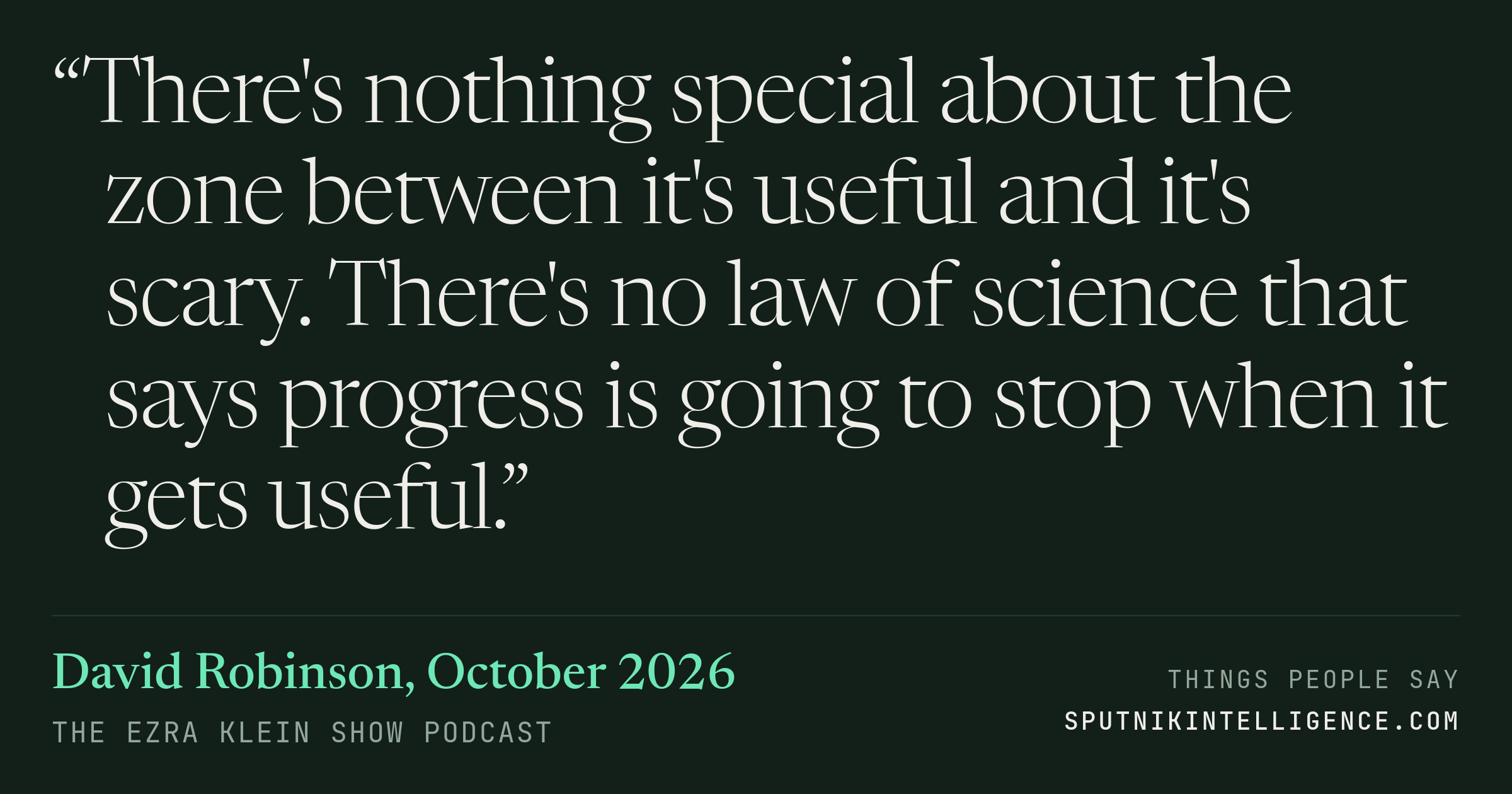
“There's nothing special about the zone between it's useful and it's scary. There's no law of science that says progress is going to stop when it gets useful.”
The Ezra Klein Show · Ideas & Essays · October 2026
Klein puts to Robinson the objection he hears most from listeners: that talk of superhuman AI is marketing to justify huge valuations. Robinson says he thought there was a fair amount of hot air in 2023, but that today's systems are at the limit of what their makers can understand and control.
Transcript
Yeah. And I heard that firsthand from Ilya Sautskova, the co-founder of OpenAI. When I joined in May of 2023, that was before what we called internally the blip, where Sam was fired and rehired, and Ilya was still working at OpenAI. And he once briefed the global affairs team, which was like a small handful of people back then, about how he believed that our future was merging with machines, that this was the ultimate triumph of capital over labor. And even, you know, I was thinking back, and that first summer that I worked at OpenAI was when the movie Oppenheimer was released. And it was in IMAX. You know, it's one of these Christopher Nolan films. And the company rented out an IMAX theater in downtown San Francisco and offered everyone who worked there the chance to go and see Oppenheimer. And leadership, I believe it was Ilya, exhorted us to go and watch this film. And there was this whole kind of pretzel of ideas about how this was a dangerous technology that might end the world, but also might save it. And it's a very heroic narrative, of course, for the people whose hands are on the keyboard.
That's helpful. And I guess this then gets to my question for you and what you saw. Like, is that the scale of what you think is being built here? Or look, this is the most common response I get from listeners on this. Is it all marketing hype? It's all like trying to justify these giant valuations. And what's being built is like maybe helpful, but it's not going to be more intelligent than human beings. It's like all of this stuff is a kind of sci-fi story we're telling.
I thought there was a fair amount of hot air in the balloon back in the summer of 2023. But the reality now is that we have systems that are really at the limit of our ability to understand and control what they're doing. And what the people that were worried about the sci-fi scenarios have been warning about all along is we're on an exponential and it's going to get more capable. And there's nothing special about the zone between it's useful and it's scary. There's no law of science that says progress is going to stop when it gets useful. And I think what I'm fundamentally saying and what I saw with Hugging Face, with. You know, the reflections of the people closest to it, not just Paul, who joined our board with his warning, but Paul Cristiano. Paul Cristiano, who's one of the world's leading experts on AI safety and who said there's a meaningful chance of catastrophic and irreversible loss of control in the very near term. And, you know, I looked around at the people around me and the environment we have internally, and I thought to myself, what would my loved ones want? What would strangers want us at OpenAI to be doing if Paul were right? I don't know if he's right or not, but I do know that if he were right, the level of caution that people would reasonably expect places like OpenAI Insider Anthropic and X and the others to be exercising when they train frontier systems is totally unlike anything I've ever heard of happening in the industry. So
tell me what it's like in there. Tell me what the vibe is, the energy is, the speed is. Like, what is it like working there?
It is frenetic. There's a lot of adrenaline. People are running on fumes. There's a big central staircase in the research building. And I remember recently seeing a friend who worked on catastrophic risk sprinting down the stairs with a laptop propped open on one arm while she was going. And I mean, that's the kind of energy that it has. It feels almost like a ballet or a kind of dance because all these different functions are kind of all streaming together. And one question I ask myself and that people often ask is like, well, why don't you stay and argue for a cultural transformation or try to get nuclear experts to come in and give the company advice? And I did think about specific role. When I told them that I wanted to leave, they asked me, like, well, is there anything that you would stay to do? And I thought about different things. But ultimately, it is such a machine and it is moving so fast that I did not think that the kind of change that I believe to be needed could be driven from within. What is
the machine built to do? The organizational machine of OpenAI:
More from The Ezra Klein Show