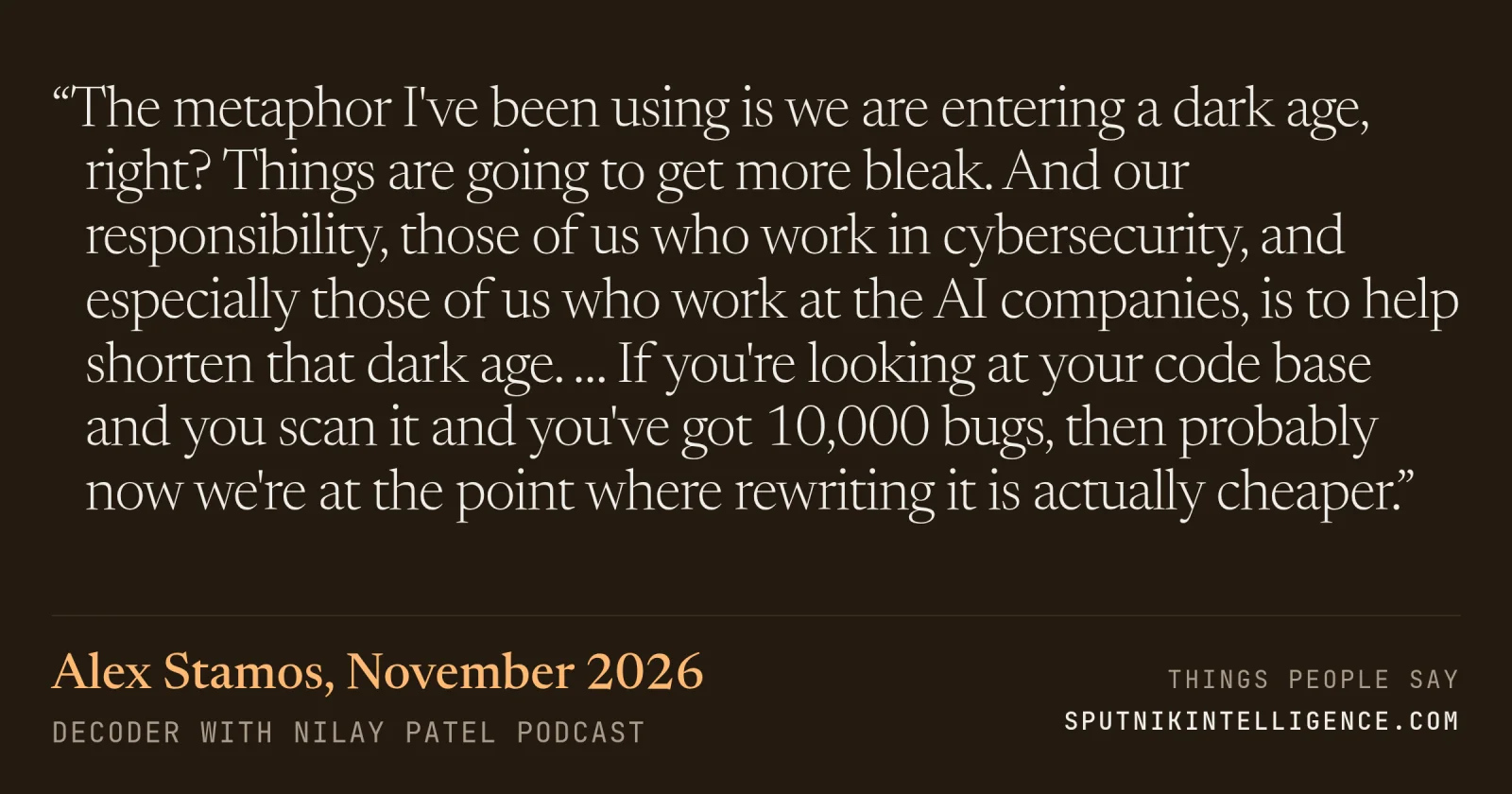
“The metaphor I've been using is we are entering a dark age, right? Things are going to get more bleak. And our responsibility, those of us who work in cybersecurity, and especially those of us who work at the AI companies, is to help shorten that dark age. … If you're looking at your code base and you scan it and you've got 10,000 bugs, then probably now we're at the point where rewriting it is actually cheaper.”
Decoder with Nilay Patel · Tech Strategy & Big Tech · November 2026
Context
Nilay Patel asked whether security gets worse before it gets perfectly secure. Stamos rejects both doom and utopia, and argues that rewriting vulnerable code is now cheaper than patching every bug AI tools can find.
Transcript
…but it can't feel like an ad. It needs subtitles, except when it doesn't. It needs to run at two times speed and deliver a complex message. Simply, of course, within 9x16. Thankfully, your company has Canva, so you can easily edit your video and every version of it. What will you Canva today?
…that has zero marginal costs. Like someone has to do it, even if the attackers are so infinite that their marginal cost is effectively zero. So are we going to go through a period where everything is so much worse and then it's perfect forever? Or how does the cost manage itself into balance?
…language. But the problem is, is we have a couple of decades of stuff that human beings wrote and that wrote in languages that we should have replaced years ago. And my feeling is, is to shorten this age, we have to do a couple of things. One is we have to stop to get out of this, like, we're just going to find bugs and patch them. A bunch of stuff just needs to be refactored, right? Like, if you're looking at your code base and you scan it and you've got 10,000 bugs, then probably now we're at the point where rewriting it is actually cheaper. That is my observation from looking at these customers of ours is that if you can get a working build, then it is actually much easier to write a whole humongous suite of tests and to spec out how this thing works and then to rebuild it within that spec and those tests securely than it is to find all the bugs and fix them. It actually is. And so I don't know what is going on through the mind of…
This is why I started by talking about how the economics of cyber led to the culture of cyber. I mean, this is like the most decoder way of approaching this conversation, I know, but there, you know, when you describe the research teams at the NSA and then the operational teams, that is a word…
I think Sundar Panchai and Andy Chassi are. I think they literally have each other's cell phone numbers. If one of them, maybe they don't listen to Decoder, but I expect one of their direct reports does. And I would like one of them to talk, go into their one-on-one and say, sir, I listened to the…
I'm just saying, I know Jason's listening. So if you heard it, I'm not even going to say that. It's not just the Linux kernel. But I'm saying,
More from Decoder with Nilay Patel