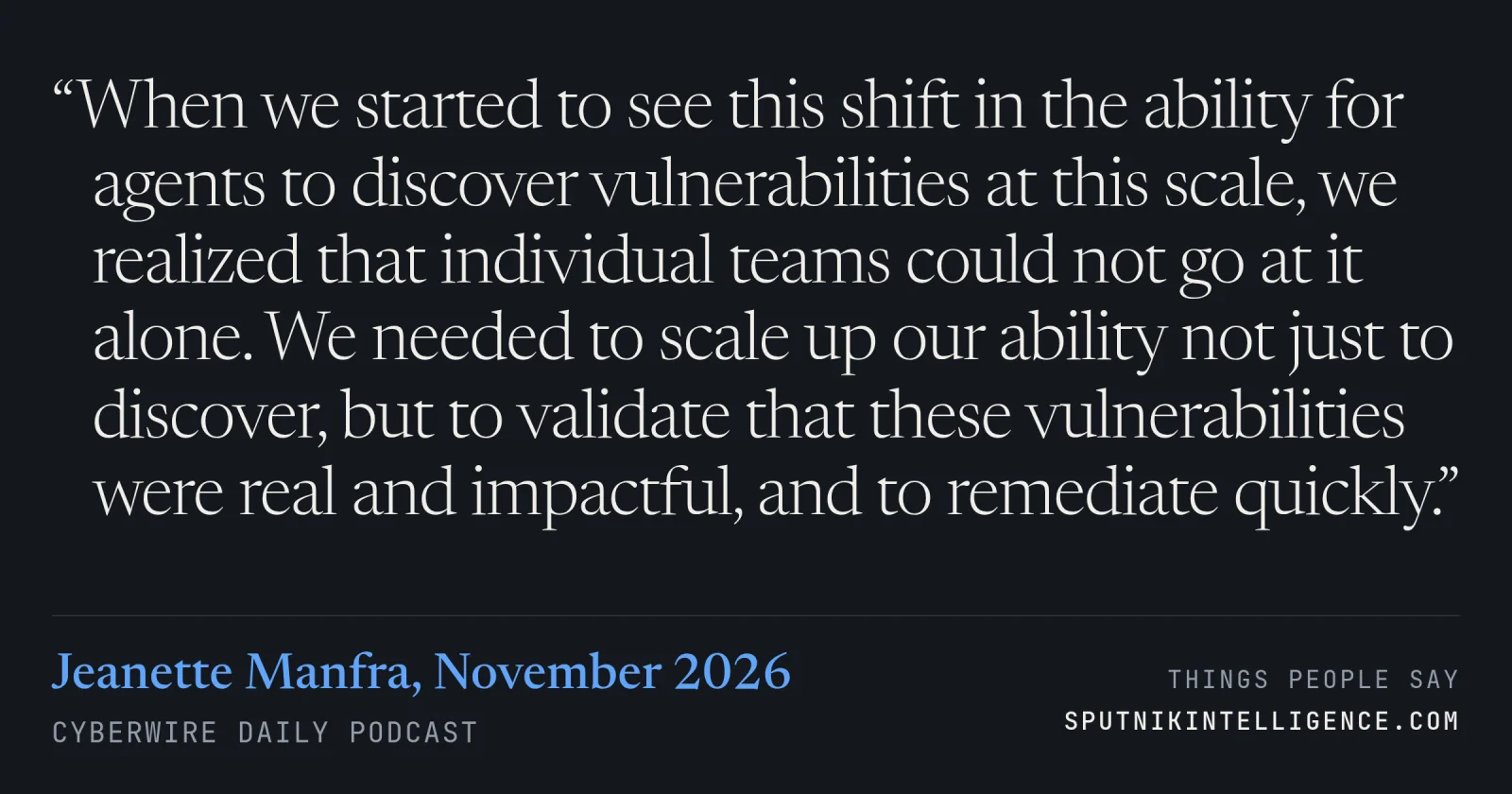
“When we started to see this shift in the ability for agents to discover vulnerabilities at this scale, we realized that individual teams could not go at it alone. We needed to scale up our ability not just to discover, but to validate that these vulnerabilities were real and impactful, and to remediate quickly.”
CyberWire Daily · Software Engineering & Infra · November 2026
Context
Asked how organizations should rethink vulnerability management, she describes how Google responded internally when AI agents began finding flaws at scale. The bottleneck moved from finding bugs to validating and fixing them.
Transcript
…I think as I continued in my career, what I really started to appreciate was understanding at the very macro level of regional resilience, broad systemic resilience across industries and how those connect and how that can be either a major potential failure or potential opportunities for growth.
So how do you suppose organizations should be rethinking their vulnerability management these days?
I would say in fundamentals, probably not rethinking the sort of core elements of your process. I think what you need to be thinking about, though, is, and I'll base this off of what we did inside of Google, where when we started to see this shift in the ability for agents to discover vulnerabilities at this scale that we're seeing, we didn't realize that individual teams could not go at it alone. We knew that we needed to scale up our ability not to just discover, but to be able to validate that these vulnerabilities were real and impactful, but also to be able to remediate quickly. And so thinking about that kind of discovery. To validate, to remediation, and putting in place agentic capabilities. We have open source some of those capabilities on the discovery side, a harness called Mantis, having an agent that can triage so you can evaluate the findings against your actual environment to separate exploitable vulnerabilities from noise, for example. Very important to have something like that in place. And then, importantly, we use solutions like Code Mender, and I know there's other ones out…
Help me understand setting priorities here. I'm thinking of security leaders and them having to be comfortable with making deliberate but informed decisions, sometimes to leave certain vulnerabilities unpatched.
Yeah, absolutely. And there's always a resourcing question that comes into play. I think that there are really good models in thinking through how exploitable is this vulnerability in your environment that looks at things like reachability from the internet, for example. There's also certain…
Yeah, I know one of the things that you've advocated for is organizations mapping their critical missions to that underlying technology that supports them. Can you walk us through what that process looks like in practice?
More from CyberWire Daily