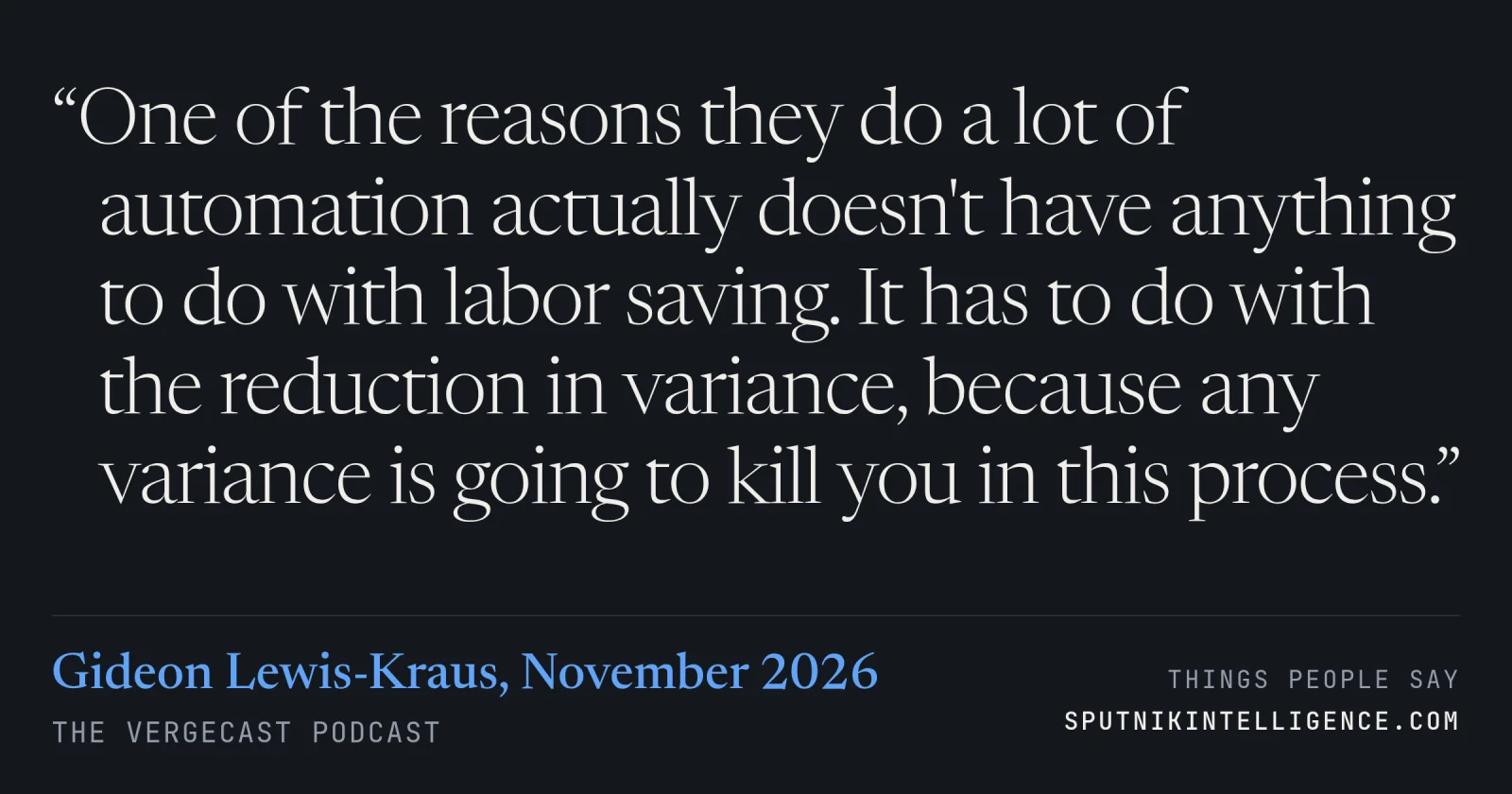
“I think the only way to describe Moore's Law is as this collective delusion that has become a self-fulfilling prophecy. A bunch of people get together in a room and make their roadmap for the next 15 years. And each guy says, I can build this thing that doesn't exist yet and might never exist, as long as you, my supplier, can build a thing that doesn't exist yet. It's a pre-commitment mechanism where everyone is like, we are going to do this thing that maybe can't be done.”
The Vergecast · Tech Strategy & Big Tech · November 2026

Context
The host suggested chip progress feels inevitable, though the reporting suggests it is almost impossible that it keeps happening. Lewis-Kraus replies that Moore's Law is less an observed regularity than a coordination device among suppliers who have each promised the others a future capability.
Transcript
…you know, terminal diagnosis of Moore's Law on the installment plan. Like they just, it seems like people in the industry just really don't think about it. I mean, they like to look back and say, like, hey, we keep kind of pulling off this magic trick, but it's not something that they talk about.
…almost Unlikely confluence of things that has actually been what has made all of this progress happen. And it's a bunch of like weirdos who barely understand why any of this works who are the ones who have made this progress happen. That there's nothing remotely inevitable about it at all.
Well, I mean, even kind of beyond that, you know, I had heard the sort of standard thing that everybody says about Moore's Law, which is, you know, it's not a law, like it's not a physical law of the universe, like gravitation, that it's just, it's merely an observed regularity. And it's an observed regularity that seems to have continued somehow for 60 years. But that's not even accurate. It's like beyond that, like I think the only way to describe Moore's Law is as this like collective delusion in the it that has become like a self-fulfilling prophecy that a bunch of people get together like from the industry in a room and they make their roadmap for the next 15 years. And each guy says, well, you know, I can build this thing that doesn't exist yet and like might never exist as long as like you at your, you know, your company, my supplier can build a thing that doesn't exist yet and your supplier can build a thing that doesn't exist yet. So everyone, it's a pre-commitment mechanism where everyone is like, okay, we are going to do this thing that like maybe can't be done, but we're all the reason we're going to do it. I mean, like, this was one of the things that really struck me. It's not that, oh, we're going to do this because we need like better AI…
Right. Yeah. It does seem like there is something kind of purely sporting about a lot of this research that is just like, what if I can just do this thing that no one else has ever been able to do? Won't that be neat? And it is. There's something really sort of perfectly scientific about it that I…
Well, I mean, TSMC is sort of obvious because they make, you know, 90% of the world's most advanced chips. So, and I think people had like kind of a vague idea that like, oh, most of these chips are made in Taiwan and like they're made by this one company. We don't really know that much about that…
Yeah. So, and I think to that end, it's probably still true that most people have never heard of it. And I think you're right that TSMC, we'll come back to TSMC, but I think most people, at least watching or listening to this, roughly know TSMC is the one that makes all of the chips. It is the best…
More from The Vergecast