 Ben Thompson
Writes Stratechery, a subscription newsletter analyzing the business strategy behind tech and media companies, and has built a reputation for framing how platfo...
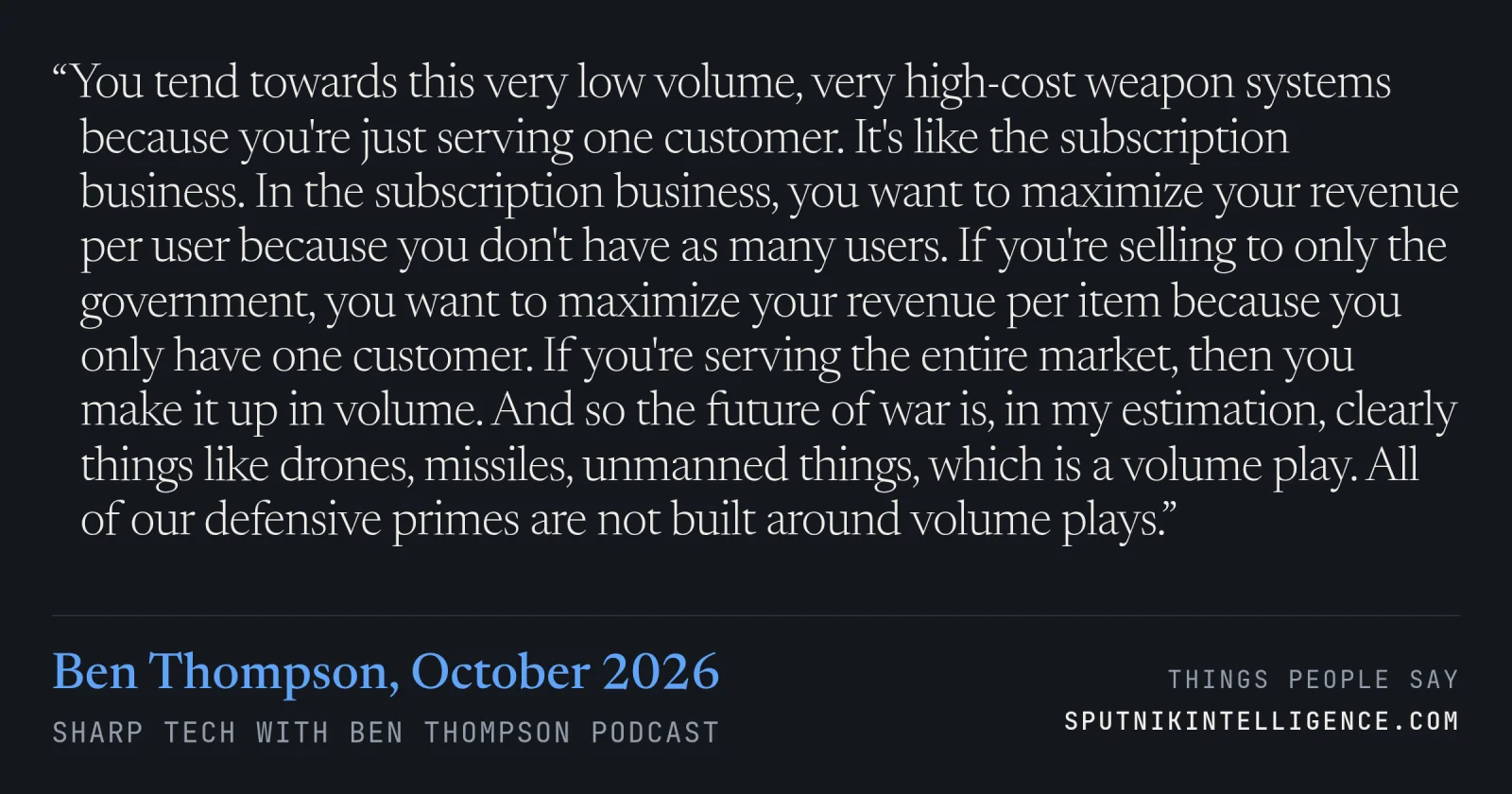
“You tend towards this very low volume, very high-cost weapon systems because you're just serving one customer. It's like the subscription business. In the subscription business, you want to maximize your revenue per user because you don't have as many users. If you're selling to only the government, you want to maximize your revenue per item because you only have one customer. If you're serving the entire market, then you make it up in volume. And so the future of war is, in my estimation, clearly things like drones, missiles, unmanned things, which is a volume play. All of our defensive primes are not built around volume plays.”
Sharp Tech with Ben Thompson · Tech Strategy & Big Tech · October 2026
Context
Thompson is arguing about the U.S. defense industrial base. Just before, he said the World War II arsenal of democracy worked because civilian car factories were repurposed for military production, and that today's military contractors serve only the government. This passage is his explanation of why that single-customer model pushes toward low-volume, high-cost weapons.
Transcript
…we don't have that capability. What do we switch to making all this military stuff? All our military contractors, because they only serve the U.S. government, they end up, number one, the U.S. government is stuck with these insane entities that all they exist to is basically the U.S. government.
Right.
But then also you tend towards this very low volume, very high-cost weapon systems because you're just serving one customer. It's like the subscription business. In the subscription business, you want to maximize your revenue per user because you don't have as many users. If you're selling to only the government, you want to maximize your revenue per item because you only have one customer. If you're serving the entire market, then you make it up in volume. And so the future of war is, in my estimation, clearly things like drones, missiles, unmanned things, which is a volume play. All of our defensive primes are not built around volume plays. The consumer market is how you get sufficient volume. Do we
need to fix the regulatory regime to enable the flowering of a domestic drone industry for the sake of national security?
Yes.
If we're going six-dimensional chess. Yeah. Maybe we do. No,
More from Sharp Tech with Ben Thompson