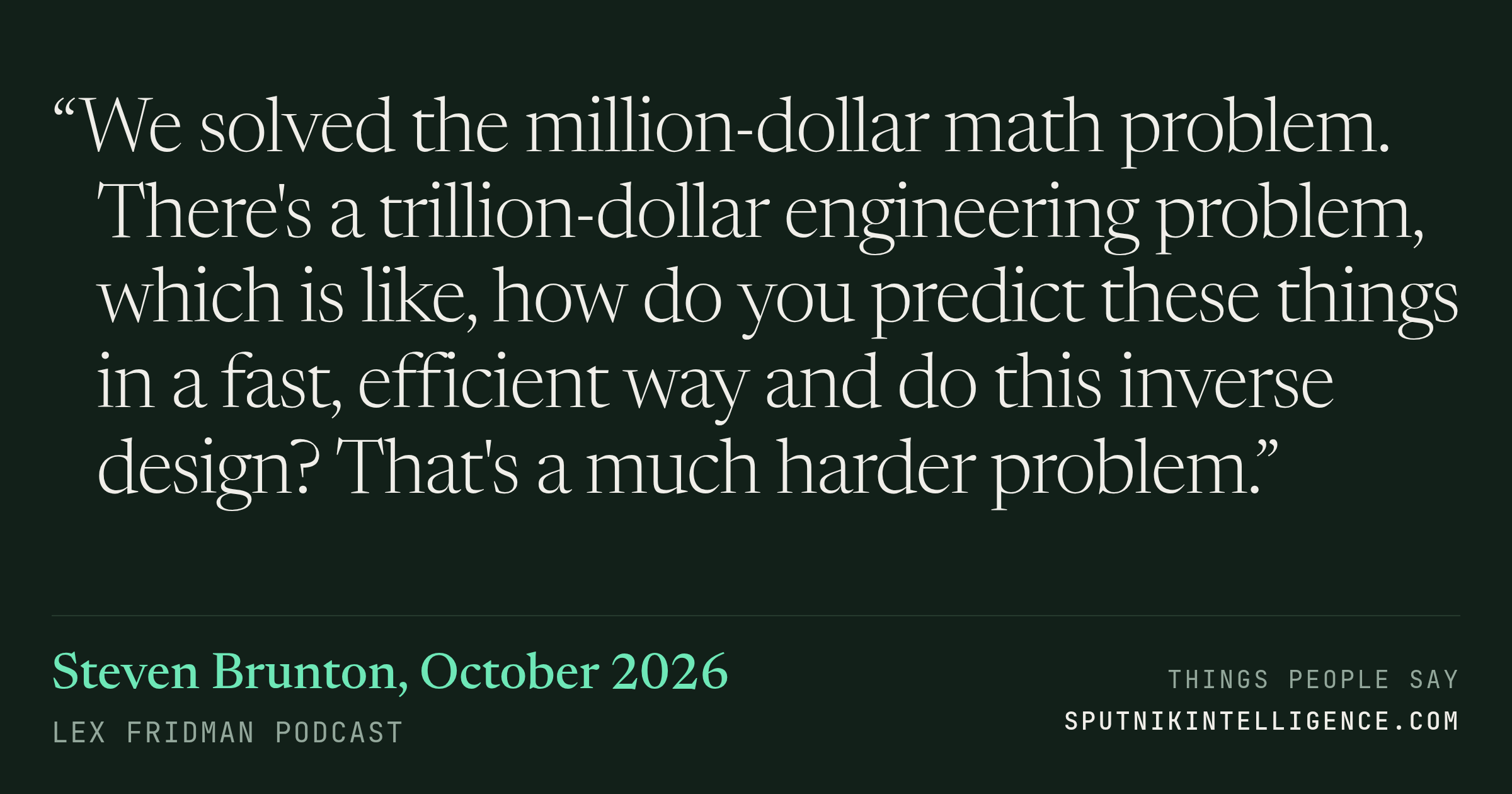
“We solved the million-dollar math problem. There's a trillion-dollar engineering problem, which is like, how do you predict these things in a fast, efficient way and do this inverse design? That's a much harder problem.”
Lex Fridman Podcast · Ideas & Essays · October 2026
Brunton, who works on fluid dynamics, on what the AI-assisted Navier-Stokes result changes for engineers. His answer: almost nothing day to day. Fluids are as hard and expensive to simulate as they were a month ago, and the proof works in a regime that isn't physical.
Transcript
So it's a very important math result.
Uh-oh.
I'll say, like, day-to-day engineering fluids and applied math kind of analysis of fluids is almost completely unchanged. Fluids are just as hard to simulate and predict today as they were a month ago or two months ago. And so when I'm trying to actually solve an engineering problem with a fluid, I want to design an airplane wing or an artificial heart or whatever it is. I'm still having to simulate and predict and manipulate this flow in a very practical way that's expensive in terms of supercomputer time and wind tunnel resources. And this mathematical theorem and proof are very interesting, but it operates at a regime that's so non-physical that it doesn't really affect my day-to-day engineering. There's still, I don't know, this is very pithy, but I like to say, you know, we solved the million-dollar math problem. There's a trillion-dollar engineering problem, which is like, how do you predict these things in a fast, efficient way and do this inverse design? That's a much harder problem. And you
say it's a trillion-dollar because that literally solves some of these problems. That's how much money you'll make, not because it's a prize, but like there's industries.
Yeah. And we could say, you know, trillion dollars of possible benefit to humanity of like better, faster solutions, lower drag, less emissions, you know, all of it. It's, we have like transportation, defense, health, energy, all of these have, you know, fluids at the very core technology. And so I…
Can you speak to some of the maybe beautiful, fascinating phenomena in the space of fluids that you've been thinking about? You mentioned turbulence. What are the big puzzles to sort of solve in the space to understand? You've mentioned drag, like air, fluid. What are like the big Millennial Prize…
More from Lex Fridman Podcast