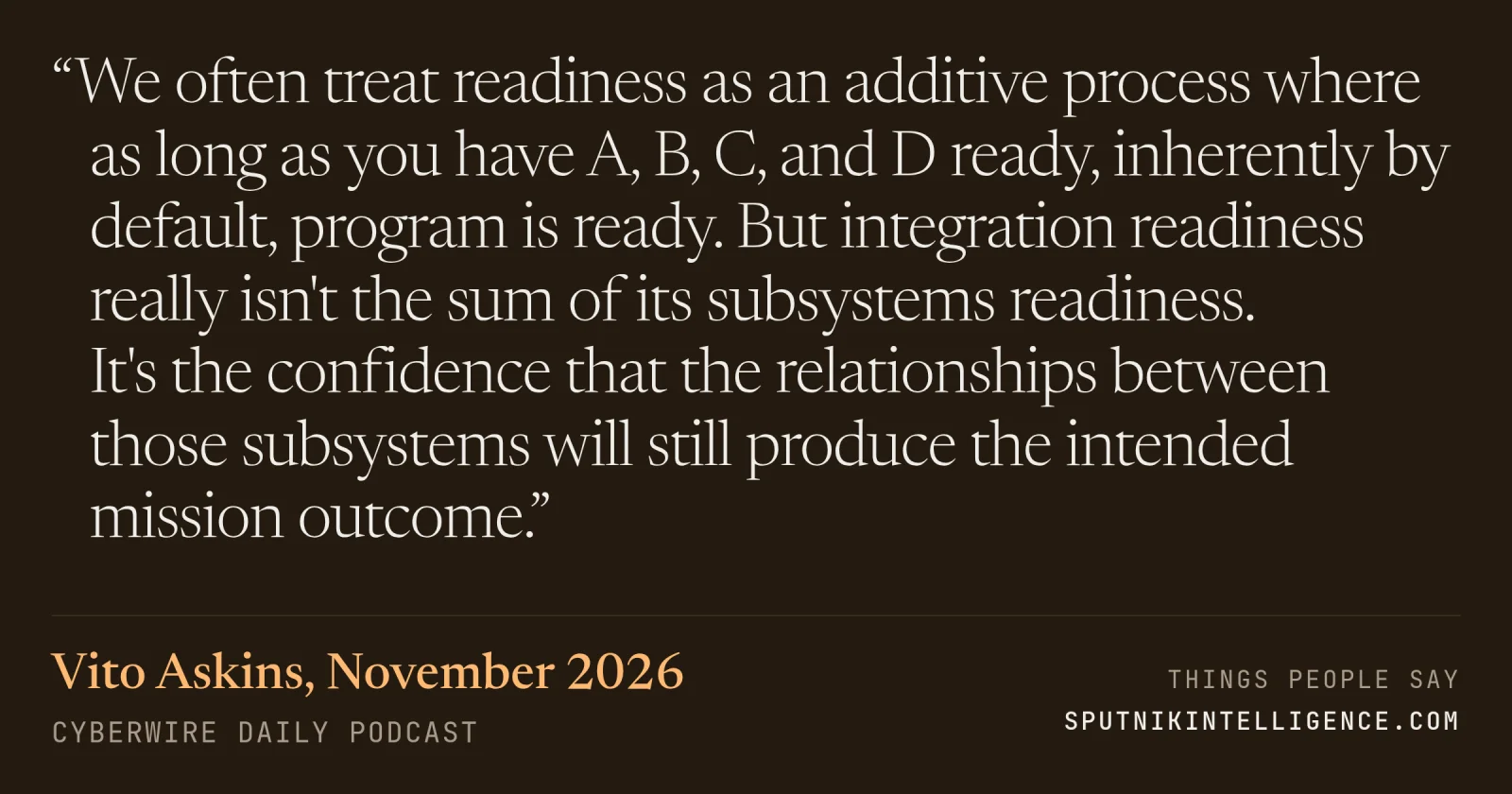
“We often treat readiness as an additive process where as long as you have A, B, C, and D ready, inherently by default, program is ready. But integration readiness really isn't the sum of its subsystems readiness. It's the confidence that the relationships between those subsystems will still produce the intended mission outcome.”
CyberWire Daily · Software Engineering & Infra · November 2026
Context
The host asked where mission integration tends to fall apart. Askins, who has written a book on integration risk in space programs, says programs wrongly call themselves ready by adding up subsystem status.
Transcript
and the new buffer by Prada.
…own certain things, things get political in terms of who's on what turf. When the rubber meets the road, it can get very complicated about who owns what responsibility. Is that where things tend to fall apart? Is that where the friction tends to lie? What have you seen and what can be improved?
It would be very hard to line up really a cut and dry point of where things fall apart. But I think the biggest indicators that you'll see or that I've seen in this is programs tend to get a lot of things wrong about mission readiness so that they can label a mission ready. We often treat readiness as an additive process where as long as you have A, B, C, and D ready, inherently by default, program is ready. But integration readiness really isn't the sum of its subsystems readiness. It's the confidence that the relationships between those subsystems will still produce the intended mission outcome. And I think a lot of problems with integration readiness is that systems engineers and technical leaderships don't ask the questions or enough questions. Rather, they make too many assumptions. And making assumptions is fine. That's how you develop a program and you stay your end goal and your customer readiness. But if you look at a program and assume it's going to do X, Y, and Z and you don't…
Yeah. So how yeah, so how do we challenge those assumptions? I actually really like your point that it's also a management thing. I mean, on a very human level, nobody wants to be the person that goes, hey, we're almost at what seems to be the finish line. Let's slow down. You know, nobody wants to…
Yeah, we challenge those assumptions and we remove that technical debt by creating a system that has such high fidelity between the advancement points of the development that there isn't, there's not allowable gaps that can just kind of pop up out of nowhere. You know, if you're working on your car…
Certainly. Yeah. And I would imagine to your excellent point about these missions are often not on orbit for nearly as long, but they're also becoming incredibly complex. The requirements are just ballooning. And certainly the plans that we're hearing for some of these multi-orbit constellations…
More from CyberWire Daily