 David Pomerantz
I'm the executive director of the Energy and Policy Institute, a watchdog organization that exposes the harms posed by fossil-fuel and monopoly utility interest...
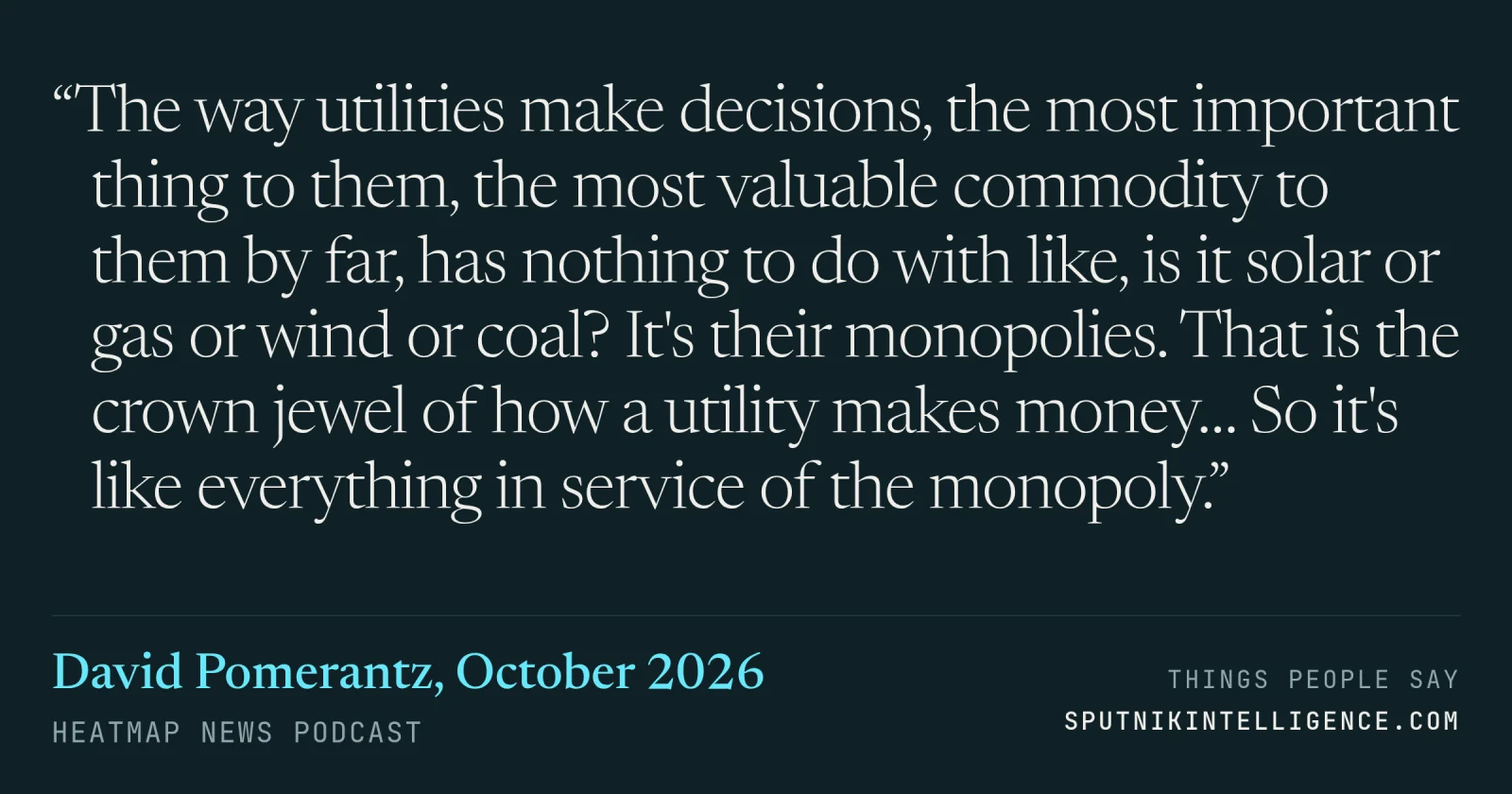
“The way utilities make decisions, the most important thing to them, the most valuable commodity to them by far, has nothing to do with like, is it solar or gas or wind or coal? It's their monopolies. That is the crown jewel of how a utility makes money… So it's like everything in service of the monopoly.”
Heatmap News · Climate & Energy · October 2026
Context
Pomerantz, who tracks the utility industry, was asked whether utilities are friends or foes of decarbonization. He says both sides of the climate debate overrate that question: utilities will accept clean-energy policy as long as they get their monopoly extended in the trade.
Transcript
…There are others who also own gas utilities. This has become more common as the industry has concentrated and as a function of mergers and acquisitions over the last couple of decades, really conglomerated a lot. And so, if you're a utility holding company that owns multiple utilities, like
Berkshire Hathaway Energy, sure, that's a good example,
…electrification, mixed on decarbonization. But actually, like, I think this is one of those cases where everybody who is really interested in climate change, and I certainly put myself in that category, even people who are really opposed to climate action, say from the political right, are like way over-indexed on how and whether that is a defining principle of how utilities make decisions. The way utilities make decisions, the most important thing to them, the most valuable commodity to them by far, has nothing to do with like, is it solar or gas or wind or coal? It's their monopolies. That is the crown jewel of how a utility makes money. And that leads to some situations where, like, you've had utilities in blue states who will accept government policy to speed up transition to renewable energy, but they'll try to get their pound of flesh as part of that acceptance. And usually, that pound of flesh is a retrenchment or reification of their monopoly. So, they'll say, like, yeah, we can dance with decarbonization a little bit…
And the monopoly here, this is a type of corporate right. I'm not even sure what to call it, that exists in very rare places in American law. Yes. Or doesn't exist that often in American law, right? The emerges from this like correct observation, especially correct in the early 20th century, but I…
basically, yes. So it all dates from when electricity and distributed electricity was a new technology form in the early 20th century and different entrepreneurs were racing to get electric light and different wires strung up. And there are some early stories from that period where, like, as new…
And the monopoly here is like a true jurisdiction, right? It's basically saying in this geographic area, only one company can provide electricity service. No other company can do it. And that kind of corporate right like exists only for this small set of regulated monopolies in the country. I mean…
More from Heatmap News