 Steve Klabnik
Programmer and writer who spent a decade working on Rust and co-authored The Rust Programming Language.
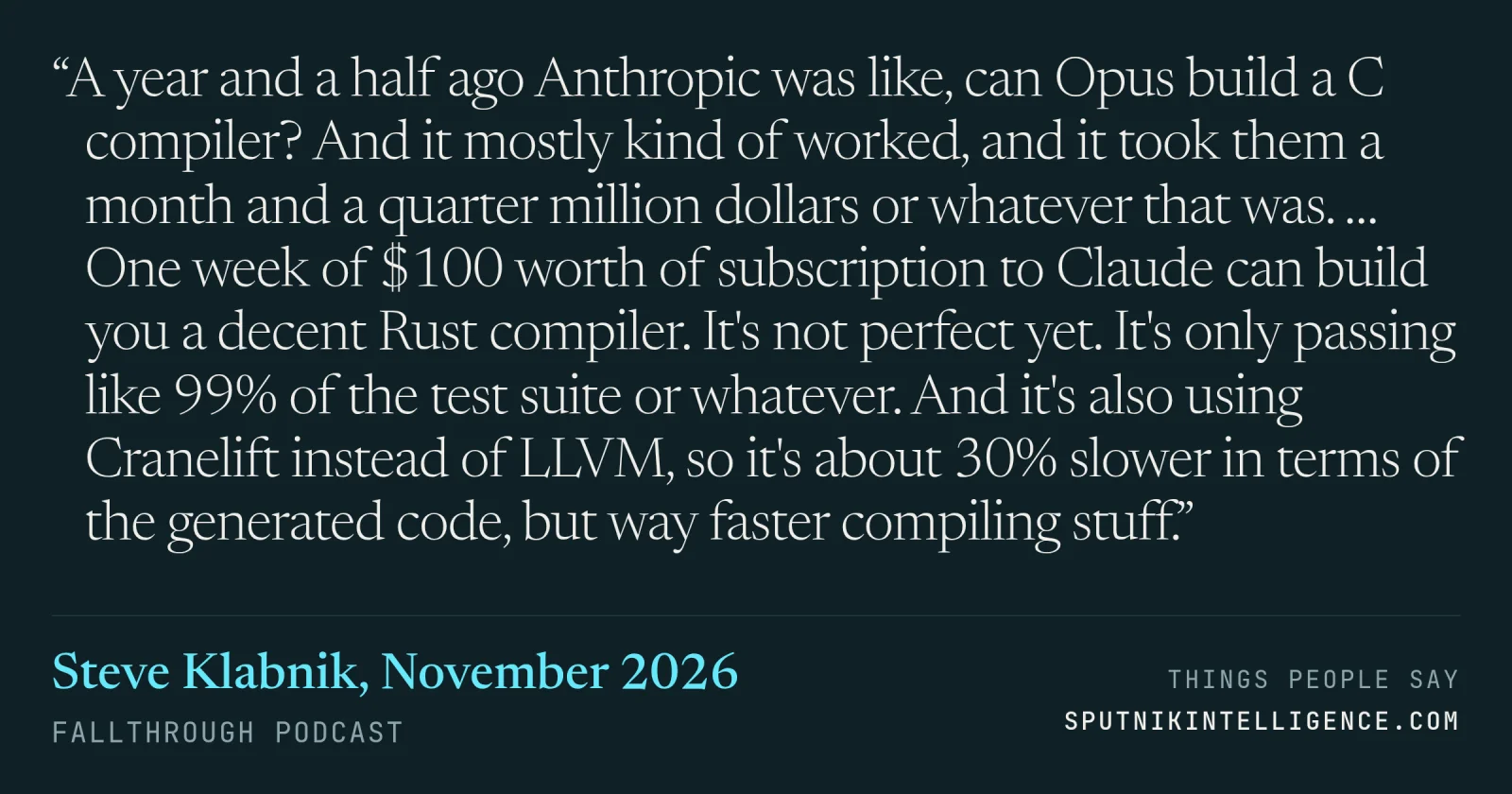
“A year and a half ago Anthropic was like, can Opus build a C compiler? And it mostly kind of worked, and it took them a month and a quarter million dollars or whatever that was. … One week of $100 worth of subscription to Claude can build you a decent Rust compiler. It's not perfect yet. It's only passing like 99% of the test suite or whatever. And it's also using Cranelift instead of LLVM, so it's about 30% slower in terms of the generated code, but way faster compiling stuff.”
Fallthrough · Hands-On Engineering Podcasts · November 2026
Context
Kris asked how Steve's workflows are holding up with the new models. Steve says he had Opus write a Rust compiler that ran mostly on its own for a week, and compares it with Anthropic's earlier C compiler experiment.
Transcript
Terra as part of it. I guess it's like it seems like it's like Astra R Soul. But anyway,
I mean, you got to use Terra and Luna sometimes. Anyway, but yeah, like, let's get your, I mean, that's a take, right? That's a hot take a year. So let's get your takes on these new models. How have you, how have your workflows been workflowing? Opus 5.5
has been awesome. It's just like, it's just, it just works. It just does. I mentioned Secret Project as a follow-through exclusive. I've been building a Rust compiler lately. And that's largely because I had my subscription. I was getting married. I was like, I'm not spending any time working on my personal projects this week. So I was just like, hey, Opus, write a Rust compiler, please. And I gave it a little bit more than that, but not much more. And then it just proceeded to work for a week straight. Like it went from like Monday to like Saturday afternoon when my weekly ran out. And it just, I didn't really need to do very much at all to keep it going. It just was like, cool, I'm just going to, I'm just going to make this happen. And the results are pretty good. I don't know if it's something I'm going to make public or not. The reasons I'm doing are complicated and I don't really want to get into it. But like, it is like when you think back to the like a year and a half ago with like Anthropic being like, can Opus build a C compiler? And it like mostly kind of worked sort of. And it like took them like a month and like a quarter million dollars or like whatever that was. Like, I, and like a lot of times people are like, you know, C is better than Rust…
Yeah. So I looked it up in 6.1, they have Soul and Terra right now. So it's good to Astra is still six. So they haven't had Astra 6.1. But yeah, no, I think the models in general, they have gotten much better. Like I've been much less annoyed with using them as of late. And like, I feel like usage…
I'm really interested if that is literally true or if this is a we are not charging you for cash misses. Like which side of that is the case? Yeah. You know, just like it's a cool move and it's good in terms of like giving us more for the same amount of money. But like I am interested, technically…
I assume either because they gobbled up all of the world's RAM and SSDs that they figured out how to architect something that makes it so this is feasible. Or it is just like, hey, we use probabilities and then we kick some of your conversations out. And then if there's a cash miss, we just don't…
More from Fallthrough