 CJ Reynolds
Senior creator at Syntax and host of Coding Garden, covering web development, JavaScript tooling and AI coding tools.
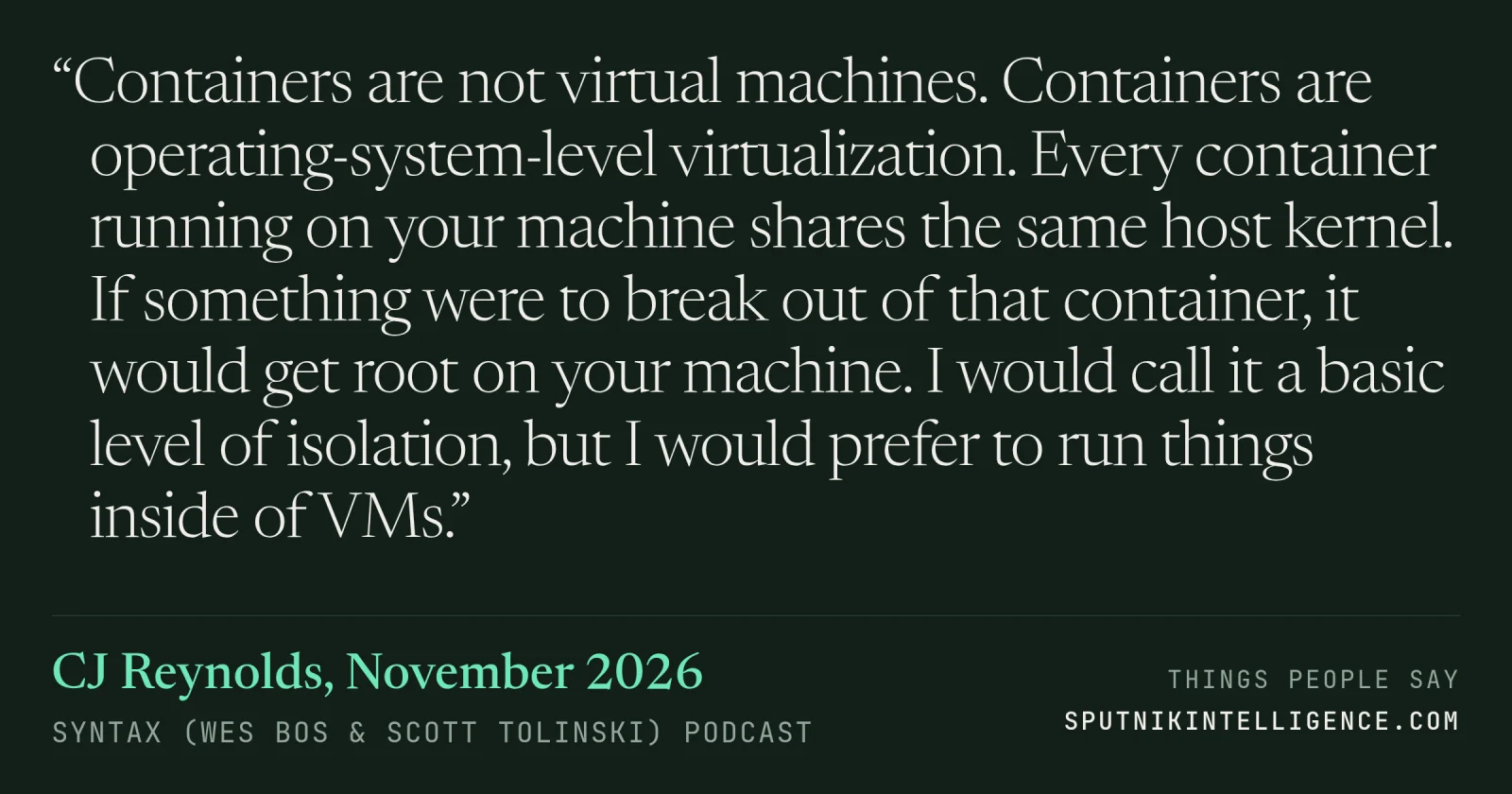
“Containers are not virtual machines. Containers are operating-system-level virtualization. Every container running on your machine shares the same host kernel. If something were to break out of that container, it would get root on your machine. I would call it a basic level of isolation, but I would prefer to run things inside of VMs.”
Syntax (Wes Bos & Scott Tolinski) · Hands-On Engineering Podcasts · November 2026
Context
A viewer asked whether Docker's isolated mode could do the job of CJ's tool for running coding agents and dependencies in per-project virtual machines. CJ explains why he sees containers as weaker isolation than VMs.
Transcript
…It has a lot of stuff that makes allows you to run your agents inside of the VM. But I initially built this just because I myself wanted to code inside of VMs. It just so happens that it also makes it really easy to code with agents inside of a VM. But yeah, let me pull up a quick little example.
Someone's asking, can't Docker run in isolated mode as well?
Yeah, so I talk about this. And actually, I'll link you our YouTube video, but containers are one level of isolation, but containers are not virtual machines. And containers are operating system level virtualization. And what that means is every container running on your machine shares the same root, the same kernel, the same host kernel. And so if something were to break out of that container, it would get root on your machine. And so that's containers. I would call it like a basic level of isolation. But I would prefer to run things inside of VMs. And so Docker does have Docker sandbox, Docker SPX. And that does spin up a VM for every project that you're working on. But again, it's a little bit cumbersome to use. Like I tried to use it. It also tries to force you into using agents upfront. This is not in the docs yet, but if you go to next.devvm.dev, I have a whole page that talks about other tools and how Dev VM is related to them. I would say Docker sandboxes are the closest thing to Dev VM, but Dev VM also has like network learn mode. It comes built in with a bunch of CLI tools that agents often need or that you…
This is something that I'm very interested in because, again, I am a developer, but I find working in VMs to be cumbersome. So yes.
And so my idea was one command, you get a virtual machine in any folder. So right now I am in the website folder. This is the syntax website. And I could technically do a PNPM install, PNPM dev, but all of that would be running directly on my computer. But instead, what I can do is just say Dev VM.…
You know, this is the biggest annoyance to me is like when you set up all this stuff and then you then have to redo your logins. I like, I have several machines where I'm logged into Claude on and it's just like I feel like I'm my job is just logging in on stuff all day.
More from Syntax (Wes Bos & Scott Tolinski)