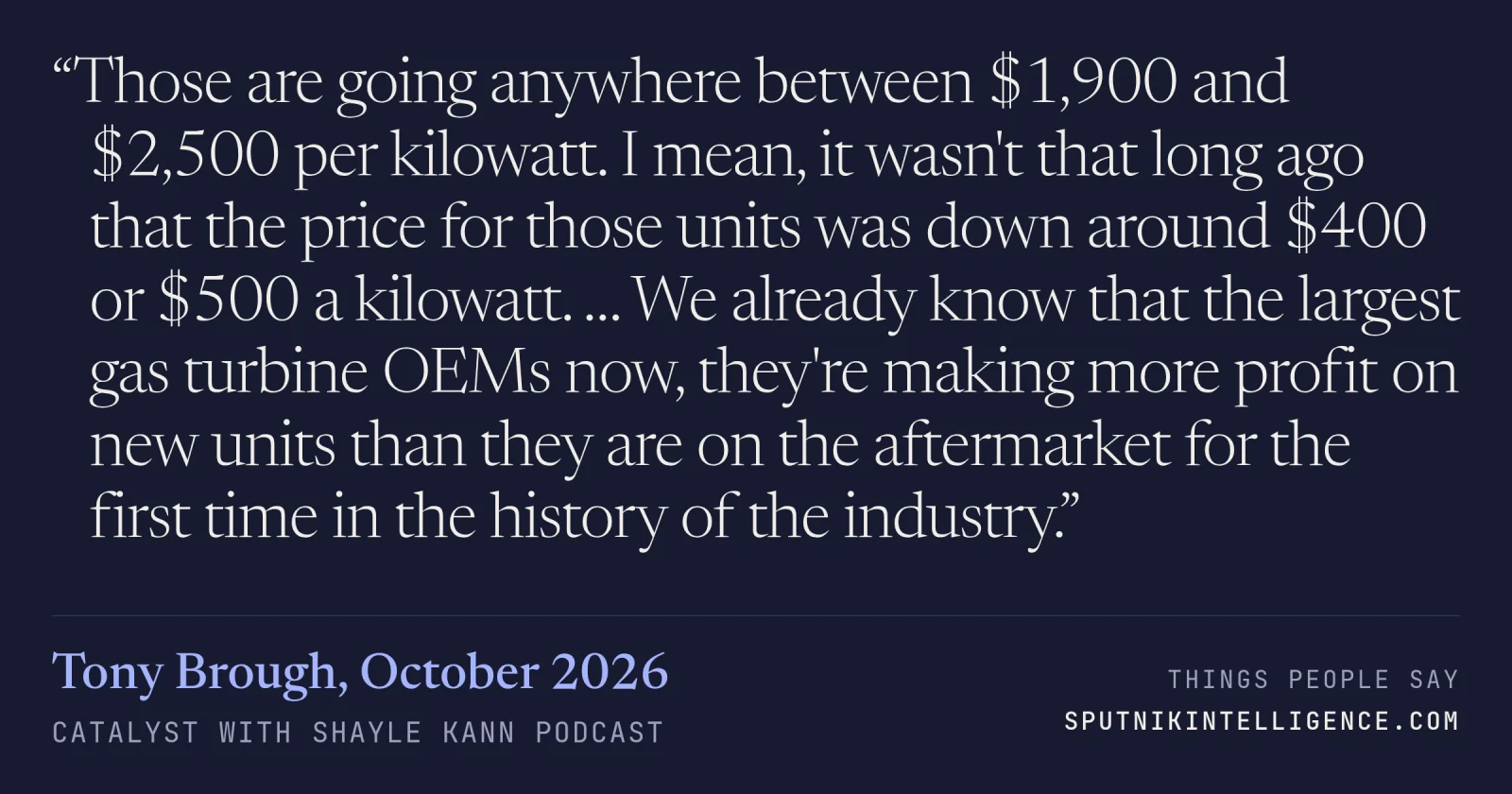
“Those are going anywhere between $1,900 and $2,500 per kilowatt. I mean, it wasn't that long ago that the price for those units was down around $400 or $500 a kilowatt. … We already know that the largest gas turbine OEMs now, they're making more profit on new units than they are on the aftermarket for the first time in the history of the industry.”
Catalyst with Shayle Kann · Climate & Energy · October 2026
Context
Shayle Kann asked what a data center should expect to pay for behind-the-meter gas power later this decade. Brough was describing 20–35 MW turbines, and expects prices to settle around $800–900 a kilowatt, still double what makers expected five years ago.
Transcript
…2.5 megawatts. Well, you could put 30 to 100 megawatts of gas turbines on that same footprint. It's just not a long-term viable solution, in my opinion, from a purely logistics nightmare perspective. It's just, you're looking at so many units to fill such a large gap. I find it a bit of a reach.
…really talked about yet is pricing. It varies across these different categories, of course, but what should I expect if I'm going to install behind the meter gas to power technology of one kind or another at my data center, you know, later this decade, let's say, what should I be expecting to pay?
…kilowatt. Now, I think that this whole market activity is actually presenting an opportunity, a long-term opportunity for the gas turbine OEMs. Because if you look back historically, gas turbine OEMs made most of their money on the aftermarket, and they struggled to make profit on their new unit activity. So it was, you know, build it, sell it, and make most of my money in the aftermarket. Well, we already know that the largest gas turbine OEMs now, they're making more profit on new units than they are on the aftermarket for the first time in the history of the industry. Now, why I say this is a kind of historic situation is because this increased pricing that we're seeing today, I think is going to come down over time. So if you're seeing prices in the $1,900 to $2,200 per kilowatt, eventually I think those prices are going to settle down around $800 or $900 a kilowatt. That's still double what an OEM in that megawatt range was expecting to get five years ago.…
Okay, so I guess final question for you. What do you think this market looks like in 2030? So we've still got the three big players. They in aggregate can produce 75 gigawatts a year, plus or minus. And then you've got this long list that we've just run through of a whole bunch of other players…
I think that's why the OEMs are being careful with their capacity additions, because I predict that the market will start to diminish. Probably 2028 and after, you'll start to see the overall market to come down. But I mean, I frequently get asked, you know, what my long-term forecast looks like.…
right, Tony, this was fun once again. Thank you. Appreciate your time.
More from Catalyst with Shayle Kann