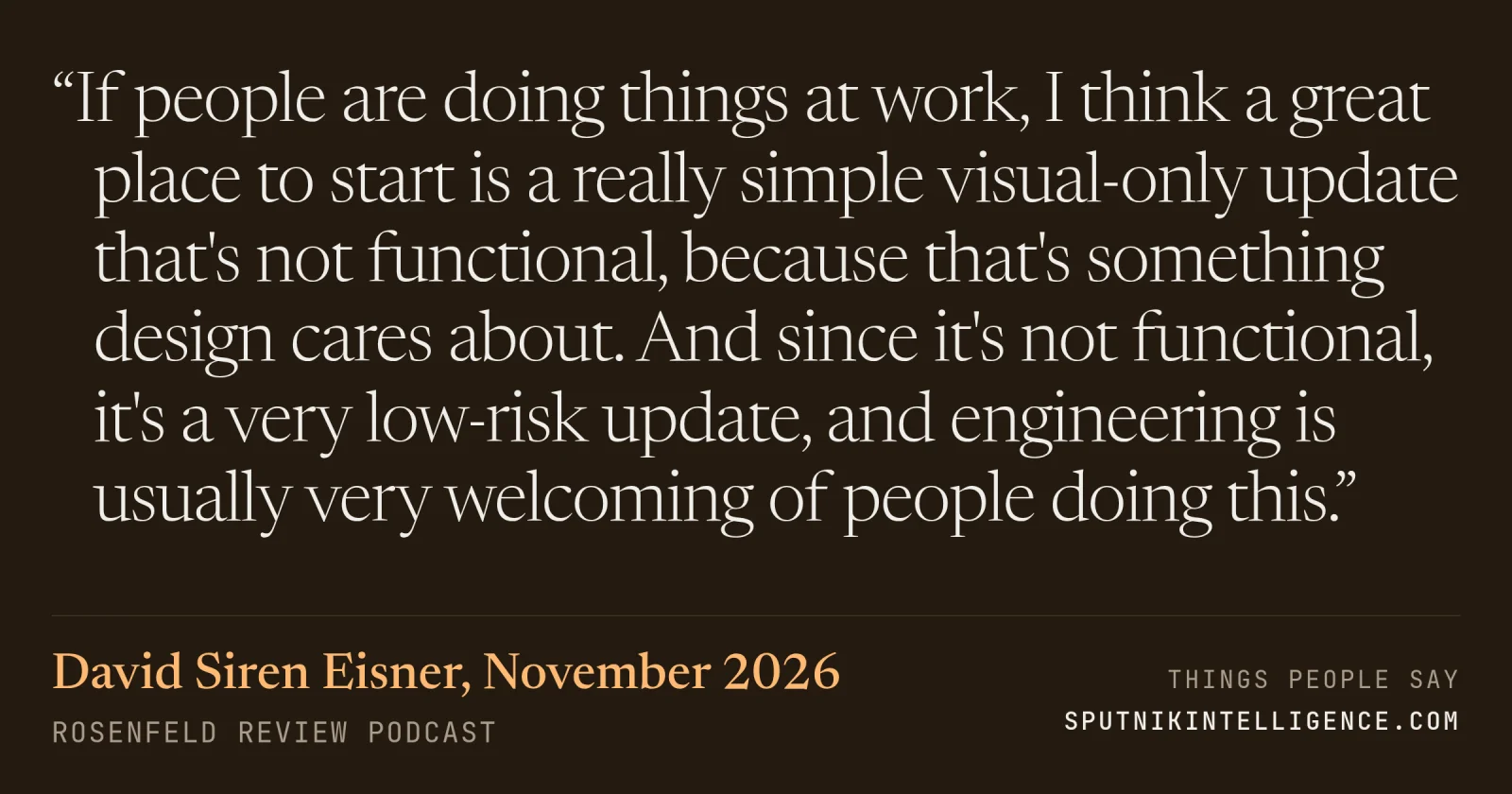
“If people are doing things at work, I think a great place to start is a really simple visual-only update that's not functional, because that's something design cares about. And since it's not functional, it's a very low-risk update, and engineering is usually very welcoming of people doing this.”
Rosenfeld Review Podcast · User Experience · November 2026
Context
Asked how a designer gets started building, David says designers often feel far behind, but nobody has been doing this long. He suggests a first step that is low-risk and gets engineering on side.
Transcript
…used to be, you know, time consuming used to be the code part. If that's condensed, we need to spend a little bit more time up front making sure we're doing the right things and ideally pulling those same people back so they can maintain context. So when they're building stuff, it makes sense.
…on and on and on. Let's bring it to a more concrete place, which is, you know, you wrote this book primarily for designers who are really under the gun even more than usual and probably are like, you know, I need to do this to like have a future. How do I get started? How do I get started, David?
Well, so, you know, I initially had done, kind of tried to find a way to make this work with my team and stumbled a bit a few times how to kind of teach people to get to and get the right place and eventually got a model which I thought really worked with them. And that's where, you know, I went and started a class to help kind of see these ideas in the industry because it didn't really matter, you know, if it worked well for us. It really only matters for design if lots of designers kind of take this up. And I taught this class for a while, still am. And, you know, I'd see people coming into the class and that was really the question. Like, how do I get started? I'm interested in this. I hear about these things. First of all, everyone feeling like I'm so far behind. And what we, of course, realized was they're not really. Most, no one's been doing this for a very long time. These are all new things. Everyone's figuring out new ways to work. And with a little bit of training and kind of unlocking some of the first steps, it became really easy for them to exceed. And I've seen…
Well, I mean, you know, like, I mean, the book really gets into the nuts and bolts of, I guess you could just say vibe coding, but not really. I mean, like, it's more than that because you're really trying to unlock the language of engineering in a way that makes a designer a better partner. I…
Yeah, 100% on that. And I do want to emphasize too, when I talk to designers, sometimes their concerns are like, oh, I'm going to be spending all my time in code and you're just, I'm turning into an engineer and that's not what I wanted to do. I even think we have some identity things like I'm a…
Well, you know, if you're listening, you know, obviously there's some, you're in a, you may be in a defensive mode. And I think it's pretty clear that David's book is going to help you there. But what I really like, Dave, is that you talk also about having fun, that this is a creative pursuit. It's…
More from Rosenfeld Review Podcast