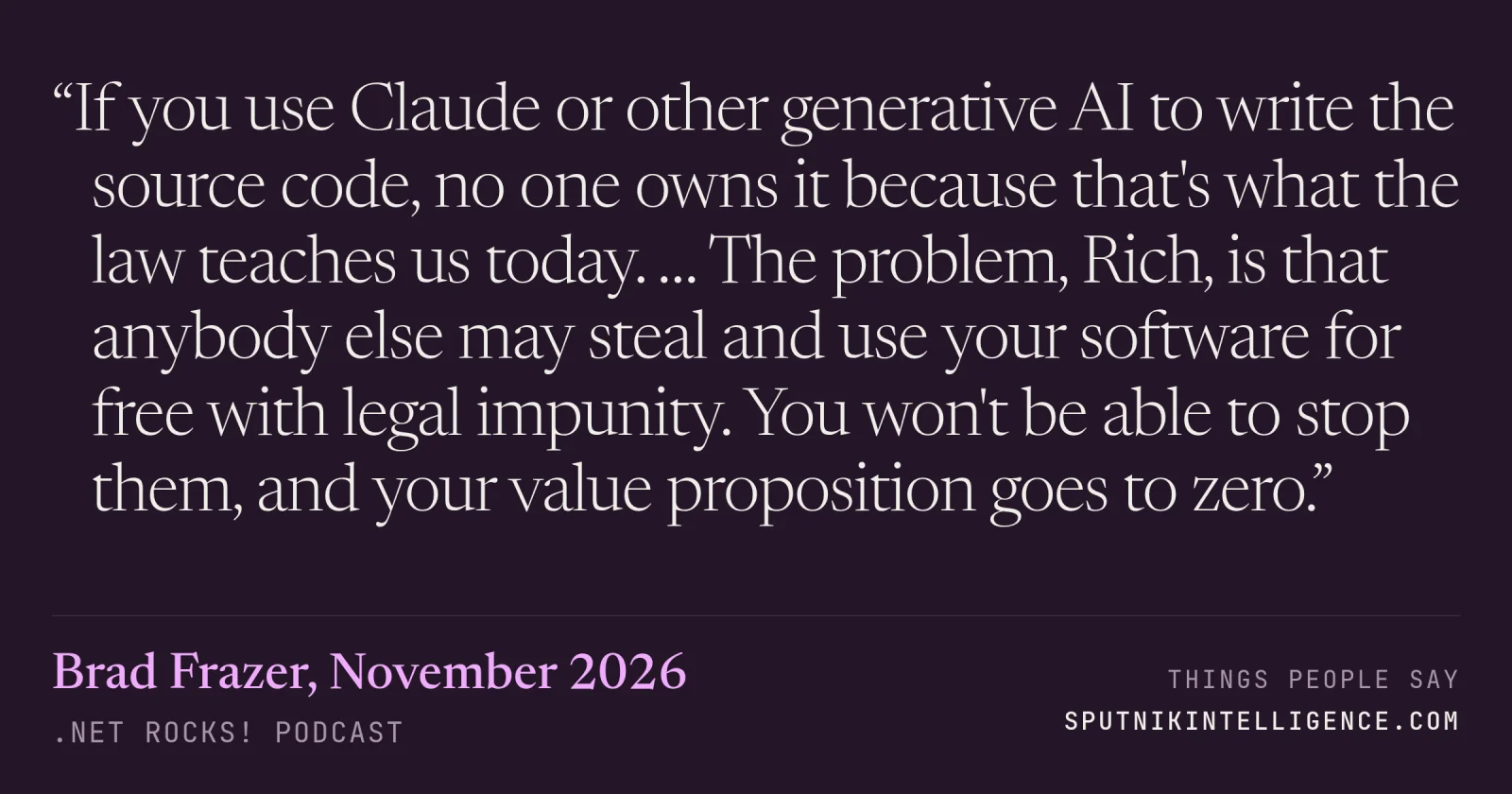
“If you use Claude or other generative AI to write the source code, no one owns it because that's what the law teaches us today. … The problem, Rich, is that anybody else may steal and use your software for free with legal impunity. You won't be able to stop them, and your value proposition goes to zero.”
.NET Rocks! · Hands-On Engineering Podcasts · November 2026
Context
A co-host had just described vibe-coding a game app he wanted to sell. The IP lawyer explains that US copyright requires human authorship, so AI-written code has no owner and copycats can't be stopped. This is his reading of current US law.
Transcript
Well, they wouldn't, but the good news is I keep it on GitHub, so no one's going to be able to find it anyway.
Nice.
…owns it because that's what the law teaches us today. So, Rich, my friend, if you as a coder make a decision that you want speed to market, speed to market, and you want first mover advantage, and you're going to get that code out there before anybody else. And so, as a function of that, you use Claude to write the code. Good for you. First mover advantage is a time-trusted way to get to market. The problem, Rich, is that anybody else may steal and use your software for free with legal impunity. You won't be able to stop them, and your value proposition goes to zero. So, there's the short and short answer, Rich, to your question. What do you do? And I would say to you, Rich, it depends. Do you want to own and monetize this thing really, or do you just want to be first to market, make a few bucks, and get out? And, Rich, let me ask you, I mean, which is it with your game app? Or Carl maybe has a question.
Yeah, I just want to, I mean, you glossed over the main point of this whole conversation, which is if, and I just want to repeat it so that people understand it. If you use an AI agent to write code, you don't own that code. The people that you wrote it for don't own that code, even if it's a work…
Yes. And Carl, would you like to take just a moment and have a more in-depth discussion about those copyright law principles? The reason I glossed over it is because I'm a copyright lawyer. And so, to me, this is fascinating. I wasn't sure what it was. So, it's one sentence of many.
I just want to declare
More from .NET Rocks!