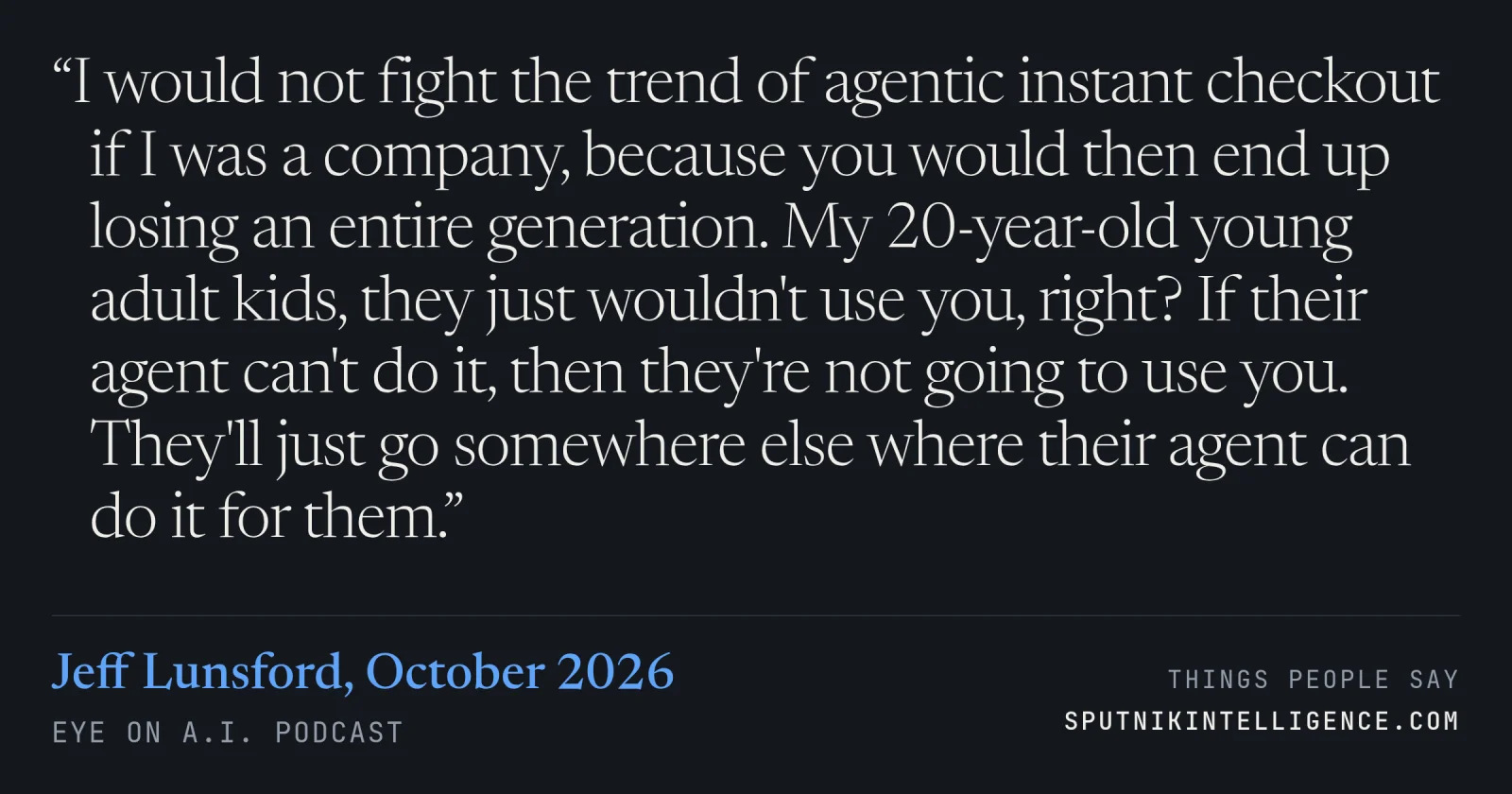
“I would not fight the trend of agentic instant checkout if I was a company, because you would then end up losing an entire generation. My 20-year-old young adult kids, they just wouldn't use you, right? If their agent can't do it, then they're not going to use you. They'll just go somewhere else where their agent can do it for them.”
Eye On A.I. · October 2026
Context
The host asked what happens to the personalization industry, built on browsing behavior, if AI agents do the shopping and instant checkout compresses the funnel. Lunsford, CEO of a customer-data company, says companies should optimize their data for agents rather than resist.
Transcript
…a concept of householding as an example. And, you know, or in B2B businesses of associating a person with a business. And so the same idea, I think, would apply where you would associate an agent with a human potentially as part of a household, but you'd probably clearly know they were an agent.
Yeah. You know, OpenAI has this thing called instant checkout that compresses the funnel to almost nothing. If agents are doing the browsing, what happens to the personalization industry that's built on browsing behavior?
That's where you go back to optimizing your data layer for that agentic checkout, right? Or that agentic experience. And yes, if you have all the right data surfaced for that agent already through the API and the protocol that you'd like to support, that agent will be able to come in, transact, and leave faster than a human. And what is the point of a website other than to get conversions? And, you know, sometimes it's to educate. Typically, it's to get some type of conversion, like a loan application done, or, you know, a lot of big pharma companies, they're trying to educate people about their new medications to different audiences. And, you know, so I think the instant checkout is just part of the future. The human traffic won't go away. You will get inbound agentic traffic that might want to use instant checkout. And if you have an optimized data layer for them, then you'll get higher conversions out of them than if you make it difficult for them. I would not fight the trend of agentic instant checkout if I was a company because you would then end up losing an entire generation. You know, my 20-year-old young…
Yeah, that's right. I have adult children too in their 20s. They're very impatient. Tillium started as a tag management company for the browsers. Is that right? Can you describe what that is?
Yeah, so for sure. When we started the company, think of around 2011. And what had happened is ad tech had kind of really gone through this Cambrian explosion of different things like SSPs, DSPs, Banner Network, so on and so forth, personalized content, A-B testing. And so companies were, you know…
Yeah. Is there, you know, people hear a lot about warehouses, a lot about orchestration. Is there a clean line between them or do they overlap? I mean, you know,
More from Eye On A.I.