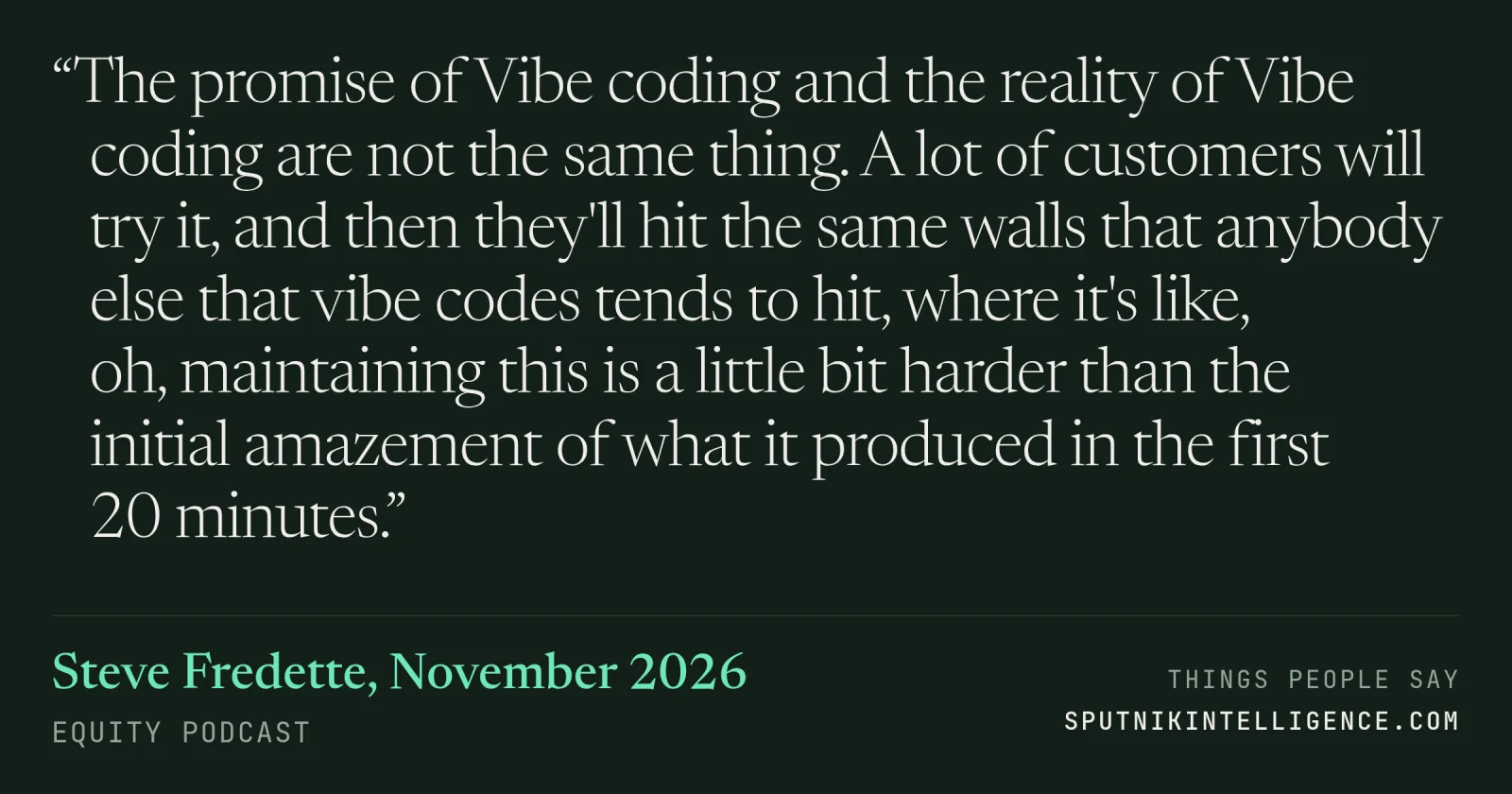
“The promise of Vibe coding and the reality of Vibe coding are not the same thing. A lot of customers will try it, and then they'll hit the same walls that anybody else that vibe codes tends to hit, where it's like, oh, maintaining this is a little bit harder than the initial amazement of what it produced in the first 20 minutes.”
Equity · Startups & Venture · November 2026
Context
Fredette says Toast's own teams use coding agents heavily, but few restaurant owners build their own software with them. This is his explanation of why owners who try tend to stall.
Transcript
…really matters. And look at the trust issues and other video AI companies that we won't name today getting in a lot of trouble in the public eye. So I think trust is so important. And so as we think about some of those areas where AI has a real privacy or trust question, we're being very cautious.
…their case, to like open way models that are going and being used by developers. Are you doing a lot of that within Toast? So you're obviously developing agentic AI applications that can be used by the customer, but are you using it internally to run your business? And like experimenting with that.
It's not quite the same as maybe a company sells to enterprise companies that can dog food their own product or a consumer AI company where you can use your own product. We definitely do that with Toast Local for our consumer app. But I think for agentic AI for restaurants, we're not a restaurant, so it's a little bit of product for us. What I would say is that you see the same patterns of developer agents. So we, you know, using a ton of different developer agents in RD, the product team's using it, the design team's using it, the engineering team is, of course, heavily using coding agents. And so the concept of a coding harness or an agentic harness, it's like, if you look at what ToastIQ is, and if you look at what a coding harness is, they're just AI harnesses. They're the same thing. And so you learn so much about how a great coding is a killer use case, and the coding harnesses have gotten quite sophisticated. Not a perfect analogy for our customers, what they need, because, in fact, we do have, I'm sure we have quite a few customers using tools like Cloud Code. But it's not, it's a very small percentage…
last question, put your prediction hat on. Not so much for Toast, but just what you're seeing within the tech sector, which is pretty broad. This seemed to be the year of the AI agent, really kind of kicking off, let's say, November of last year and really picking up speed. Do you see that…
Well, I definitely see people focusing more on cost now than they were before, right? So I think there was an era where it was like, just figure it out, go as fast as possible, use any AI you want, to an era of like, well, the CFO maybe is kind of asking all SAL to figure out why our AI spad is so…
Yeah.
More from Equity