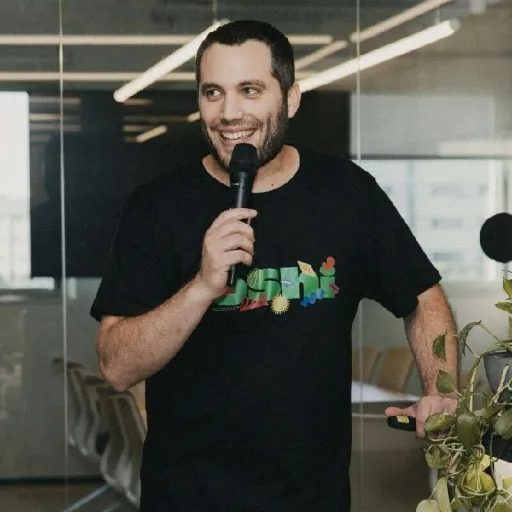
 Ofek Ron
On Protein Production Technology Podcast
“We started a company thinking we will be a 3D printing company. We were developing this machine for three months when we had not a lot of money. A minute before we pressed the button to make it happen, one engineer came with another idea. He said this thing's not going to work, and he had the idea of building the fish layer by layer. Instead of producing a nozzle machine, we produced a forming machine.”
Protein Production Technology Podcast · Alternative Proteins · November 2026
Context
Asked about the origin of Oshi's technology, he recounts the last-minute pivot from a nozzle printer to the layering approach the company now uses to make fillets.
Transcript
…And they have more practical experience, they can deliver even better than the top talent PhDs that you have in your country. And this is something that I'm really taking with me now. You know, when you hire someone, education is nice, but practical experience and discipline is worth so much more.
…company, and that was building the equipment to make it. Again, you said something in our prep call that rather sums up the problem: no machine on earth knows how to produce whole cut fish fillets. So when did you realize you were going to have to become a machine builder as well as a food company?
So I think from the beginning, it was the pitch that we're going to build a machine that will create a fish. The only thing that had to change is the machine itself. Okay, so we started a company thinking we will be a 3D printing company and we had a very A cool prototype that shows how we have a multi-nozzle machine that is coming up and the fish is perfect. And we had a very different approach. We were developing this machine for three months when we had not a lot of money after our first race. And the machine would cost hundreds of thousands of dollars post-developing it. And a minute before we pressed on a button to make this thing happen, one engineer in the company came with another idea. He said this thing's not going to work. And he had another idea of building the fish layer by layer by layer by layer. And actually, instead of producing a nozzle machine, we produced a forming machine. So the way we do product today is our machine takes layers of fish, which we make by mixing ingredients, like you make a pizza dough. And this machine knows how to develop layer on layer something that will have a structure and texture of a fish fillet. And from the beginning, we knew we're going…
You've admitted there are engineering decisions you'd make very differently today without giving away anything proprietary. What did you learn about building machinery that you simply couldn't have known when you started?
It's a good question because that's the part we struggle the most. Okay, why I'm saying struggle the most? Because the machine we invented a few years ago, we tried to scale it, to scale it. We still didn't manage to scale it. And what happened is now we just produced a big set of machines so we…
You've also talked about bringing the production cost of a fillet down from roughly $40, I think it was, to around $6. So what changed to make that possible? And how much further does the cost still need to come down, do you think?
More from Protein Production Technology Podcast