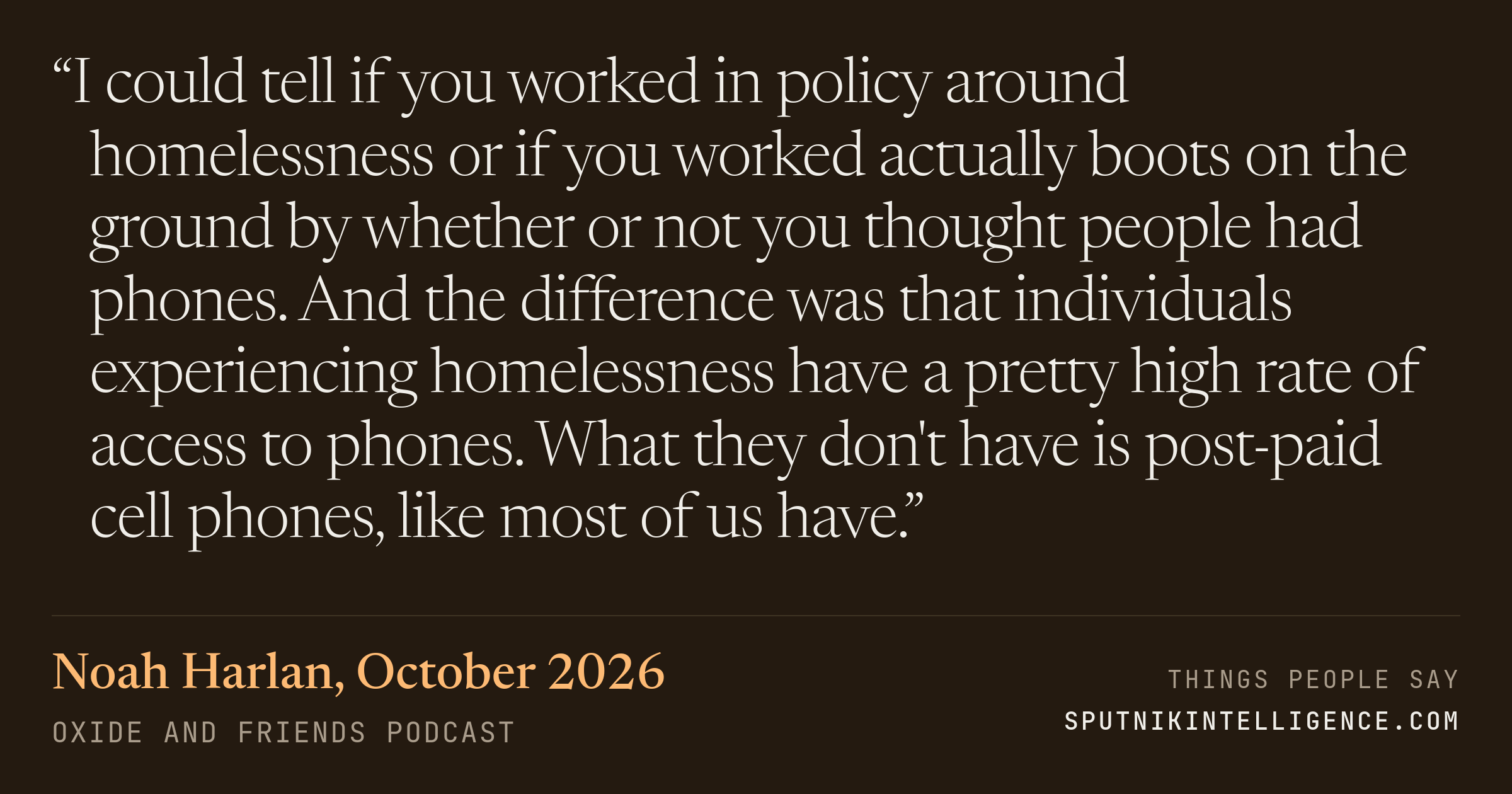
“I could tell if you worked in policy around homelessness or if you worked actually boots on the ground by whether or not you thought people had phones. And the difference was that individuals experiencing homelessness have a pretty high rate of access to phones. What they don't have is post-paid cell phones, like most of us have.”
Oxide and Friends · Hands-On Engineering Podcasts · October 2026
Harlan recalls a hospital-system official who told him homeless people don't have phones. Administrators were going by shelter intake reports that recorded phone numbers, while people were actually using prepaid SIM cards or free public Wi-Fi.
Transcript
…some, you know, let's not try and be Accenture or Tyler Technologies or whatever and try and like get the billion-dollar contract. Let's actually work on the ground and try and solve some of these problems from the bottom up with a really specific focus on the user experience of the individual.
…i think that i mean this is something that that i think it's interesting to me that that this is like the kind of disconnects that exist when you're tackling this problem because you would think that like you want to describe that a little bit because that was yeah the disconnect was surprising to
me So the number of times that like I've encountered someone where I've just wanted to like scream in the last five or so years working on this is hard to count. But one of them was we were having a meeting with it was a woman who worked, I think, for New York Health and Hospitals Corporation, which is the city-run hospitals in New York. And she was responsible for a bunch of their housing stuff. And she said, you know, we were talking to her about Keep and how it could be used. And there was a bunch of interest in the org in potentially using it for some case management stuff. And she was like, yeah, but the problem is that like homeless people don't have phones. It's like, right. No, that's not true. It's not true at all. Like actually an astonishing number of them do. And we sort of dug into it to try and figure out why she thought that. And eventually what we realized is that like, if you speak to like this, this became like one of those great like shibboleths where like, you know, you know, the scene in Inglorious Bastards with the three fingers where it's like, oh, I see you. Where like I could tell if you…
And this is like also one of those aspects of wicked problems. Like there's not going to be a solution to this stuff. I mean, you got to be content with, all right. So this, we're going to have to pick and choose a little bit. We're going to have to have a solution. They're going to be, there are…
Yeah. And the inclusivity arguments are infuriating. They're like, hey, yeah, it sounds like a good solution, but actually like 15% of people, this won't work for. So we're not going to do it. And you're like, but you could be helping 85% of the people. And that would make. big difference and then…
you also in terms of like picking and choosing a little bit too because you also i'm sure you've got folks that are beginning to to teeter where their their problems are beginning to compound and they're going to become not only are they going to have much more hardship but they're going to be much…
More from Oxide and Friends