Ideas & Essays · August 2026
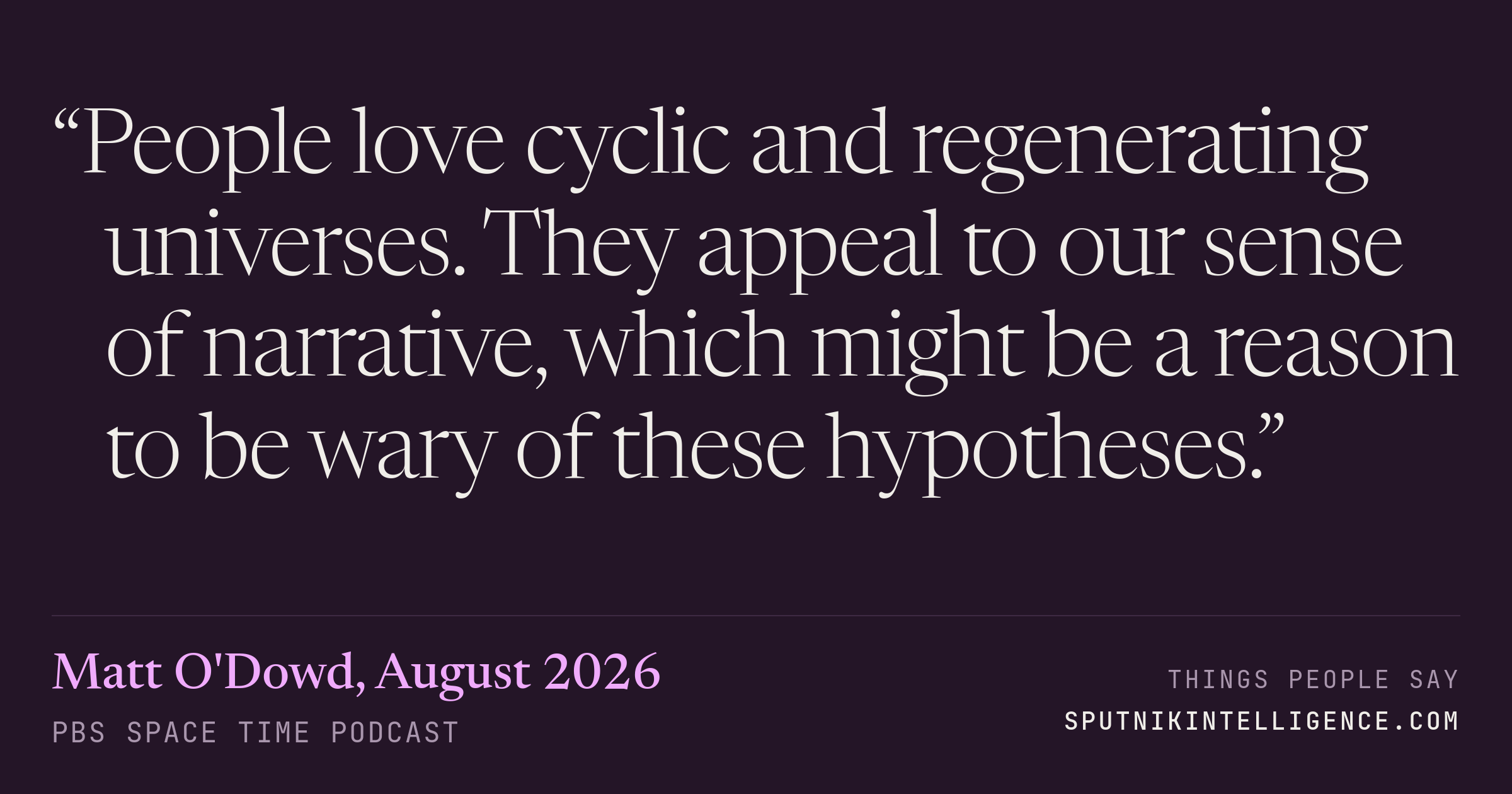
O'Dowd had just run through the alternatives to a singularity at the start of time: cosmic inflation, the Big Bounce, colliding branes in the Steinhardt-Turok model, Penrose's conformal cyclic cosmology, Smolin's universes born inside black holes. Having laid out how satisfying the cyclic options are, he turns that satisfaction into a reason for suspicion.
When you need to build up your team to handle the growing chaos at work, use Indeed Sponsored Jobs. It gives your job post the boost it needs to be seen and helps reach people with the right skills, certifications, and more. Spend less time searching and more time actually interviewing candidates who check all your boxes. Listeners of this show will get a $75 sponsored job credit at Indeed.com/slash podcast. That's indeed.com/slash podcast. Terms and conditions apply. Need a hiring hero? This is a job for Indeed Sponsored Jobs.
This episode is brought to you by Google Chrome. You think you know a browser, but Gemini and Chrome, that's new. It can help you with practically anything on the web, like restoring a vintage motorcycle from a 50-page restoration block, or finally break down that long article you've had open for weeks. Gemini and Chrome is here for it. Ready to make anything online make sense? There's no place like Chrome. Check responses set up required compatibility and availability various 18 plus.
We've talked about that conflict and its possible resolutions before, but the upshot is that we just don't know how the universe behaves in those conditions. But we do know that pure general relativity is not a good description, and so we probably shouldn't believe its prediction that all space was compacted into a single point and that this is where time started. Okay, so what are the alternatives? Can we really track geodesics and the timelines they embody through the Big Bang and out the other side? If so, what do we find there? There are several possibilities, and they deserve their own episodes, and we'll actually get to those soon. But to whet your appetite, first up, cosmic inflation can offer a temporary reprieve from the singularity. Eternal inflation suggests that our universe appeared as a regularly expanding bubble in an unimaginably larger, continuously inflating space-time. In that case, before the Big Bang was a period of exponential expansion that could have lasted indefinitely. We'll get to the nitty-gritty of that with its inflotons and bubble universes real soon. There are also various cyclic universe options. The first cyclic universe idea was the Big Bounce, in which the gravitational attraction of all matter in the universe was enough to cause it to re-collapse and then presumably bounce outward again. We now know that there isn't anywhere near enough matter to do that. Unless we bring in string theory. The Steinhardt-Turok model suggests that our universe floats in a high-dimensional space, living on geometric objects called brains. Collisions between those brains initiate cycles of expansion and contraction. Then there's Roger Penrose's conformal cyclic cosmology. It's even weirder because it postulates the infinite future boundary of an eternally expanding universe looks like the Big Bang of a new universe mathematically. So our heat death is someone else's Big Bang. There are some less abstract ways to get a new Universe out of an old one. For example, an extreme quantum fluctuation could initiate a new Big Bang given infinite time. Or the same amount of time could lead to all particles randomly converging back to the same spot. Or maybe black holes birth new universes as in Lee Smallins' fecund universe hypothesis. There's a poetry to that last one. The geodesics approaching the black hole singularity become the geodesics emerging from the new Big Bang singularity. People love cyclic and regenerating universes. They appeal to our sense of narrative, which might be a reason to be wary of these hypotheses. Now, they also appeal to our intuition for causality.
When you need to build up your team to handle the growing chaos at work, use Indeed Sponsored Jobs. It gives your job post the boost it needs to be seen and helps reach people with the right skills, certifications, and more. Spend less time searching and more time actually interviewing candidates who check all your boxes. Listeners of this show will get a $75 sponsored job credit at Indeed.com/slash podcast. That's indeed.com/slash podcast. Terms and conditions apply. Need a hiring hero? This is a job for Indeed Sponsored Jobs.
This episode is brought to you by Google Chrome. You think you know a browser, but Gemini and Chrome, that's new. It can help you with practically anything on the web, like restoring a vintage motorcycle from a 50-page restoration block, or finally break down that long article you've had open for weeks. Gemini and Chrome is here for it. Ready to make anything online make sense? There's no place like Chrome. Check responses set up required compatibility and availability various 18 plus.
Things happen because prior events cause them. Many of our ideas just push back the uncomfortable something from nothing moments. Physicists have a thing or two to say about that, from quantum fluctuations from nothing to Stephen Hawking's timeless interpretation of internal inflation that draws on the holographic principle. All things we'll discuss in the future as we travel beyond the beginning of space-time.