← Things People Say on Podcasts

“…I feel like there's been a lot of like, hey, look what I've done type of conversations happening within teams, not a lot of look what we did.” robby russell · Maintainable

Hands-On Engineering Podcasts · September 2026
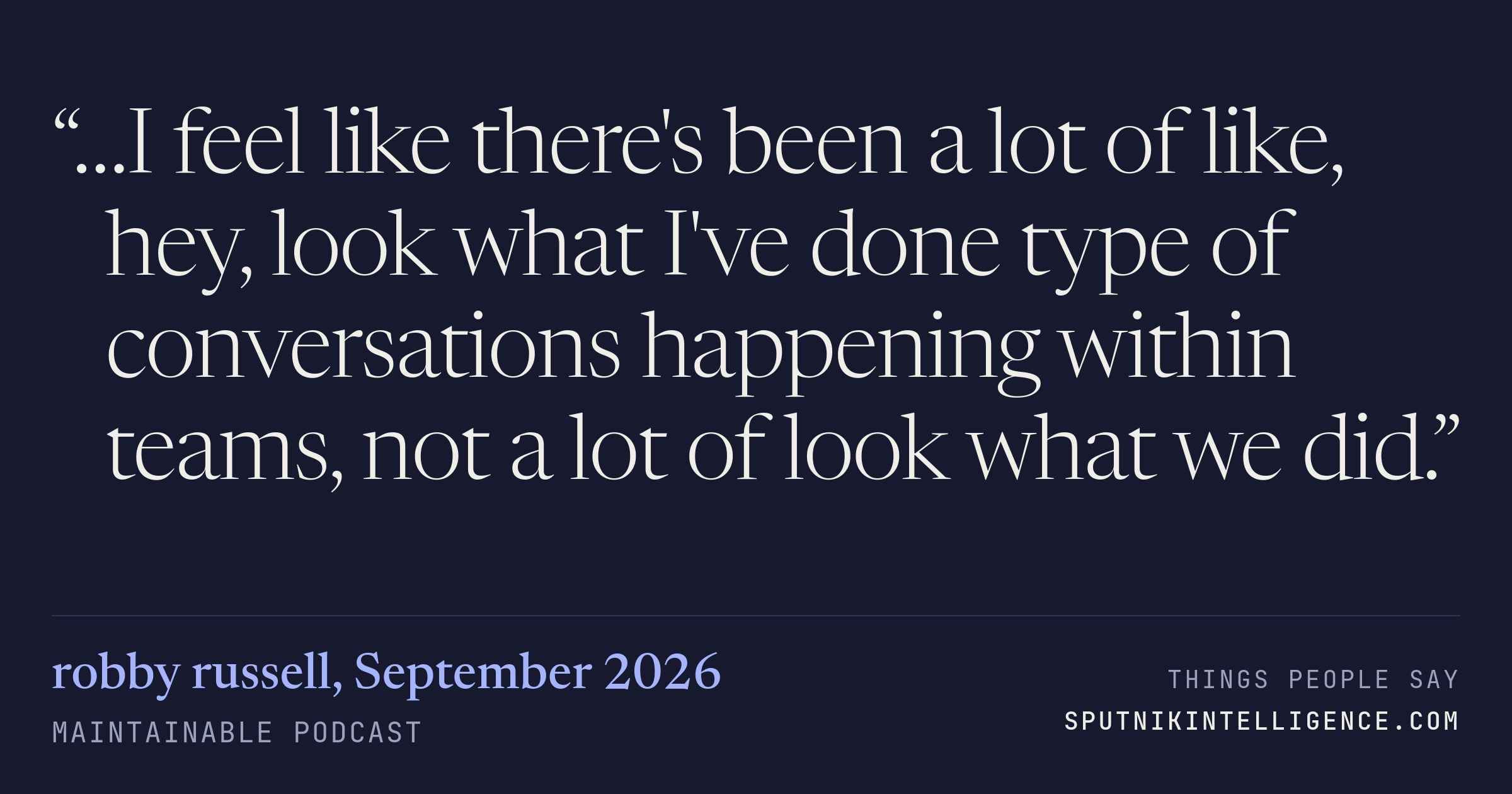
“…I feel like there's been a lot of like, hey, look what I've done type of conversations happening within teams, not a lot of look what we did.” — robby russell, Maintainable

Russell is thinking aloud about what AI tooling has done to team dynamics, after his guest described a widening comprehension gap on engineering teams. He goes on to say his own team's Slack help channels have gotten noticeably quieter, and wonders what that does to the maintainability of the software. His worry is that a team sport is quietly becoming a solo one.

Transcript

Maintainable Around 33:10 into the episode
robby russell

don't know, I'm not sure.

kristin isaac

Yeah, so I think, yeah, I think there's an I think there's an understanding gap and it's growing personally. And I hear that a lot from engineers. Not only do I hear that, but I hear the bugs that AI writes are actually quite clever, often hard to find and then hard to debug in production. So, debugging can take several deployments to kind of figure out what's going on. So, it's a lot faster, which is great. I don't think it's going away, but I do think that there's this understanding gap that is there and it's increasing and it will continue to increase. I can tell you my CPO, Brian Kaufman, he's an engineering leader. His opinion is that modern coding with AI tools is much, much, much harder now than back 20 years ago when he was in C, because it's the context burden of all the thousands of libraries and microservices and AI generated code and everything layered on top of one another. And you could say it maybe is a maintainability crisis ready to happen. I don't know. What do you think? This is your area of expertise.

robby russell

I mean, this is why I bring people on because I'm like, I don't know what's going on. I'm not smart enough to know how to read the tea leaves necessarily. I think, you know, when I think about it, I think it's been a great uplift in helping take care of a lot of day-to-day tasks in a certain way, or maybe, but also, yeah, I think the comprehension or feeling like you can jump in and out of a code base is more interesting and that you can do that quicker. But then I'm like, how much do you need to retain anymore? And then that part I'm trying to wrap my head around. I also think it's been an interesting thing where something I've talked about a lot with AI tooling is I feel like there's been a lot of like, hey, look what I've done type of conversations happening within teams, not a lot of look what we did. And I think more about the team dynamics shifting. And I don't know how that, like the things we used to collaborate with each other on, like, hey, can you help me with this? Or can I help you with that type of problem? We're siloing ourselves in a way. And I'm like, how does that then impact the broader maintainability of the software and our career progressions maybe in parallel and our professional development? I don't know what that all looks like, but those are things I think about in a broader sense, I suppose. But just like, oh, I got my little rubber ducky here. And my, that's like literally just something I can, something I can chat with now. And some people are like literally having voice conversations with their AI tool to help them with the code thing, which is great. And you're not having to bother another person, I suppose. But at the same time, it was a team sport and now it feels a little bit different.

kristin isaac

Where's the team? Yeah, the challenge is real. I actually heard a university professor speaking about AI tools the other day and he was sharing a similar pattern in the classroom that's happening at universities where university classrooms, of course, used to have lots of questions and the questions have kind of gone away because now people have cloud and chat GPT and perplexity and all that. And they're asking the LLMs instead of asking in the classroom. And that could be deeply problematic because, you know, learning is social. As humans, it's a very social work for us. And so when you take out the social elements, because people are collaborating with their AI tools instead of with each other, that could have a real impact. I agree with you. Yeah, he also said that actually there are some other almost degenerative effects of AI on students they're seeing because they're able to use AI instead of thinking through things on their own. And so if they really want students to learn things in a new way, sometimes they have to say, put away all, put away your computer, put away your phone. We're going to go back to Blue Books. We're going to give you pencil and paper exams now for the same reason. Because sometimes you need to really think through those challenging problems and use your brain and not get all the shortcuts on AI. You

robby russell

know, I think speaking back to the engineering team dynamic and wondering, you know, just as something, and if anyone listening out there can share this, like I feel like I've noticed that my own engineering team's Slack channels where they would usually ask each other for help has gotten a lot quieter. And I don't think we've really talked about that a lot. And maybe that's like, hey, I hate this weird thing. Has anyone seen this before? Does anyone know where I can find this? Like, and maybe that's not a bad thing. They can take care of those things themselves because that was usually like after they, because we always told them, like, ask questions after you went through this process of, did you look at the documentation? Did you do this? Did you check this? Did you check this? What can you learn? You know, now they can answer that stuff. Bit quicker and they don't have to do that. But I feel like then it feels like a little bit of that social glue dynamic is the connective tissue is not happening quite as much in teams. And I don't know. But

kristin isaac

do you feel like, do you feel like it's impacting sort of younger engineers more, sort of fresh, fresh grads and more junior folks?

Speaker names from our own diarization · position estimated from where the line sits in the episode