“If they're spending tens of billions of dollars on chips and compute and data centers, which a lot of people don't seem to like these days, shouldn't they actually have to pay for the content? Why is that the one piece of this trillion dollar market that they're building that doesn't have to get paid for?”
The 404 Media Podcast · October 2026
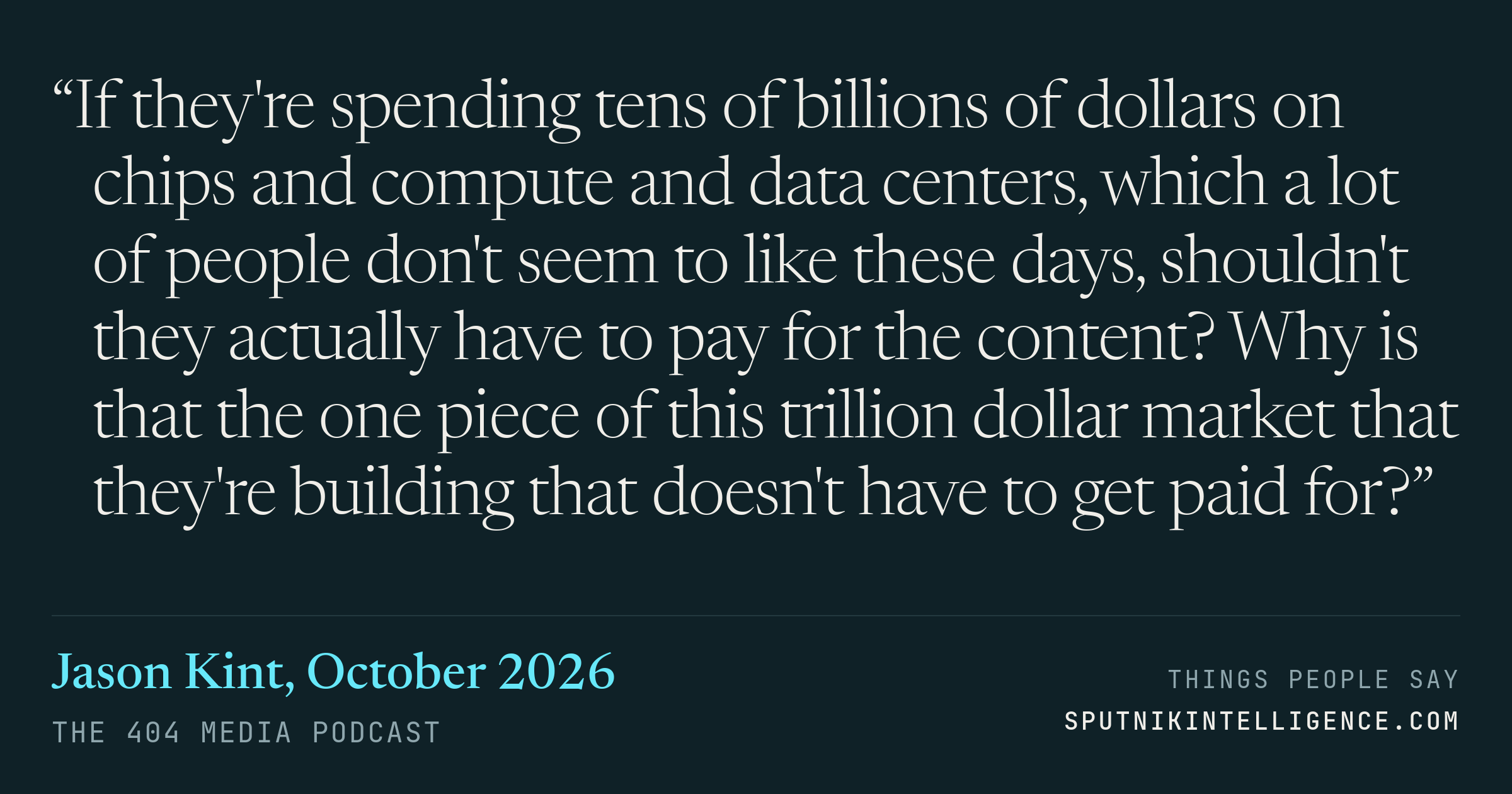
Kint, who speaks for a group of publishers, was asked what they can do about AI companies beyond suing. He said most of his time goes to finding ways to use the technology, and that the dispute comes down to this one question.
Transcript
Yeah. And then, I mean, they settled for $5 billion with the FTC. They, the same exact day, very, very quietly settled with the security SEC, which, you know, was, I think, probably necessary to get the FTC off of Zuckerberg personally based on the evidence we saw. Everything regarding the board communications around that just got exposed, I don't know, last year in Delaware in a case that they settled for hundreds of millions of dollars. And they settled with users in a class suit just a couple of years ago in Northern California for 800 million, the largest privacy zone ever. And so settle, settle, settle, settle. They settled as part of this child harm case, right, with Cambridge Analytica just a few weeks ago. So, you know, that's, I think, been a part of the issue: the evidence never really got exposed. And it was about, you know, the election piece was maybe oversold, maybe, we don't know. And then on top of that, it became about one guy or one app rather than the entire ecosystem, which was really about exposing all of our data in return for usage and monetization and growth of the platform, especially on mobile, as aggressively as possible without really any choice.
I've been talking to you about these court cases because I like to nerd out on court cases and because you have a very good ability to break down these really complicated cases, find these really interesting documents in discovery and that sort of thing, and then share them. I guess outside of litigation, what can publishers do to kind of push back against this? What can consumers do to kind of fight for both their privacy, but also for something that is not the wholesale destruction of the web and sort of the consolidation of powers in this AI-ified internet?
I mean, from a publisher perspective, we have been saying the same thing for a while. And I think it still holds true even with AI: the direct relationship with the user is really important, especially if the user is choosing to pay for your service in some way. Like, hey, they know your brand. They're choosing to use it and pay for it. And so growing that direct relationship. As much as we're talking about litigation, and certainly there's interesting legislation that's possible, we'll see. But most of our time and my time is really spent thinking about cool new ways to leverage this technology, too. And so, you know, a lot of our members, including, by the way, the New York Times, are doing some of the most innovative things you can imagine because this technology is going to be a part of our future, especially AI. And so it's really just more a matter of, you know, if they're spending tens of billions of dollars on chips and compute and data centers, which a lot of people don't seem to like these days, shouldn't they actually have to pay for the content? Why is that the one piece of this trillion dollar Market that they're building that doesn't have to get paid for. And so that's really about, you know, does a publisher get paid for their content? They should be. But then there's lots of cool opportunities. And I think everybody should be experimenting there too in terms of how to use it with the right guardrails on. So diversification across revenue streams, direct relationship with users, trust with the user, allowing the user to opt out of, you know, third-party data collection, I think is as useful. It's anything that tells the user you care about them.
Anything else that we should have talked about? I feel like we can talk about each of these court cases for a very long time, but this is sort of like an overview of some of the more important ones rather than a deep dive. But anything else that we should have talked about?
The only other thing I'd say just to you is the, you know, the other thing to be doing is knowing your audience and creating great content for them, right? Or news, reporting, analysis, interesting things that they want to read. So, which brands like yours are really, really good at. So knowing your audience and giving them what they want. So hopefully this discussion fed into that a little bit too. So I appreciate your interest in the court cases.
It did. Yeah. Thank you so much for your time. I'm going to continue to follow these cases, but honestly, probably follow them through you. So if you're not familiar with Jason's work, definitely go check it out. Digital Content Next, but also on X and Blue Sky. Jason is always tweeting the most interesting links and screenshots to court records. And I don't know, I've gotten very into reading these court records because if you want to understand how, I guess, how aware these big tech companies are of the destruction that they're doing to the web, this is a good place to start because they are not supposed to lie to the court. And it doesn't seem to me like they're lying to the court because they're being very honest about how destructive it is.
More from The 404 Media Podcast