 Kashmir Hill
On The 404 Media Podcast
Kashmir Hill
On The 404 Media Podcast
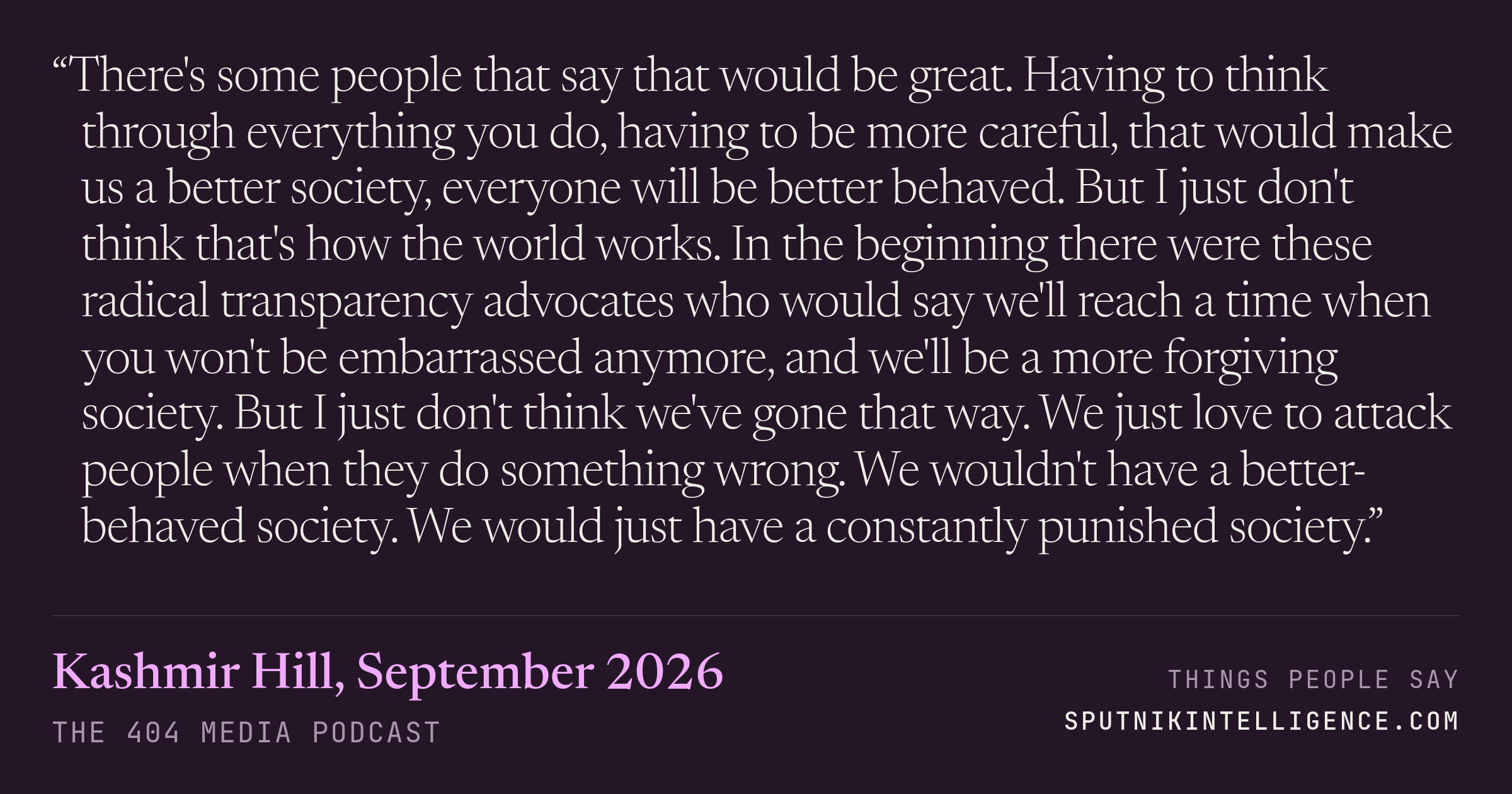
“There's some people that say that would be great. Having to think through everything you do, having to be more careful, that would make us a better society, everyone will be better behaved. But I just don't think that's how the world works. In the beginning there were these radical transparency advocates who would say we'll reach a time when you won't be embarrassed anymore, and we'll be a more forgiving society. But I just don't think we've gone that way. We just love to attack people when they do something wrong. We wouldn't have a better-behaved society. We would just have a constantly punished society.”
The 404 Media Podcast · September 2026
Hill, who has covered privacy for two decades and broke the Clearview AI story, was discussing what changes if face recognition becomes a feature in consumer smart glasses rather than something you seek out on an obscure website. She had just described stopping a sensitive conversation on a train in case a stranger with PimEyes could connect it to her. Her bet is that people would come to want device-free spaces, which is already happening with Meta's glasses being banned in courthouses.
Transcript
Yeah, I mean, well, I think most people don't have the inclination to use it. I think what could shift is if this does become mainstreamed, you know, if Meta does decide, as it's been talking about, to put this feature into its glasses and just start selling that to people, then it leaps from you have to go to this weird website to do this to, oh, this is just a feature that I have access to through one of the biggest technology companies in the world. Then I think people just start using it. You get on a train and you just kind of casually look around. Who else am I on the train with? You're at a restaurant. You just start looking around just because like you can. It's so easy to do. It's very seamless. Meta says they don't want to do it this way, that it wouldn't be a like identify a stranger. It would be identify people in your social network. But I just think that like once the guardrails start falling, that that would happen. And I think that what shifts is that if we do start living in that world, you just have to be so much more scared all the time that you're going to make a mistake. And I just think it would be similar to the way that like when we go online and you're on a social network and you kind of say something and you have to be very careful. Like you're like, is this going to come back to haunt me? You'd have to live your life like that. Like I thought about, I was on the train the other day having a sensitive conversation and I stopped right away. I was like, oh, I can't have this conversation here. You know, somebody might realize who I am. Maybe there's some person on this train that uses PimEyes and is going to make the connection between what I'm talking about and the fact that I'm working on a story about this. I just think we'll have to go through life with that feeling of you're under surveillance all the time by the people around you. They could connect this to you in a way that could haunt you.
Yeah. And like, that's a serious example where you're talking about a sense of story and you realize, oh, I shouldn't do this because someone will overhear it. And then I think of the classic tweet, which was something like, oh, I love waffles. And someone replies, oh, so you hate pancakes then? It's like, no, I'm talking about waffles. You have to live like that in the real world where anything you do might get taken out of context. You might get unmasked immediately by a pair of smart glasses. And you have to constantly moderate your behavior. Not that I'm advocating for go out and be a social nuisance. Like you won't be able to be normal in public anymore. And like, that's terrifying to me. It could really, really change people's behavior.
And I've always heard this. There's some people that say that would be great. Having to think through everything you do, having to be more careful, that make us a better society. Everyone will be better behaved. But I just don't think that's how the world works. And I've been hearing that and covering privacy for two decades now. In the beginning, there were definitely these kind of radical transparency advocates who would say, oh, you know, we'll reach a time when you won't be embarrassed anymore because we all live our lives online. Make mistakes, and we'll be a more forgiving society because everyone will have their mistakes. But I just don't think we've gone that way. We just love to attack people when they do something wrong. So, yeah, I don't think that we would have a better behaved society. We would just have a constantly punished society. I think people would hate it. I really think people would want to live in a world that didn't have devices anymore and have spaces where you couldn't bring these in, which we're already seeing with Meta's glasses.
The 404 Media podcast is brought to you by NordLayer Browser. NordLayer Browser is an enterprise browser that secures online work without getting in the way of productivity. It gives IT teams full visibility and control over every web-based AI tool, SaaS application, and download across the organization while making sure employees can still enjoy a seamless browsing experience. Designed for today's distributed workforce, NordLayer Browser helps companies protect access to their internal resources and prevent accidental data exposure. Go to nordlayer.com/slash browser/slash 404 podcast and use the coupon code 404podcast10 at checkout to get NordLayer Browser at 10% off today. That's nordlayer.com/slash browser/slash 404 podcast and use coupon code 404 podcast 10. So, for fun, if you could call it that, I googled myself last week and found my home address, my phone number, and a relative I'm fairly sure I've never met, all on directory sites that I never signed up for. That's the data broker economy. They scrape your info, package you up like a trading card, and sell you off to whoever's paying, which is exactly how identity thieves go shopping. Bad luck when your entire job is not getting doxxed. That's why we use Incogni. Instead of you spending hundreds of hours filling out opt-out forms across 40 browser tabs, Incogni gets to work by sending legal removal requests to over 420 harmful data broker sites. It's independently verified by Deloitte, resubmits requests every 30 to 60 days as brokers try to quietly get you back on the internet. And you can track every request right from the app. On the unlimited plan, the exposure scanner digs up the weird stuff across the wider web. We're thinking old forums, random blogs, or obscure directories. It surfaces all of your exposed profile links right in your dashboard where you simply select which links you want taken down. And Incogni's team of human privacy experts will handle the manual corporate takedowns for you. Take back control today. Go to incogni.com/slash 404media and use code 404media for 60% off an annual plan. That's incogni.com/slash 404media, promo code 404media. Risk-free with a 30-day money-back guarantee. They can't harm you if they can't find you. I've been trying to get out of the habit of buying clothes for one specific moment. I'd much rather buy something now that I know I'm still going to want to wear next fall and the fall after that. That's where Quince really makes sense. They focus on high-quality wardrobe staples made from premium materials like 100% Mongolian cashmere, organic cotton, and merino wool. The styles are timeless, simple, and easy to work into the clothes and wardrobe that you already own. Their 100% Mongolian cashmere sweaters started just $60, which is pretty crazy when you consider the softness and quality you'd normally associate with much more expensive brands. They've also got premium pants, fitted tees and polos, and breathable activewear, so you can build out the everyday part of your wardrobe without paying designer prices. That's the Quince model. Everything is priced 50 to 80% less than similar brands because they work directly with ethical factories and cut out the middleman. I've been using Quince for my house, but also for my wardrobe. I have a lot of Quince t-shirts at this point. I have Quince European linen shirt, but I also have shorts and these linen pants that I wear all the time. And the thing about Quince is that I know that they're really high quality. Like I have these shoes. I've been wearing them all summer. I'm going to wear them all fall and probably all spring as well because I know that they hold up really well. And that's exactly what I like about Quince. I'm buying really high quality things that I can use every day. They're staples. Set it and forget it, basically. Like I have a Quince rug, I have a Quince bedspread, Quince Duvet cover, Quince pillows, Quince towels, and I like all of the things that I've gotten from them. Find your next fall favorites at Quince. Download the Quince app for app-exclusive offers or go to quince.com/slash 404media. Get free shipping on your order and 365-day returns. Now available in Canada and the UK too. That's quince.com/slash 404media.
Actually, these perfectly to what I was going to ask now, which is that there is obviously a backlash to these glasses, and they haven't even launched the facial recognition stuff yet. Like it's not even out yet, and people are mad already. And of course, we had the Google Glass stuff, the whole glass hole thing years ago. I still think the good Google Glass as a device looked pretty cool.
Really? Wow. Oh my God.
More from The 404 Media Podcast