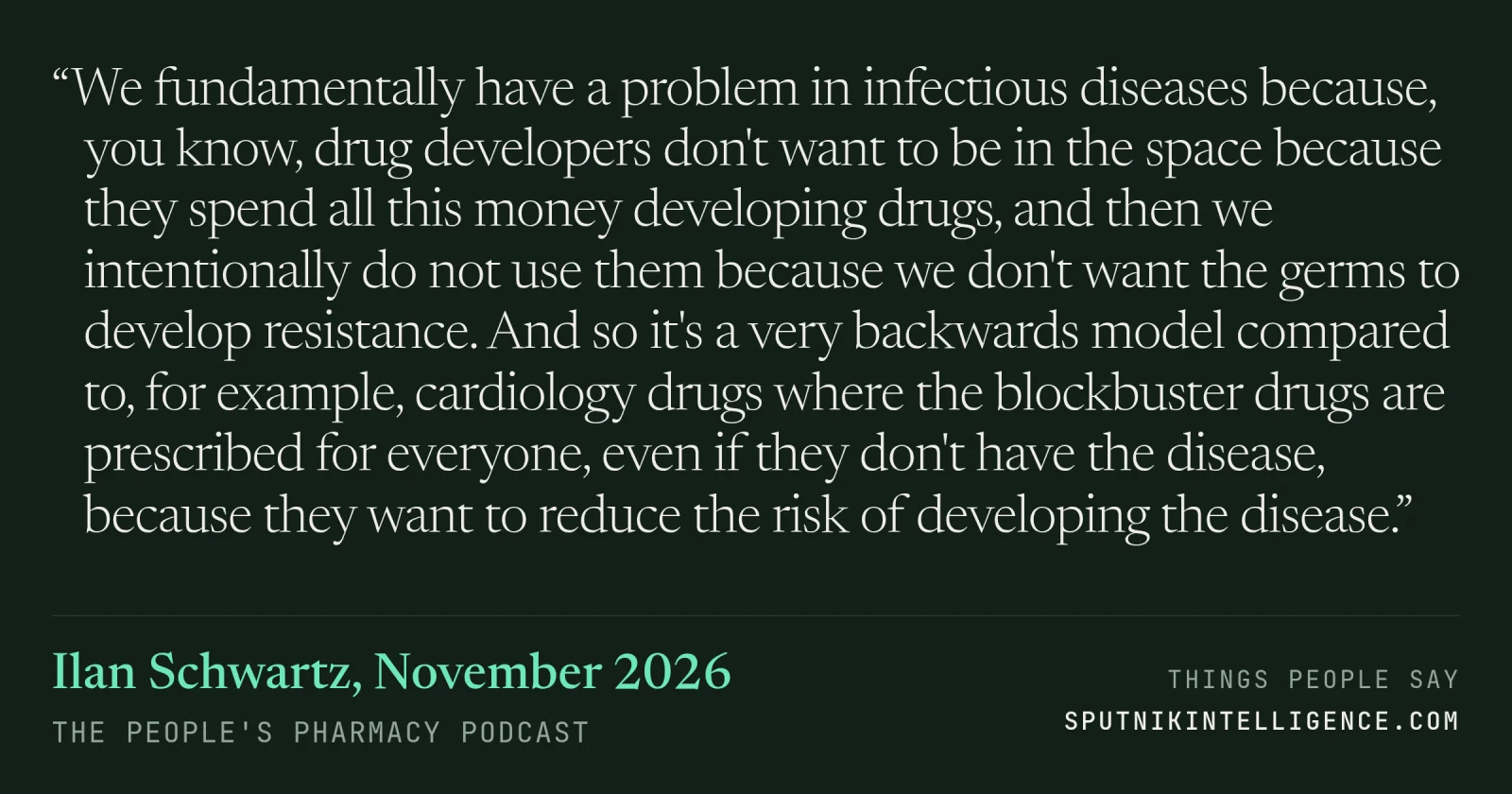
“We fundamentally have a problem in infectious diseases because, you know, drug developers don't want to be in the space because they spend all this money developing drugs, and then we intentionally do not use them because we don't want the germs to develop resistance. And so it's a very backwards model compared to, for example, cardiology drugs where the blockbuster drugs are prescribed for everyone, even if they don't have the disease, because they want to reduce the risk of developing the disease.”
The People's Pharmacy · Health & Longevity · November 2026
Context
The host had just said the drug industry hasn't spent billions on new antifungals. Schwartz, an infectious disease doctor, explains why the economics of antimicrobials work against new drugs.
Transcript
hanging out. It's not causing any problems. In other times, it can invade into the tissue, into the bloodstream, and cause serious problems.
…industry to spend tens of billions of dollars developing new medicines, which makes it much harder for you and your colleagues to treat somebody who has, whether it's candida aris or some other fungal infection that has really embedded itself, for example, in your lungs or even in your brain.
So we fundamentally have a problem in infectious diseases because, you know, drug developers don't want to be in the space because they spend all this money developing drugs, and then we intentionally do not use them because we don't want the germs to develop resistance. And so it's a very backwards model compared to, for example, cardiology drugs where the blockbuster drugs are prescribed for everyone, even if they don't have the disease, because they want to reduce the risk of developing the disease. It's very different in infectious diseases. And so there's fundamentally some issues with the funding model of how drugs get developed. But also, even within those constraints, as I mentioned, fungal infections are a lot less common. As you said, they're less sexy, probably because of that. We don't hear about them as frequently. And numerically, the number of patients who are affected are…
Let me just ask if I've got this right. What you're saying is that now eukaryote is kind of a big fancy word with a Greek background, I think. But what you're saying basically is that we are sufficiently similar to fungus, that if we can damage the fungus, it might also damage us.
Correct. There are far fewer targets on the fungus that are different than our own cells that we can go after and kill the fungus without causing toxicity.
Now, you mentioned immunity and the fact that some people have impaired immunity because maybe they're being treated for cancer, but a lot of the commercials I see on television these days, you know, the new immune-modulating drugs for rheumatoid arthritis and psoriatic arthritis and eczema. And…
More from The People's Pharmacy