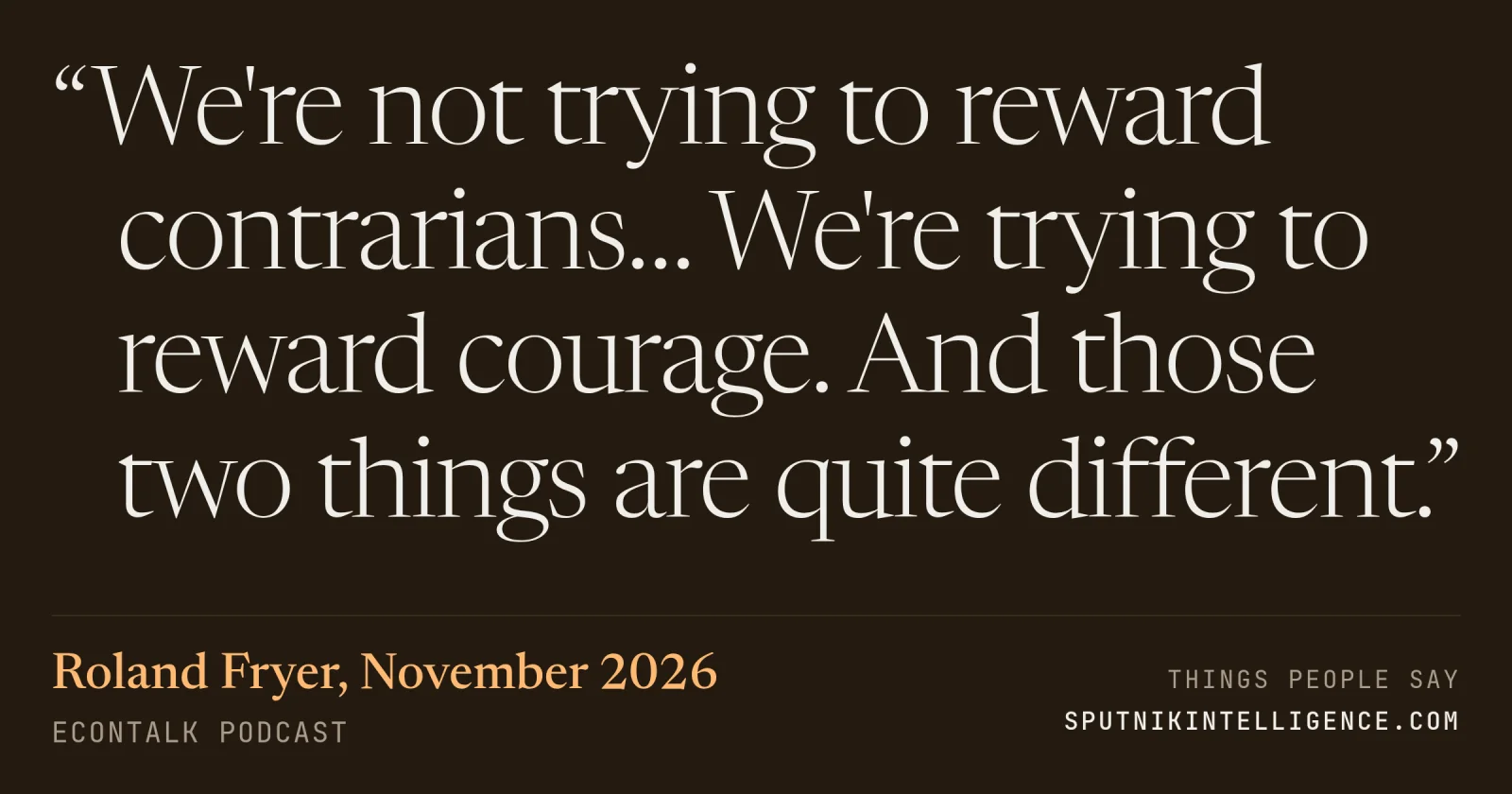
“We're not trying to reward contrarians… We're trying to reward courage. And those two things are quite different.”
EconTalk · In-Depth Interviews · November 2026
Context
Roland Fryer explains a new $1 million prize for social scientists who followed their data into controversial territory, and separates it from rewarding provocation for its own sake.
Transcript
Oh, it's so good to be back. Thank you. Thank you for having me, Russ.
Our overall topic today is the role of research at American universities and an effort that you were involved with spearheading with investor Bill Ackman to improve research called the Carib Trust Prize for Academic Courage. What is it? And tell us about it.
…anyone talk about the cost of saying something unpopular that their data set from STATA had generated from their laptop computer. And so I'm worried about two things, and I'll stop the ramble. One is we want to make sure we reward scholars and create a set of incentives to take on society's biggest and most controversial ideas. But we're not trying to reward contrarians. I hope we get into that. We're trying to reward courage. And those two things are quite different. And the second thing, and the thing that really is the reason for the prize, is it's actually less about the academics doing the work and more about the work. A few years ago, I walked into my undergraduate class earliest, as usual. I usually get in 30 minutes early because it's kind of an impromptu pop-up office hours. People just come up before class and ask questions and things like that. And…
Of course, I'm very sympathetic to this effort. But if I understand it correctly, it's not going to be a prize for a particular study that boldly went against the grain and claimed something uncomfortable but true. But it's just going to go to people to give them the freedom to pursue things they…
Not quite. It is going to go for that study that does that.
Okay.
More from EconTalk