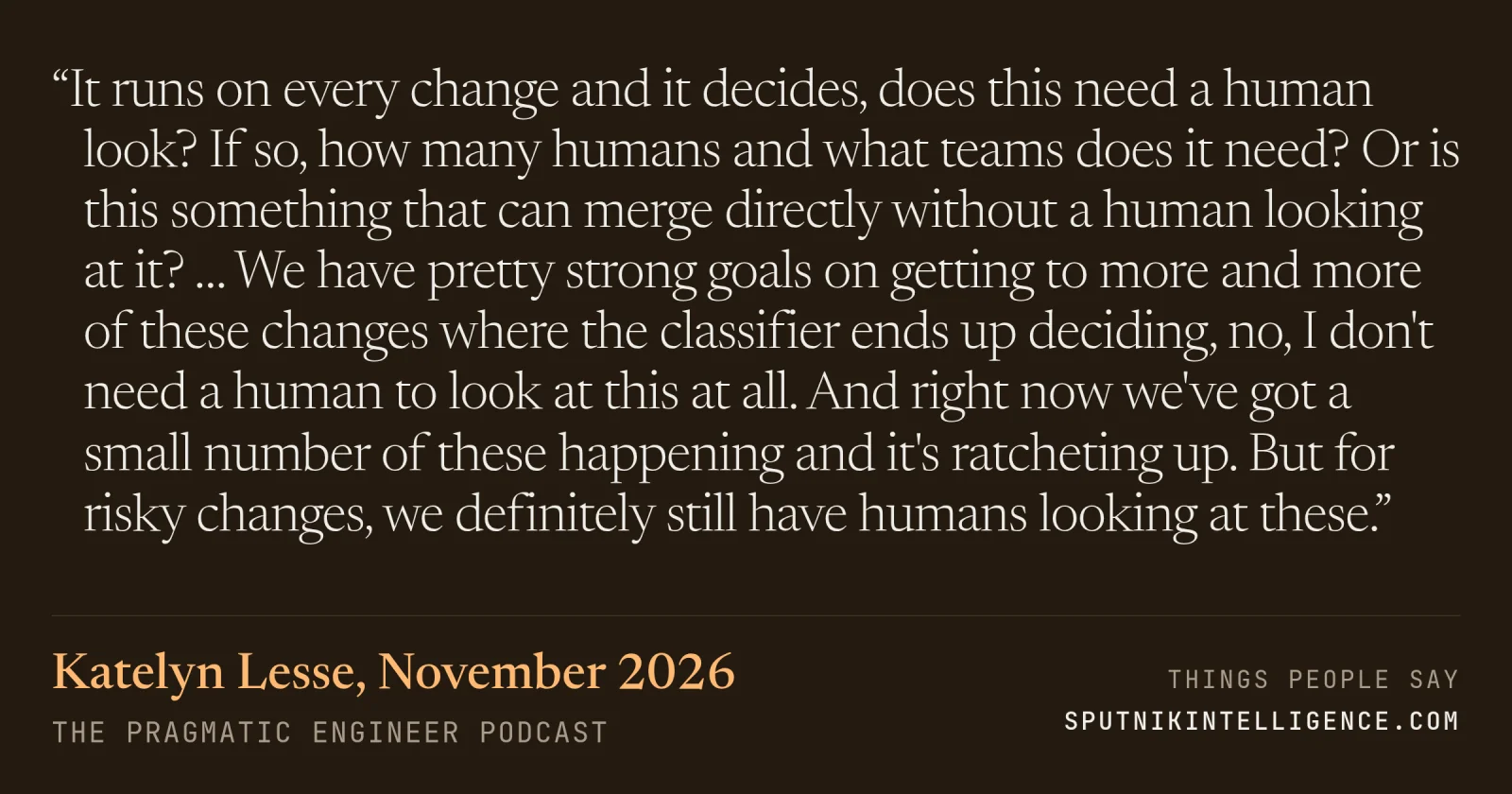
“It runs on every change and it decides, does this need a human look? If so, how many humans and what teams does it need? Or is this something that can merge directly without a human looking at it? … We have pretty strong goals on getting to more and more of these changes where the classifier ends up deciding, no, I don't need a human to look at this at all. And right now we've got a small number of these happening and it's ratcheting up. But for risky changes, we definitely still have humans looking at these.”
The Pragmatic Engineer · Hands-On Engineering Podcasts · November 2026
Context
Asked whether Anthropic still requires a human code review on every change, she describes a Claude-based classifier that runs on every pull request and decides whether a human needs to look. It lands the week Anthropic launched a product that lets Claude review and approve PRs.
Transcript
…more of this something that doesn't require you to have to get involved and be like, you know, it wouldn't be a great job if all you did was like sit there and watch a Slack thread and then like say yes or no or okay, fine, I'll go ping that person, right? Like that just wouldn't be interesting.
…to that, but they were mandatory. Do you have that? Or do you just say, I will give trust and accountability to the engineer who's building it and then they will decide, do I need to pull in someone? Or does this look good because of all the, you know, I verified it or I know it's not a big deal.
Yeah. So we have a system that it's, I mean, it's a claw, but it's a classifier, you know. But it runs on every change and it decides, does this need a human look? If so, how many humans and what teams does it need? Or is this something that can merge directly without a human looking at it? And this is where I kind of mentioned this idea of like a very mechanical change. We're trying to do this thing where you define like, what are the changes that end to end? You shouldn't have to spend time on this, right? Like we've done these things a million times. They all look the same. So can we classify this change as one of those like very mechanical, you know, such something like get a…
Once it gets deployed through the different change change gates, in production monitoring and incident management, how do you do that? Because again, pre-AI, you would have your dashboards that you would define. You would manually put together alerts on how you do it. And of course, at more…
Yeah, so a lot of it is really similar. A lot of it is, you know, we have all of our monitors and our detectors and our alerts that fire. And just like any other engineering team, often we get noise, right? Like you get alerted about something that's not really an issue.
That's just how it is.
More from The Pragmatic Engineer