August 2026
Nagarajan was describing what he saw at the ASAE annual conference, where association leaders had moved past experimenting and were actually shipping AI work. He has, in his own words, been beating the drum about AI for years, which makes the disavowal at the end of the answer the surprising part. The measure he offers instead is whether members' lives are better, not whether the technology is impressive.
And we are your hosts. And as usual, there's nothing happening in the world of AI. So I think we're done for the episode, right, Mallory?
Yep, 30-second episode, everybody. Thanks for tuning in. Just kidding. We've got a lot to cover today. Amit, I know you are fresh off some travel to ASAE annual. How was that?
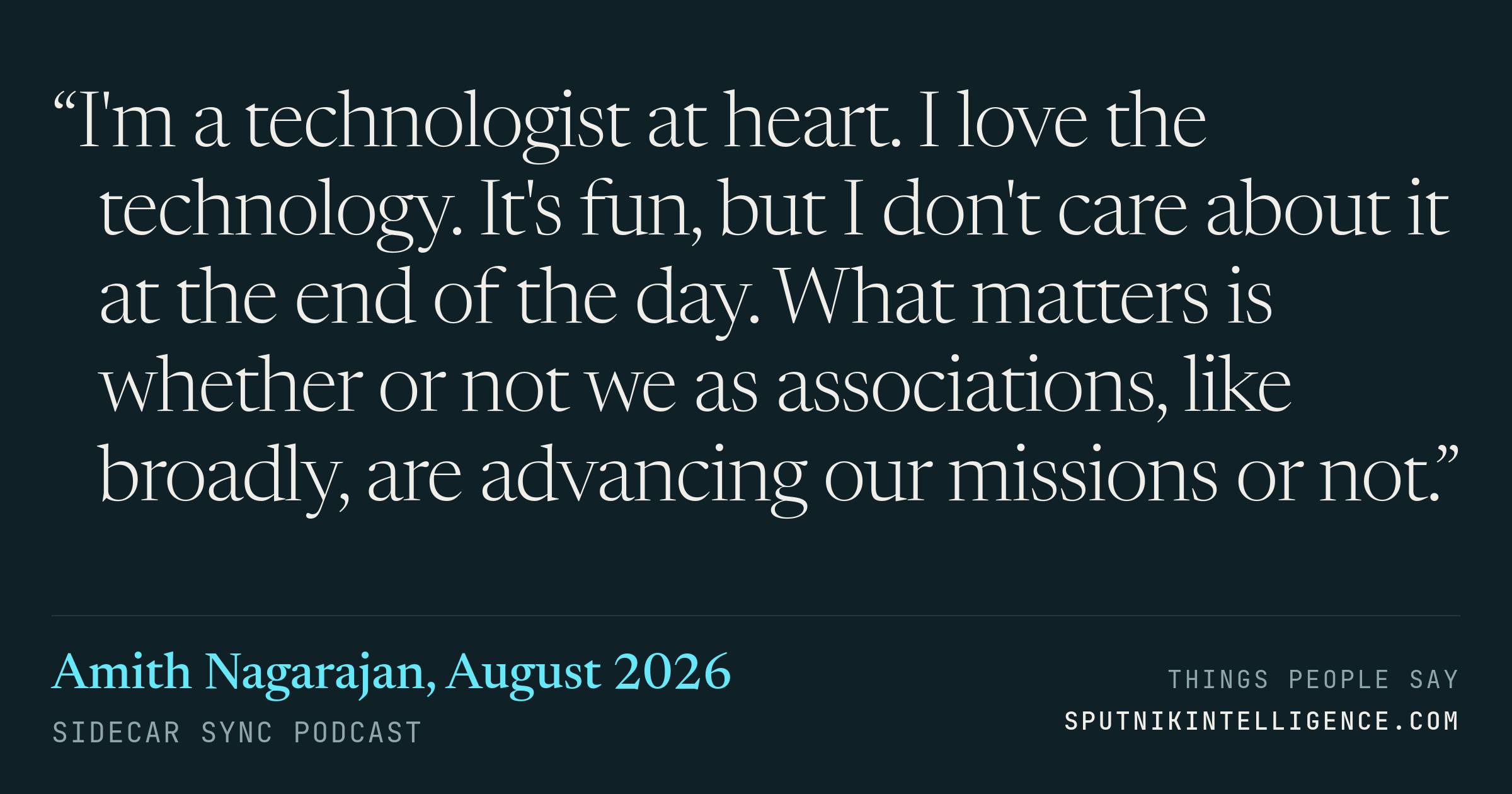
I loved it. It was so great. ASAE did a wonderful job putting together, they always do this. They're great at putting on events, but annual conference was a fantastic event. There were so many people there that were excited about just what's going on in general. And, you know, from an AI perspective specifically, every event that I go to, there's a progression in terms of kind of the frequency with which I talk to association leaders from large and small associations, from the most senior level positions down to folks that are earlier in their careers. And this progression I'm referring to is essentially really doing things, you know, hands-on doing things with AI. It's more than just experiments. It's gone way past that. And I find that exciting. I mean, we've been out here beating the drum about AI for quite a long time now. It was quite lonely for a while, and now it's not. And it's pretty cool to have a raging party going where everyone's, you know, coming to get excited about AI. But the most important thing is I'm hearing people talk about how it's helping them serve their members. It's not just about internal efficiency, but people are saying, hey, like I'm able to actually do AB and C to make my members' lives better because of AI. So technology is awesome. I'm a technologist at heart. I love the technology. It's fun, but I don't care about it at the end of the day. What matters is whether or not we as associations, like broadly, are advancing our missions or not. And that's what I'm starting to see.
Did you hear about any use cases from association leaders that surprised you? Because I feel like as much as we talk about and you think about this, it would be pretty difficult for you to hear about a use case that you hadn't already thought about. But I'm curious, have you heard anything recently where you said, oh, that's a good idea?
Mario, have you ever seen the video where there's, you know, there's basically a bunch of distractions going on in this video? I'm trying to remember exactly what it is, but it's essentially you're watching like a landscape and you're watching all sorts of people moving around. And they're saying like, oh, count the number of people that enter and leave the movie's frame or the video's frame. And people are like busy counting the number of people coming in, coming out. And there's like, oh, is it, was it 17 people? Was it 19 people? And see, you play this in a room full of people and the video goes by and people are arguing about 17 versus 19 or 21. And then someone asks after about a minute or two of discussion, hey, did anybody see the eight foot tall gorilla walk through the room and wave at everybody? And the answer is like, what? We didn't see that. It's in the video. And then they play the video again. Instead of focusing on counting all the different individuals coming and going from the video frame, there's this giant gorilla in the background about halfway through that's like waving its arms like this and being silly. And presumably it was a person in a gorilla suit. I never actually checked it out. So, but it's a gorilla-esque creature. And but people didn't notice it is the point. So I guess the reason I bring that up, aside from the fact that it's just kind of fun, is when you are distracted day to day with a lot of tasks that are keeping you underwater, you miss big things. And so what is happening a lot of times in associations is you talk to people, let's say, who are in member services roles, and they are inundated with one email after the next email, after the next email. And these are smart people who care about your mission, who know your members. They know a lot about the domain. And all they do all day long is count people coming in and out of that video frame and they don't have time to think at all. And so they miss the gorilla. They miss the big opportunity. And what's exciting is that if you can save some time, increase efficiency, and then give your people a little bit more breathing room to take a breath and actually look around and say, hey, what's going on with our members? What's happening? They actually realize there's opportunities to serve your members better, right? There's a lot of bottom-up organic idea generation because you're no longer starved of oxygen in that creative process. So that is part of what's happening that I find exciting is people saying, you know what? This thing, this board deck that used to take me 40 hours to prepare once a quarter, it took up a whole week. Now it takes me 40 minutes to prepare it and it's better quality. And I spend that 40 minutes vetting the content. Previously, it was kind of this, you know, horrible like process. And now it's so automated that I can actually think about it. And then I'm able to reclaim that leak, do more actual thinking about what I should be talking to the board about, and then maybe even have some time left over to do other things, right? So that to me is the opportunity is you make some savings happen and then you invest that in improving the experience.
Wow. I love a good analogy, Amith. I have not seen the video you're talking about. I'll have to go find it after we record this, but I'm going to try to carry this through line throughout the episode of finding the gorilla and making sure you're open enough to see it when it walks in the room.