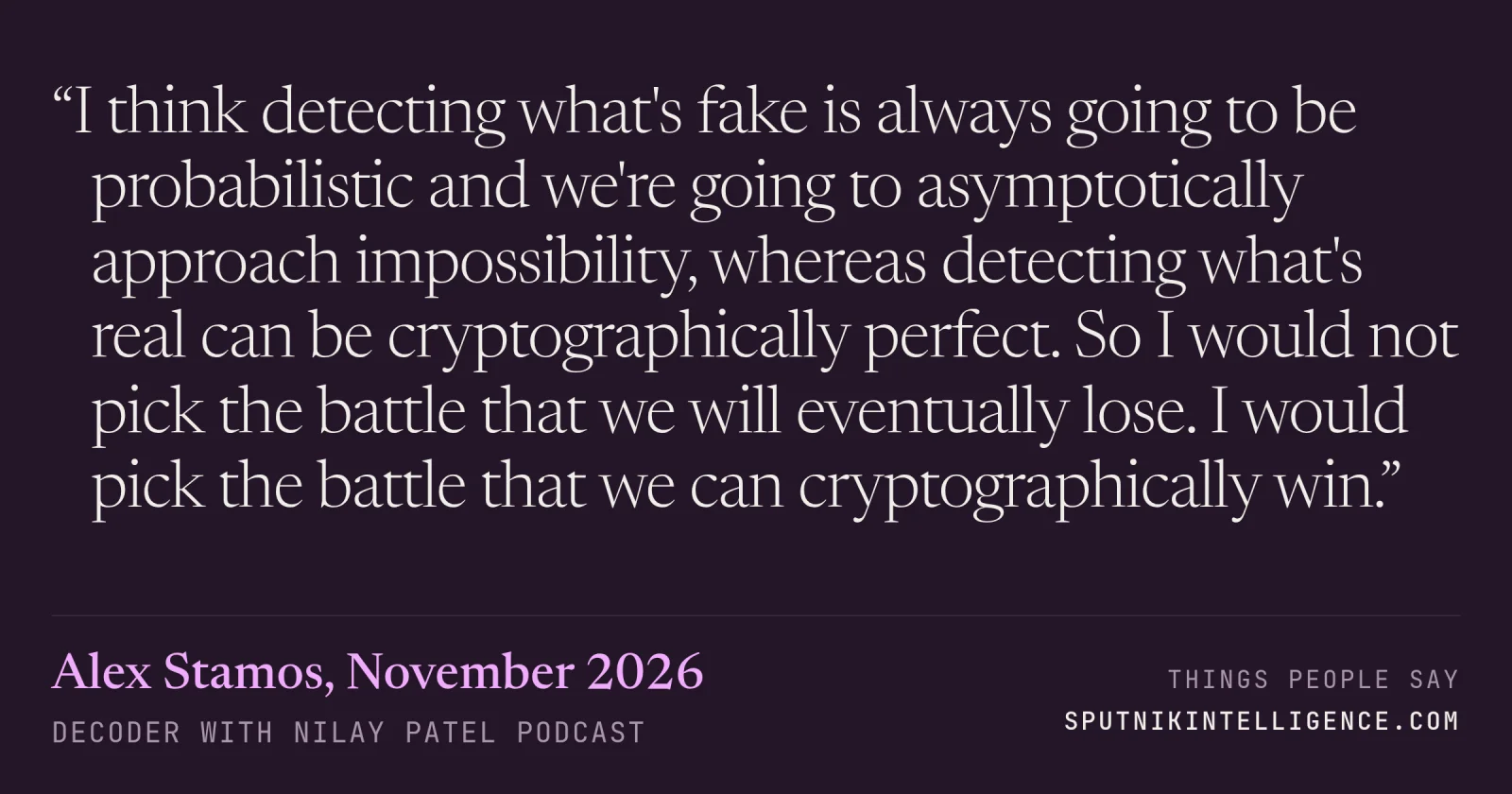
“I think detecting what's fake is always going to be probabilistic and we're going to asymptotically approach impossibility, whereas detecting what's real can be cryptographically perfect. So I would not pick the battle that we will eventually lose. I would pick the battle that we can cryptographically win.”
Decoder with Nilay Patel · Tech Strategy & Big Tech · November 2026
Context
The conversation had turned to AI slop on social networks and whether platforms can reliably label AI content. Stamos argues for verifying authentic content, such as photos signed at the camera, rather than trying to detect fakes.
Transcript
in a, not in tweet length. That's true.
The cheap ones, I can. But I'm just saying, like, the notion that we're going to verify what's real instead of detecting what's fake feels very important in the context of the media we consume. I
think detecting what's fake is always going to be probabilistic and we're going to asymptotically approach impossibility, whereas detecting what's real can be cryptographically perfect. So I would not pick the battle that we will eventually lose. I would pick the battle that we can cryptographically win. That would be my suggestion.
And there's somewhere in there where you have to build an entire chain of custody, right? We're going to take the sensor data off the camera. We're going to put it in a cloud server. We're only going to allow edits on this server. That file will never get monkeyed with.
Sure, that's true for the New York Times. Yeah. And sort of Photoshop and stuff, but not for Instagram. For Instagram, you can do it all because it's only the iPhone and it's only Instagram. So like the entire chain of custody is within your app. It is within the iPhone sensor. It's an Instagram.…
Look, like I said, we could do another whole hour on that because it feels like right next to the cybersecurity problem is the social engineering problem. And right next to the social engineering problem is the fake media problem. Right. No, absolutely. How many phishing attacks are just this…
More from Decoder with Nilay Patel