 Mark Zuckerberg
On Cheeky Pint
“You don't want a moralizing lecture for why you're wrong for asking it to do the thing. Obviously, if you're trying to do something that's catastrophic, it needs to gracefully, without pissing you off, not do it. But in general, we view alignment as more of a question of instruction and values alignment with the person who it's intending to serve.”
Cheeky Pint · Bootstrapped & Indie SaaS · October 2026
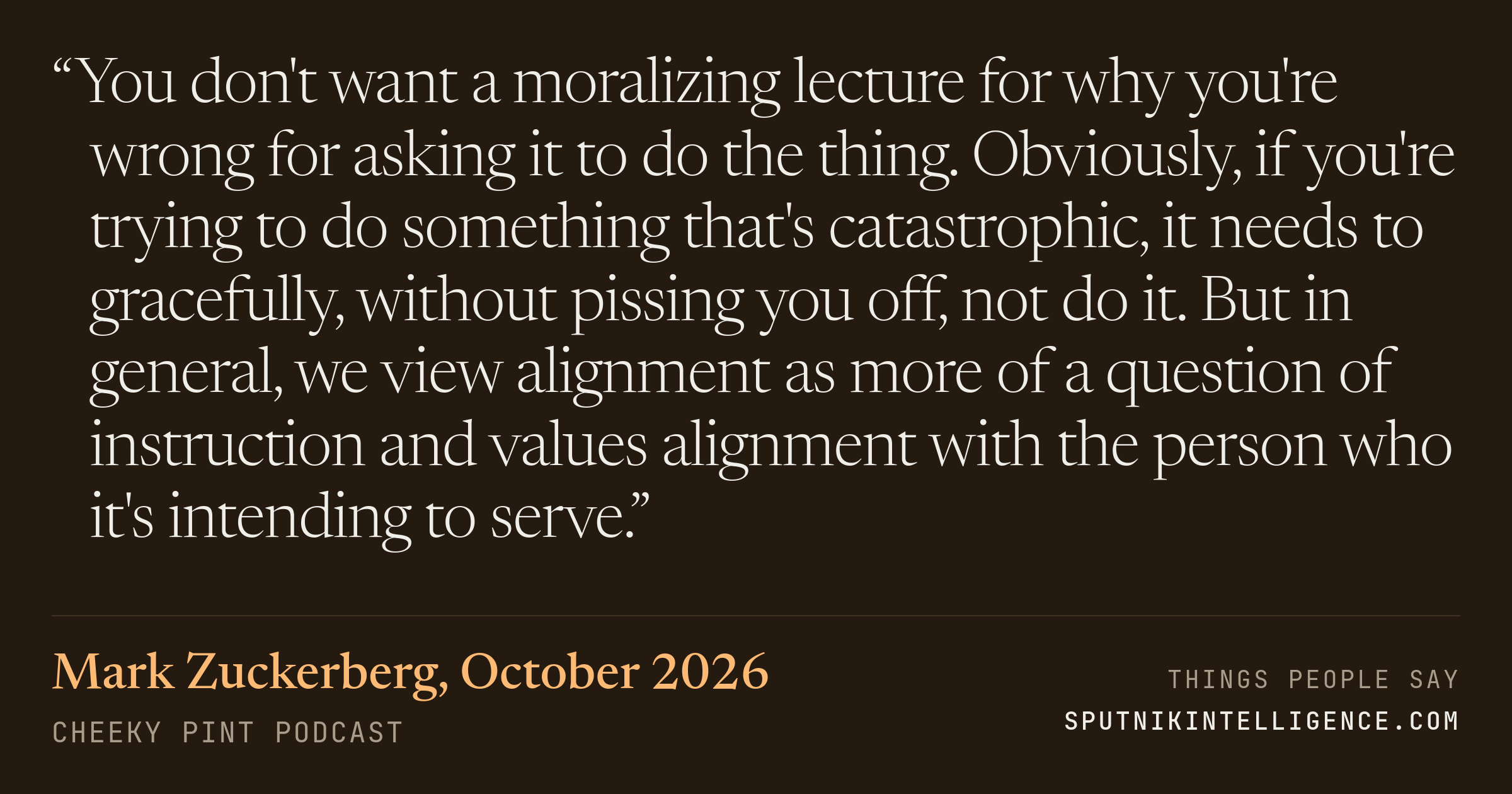
Zuckerberg on how Meta's idea of alignment differs from other labs. Because Meta is building agents that act for people, he says the priority is that the agent reliably does what its user asks, and he called this very different from how some of the others think about it.
Transcript
…is a very philosophical concept, of like, who do you want it to be aligned to? I mean, a lot of our theory is we care more about it being aligned to, you know, we're trying to give people agents, right? And it needs to... If you ask it to do something, you need to have a high confidence that it's going to do what you ask it to do. You know, like, you want it to do that with high reliability. You don't want a moralizing lecture for why you're wrong for asking it to do the thing. Obviously, if you're trying to do something that's catastrophic, it needs to gracefully, without pissing you off, not do it. But in general, we view alignment as more of a question of instruction and values alignment with the person who it's intending to serve. And I think that that's kind of a different mode of thinking about it. It's very different from, I think, how some of the others do. Alexandr Wang But one of the more interesting things I think that is maybe a question related to your original question is also just how long the process of training one of these models takes. Like Muse Wonder... In general, we've planned Muse Wonder since last…
More from Cheeky Pint