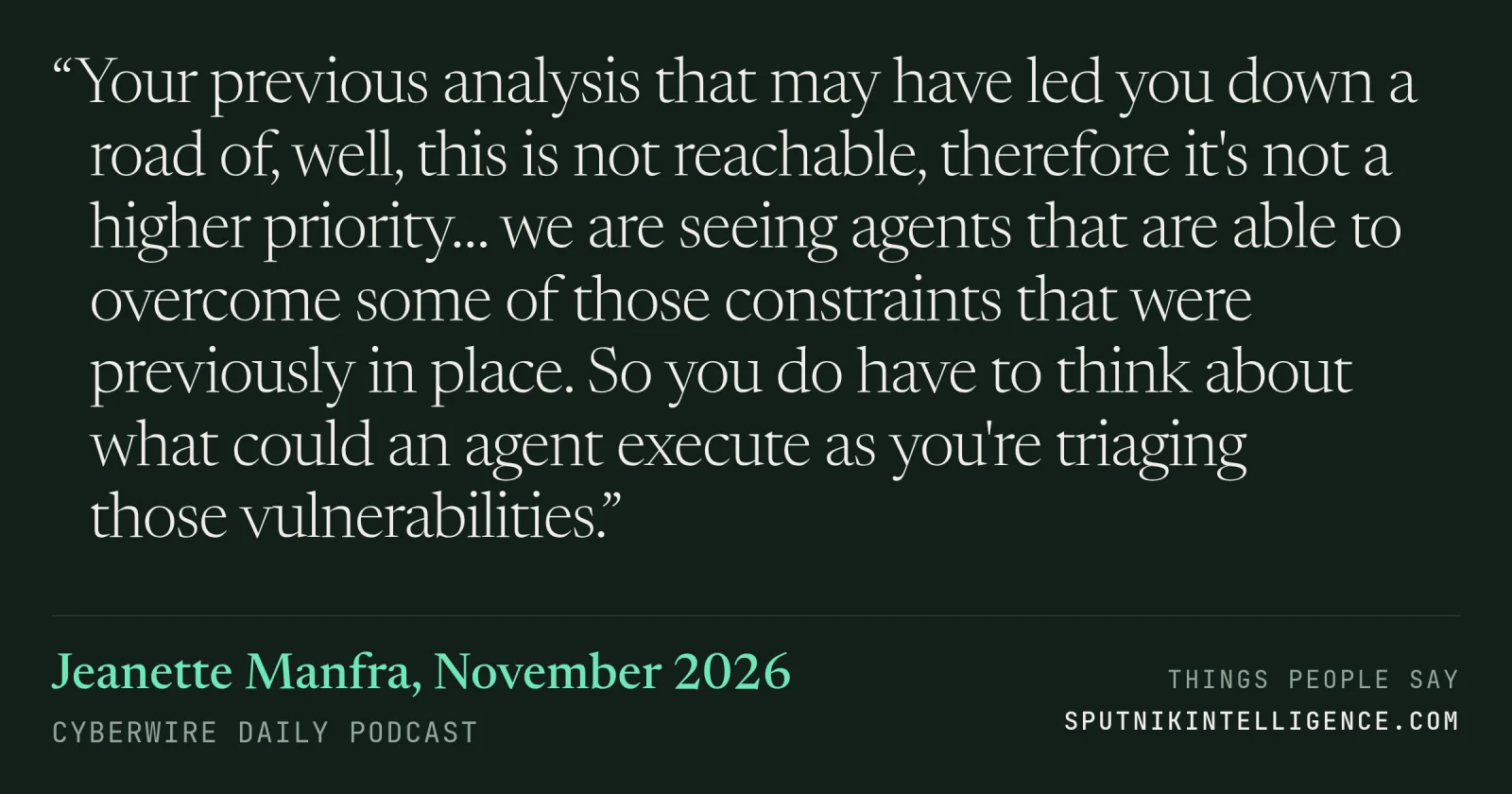
“Your previous analysis that may have led you down a road of, well, this is not reachable, therefore it's not a higher priority… we are seeing agents that are able to overcome some of those constraints that were previously in place. So you do have to think about what could an agent execute as you're triaging those vulnerabilities.”
CyberWire Daily · Software Engineering & Infra · November 2026
Context
Asked how security leaders should prioritize vulnerabilities, including deliberately leaving some unpatched. She warns that "not reachable" is no longer a safe reason to deprioritize a flaw once AI agents are the attackers, in a week when AI-driven attacks by state hackers were in the news.
Transcript
…workflows. Now, of course, you still need humans to be able to review that and safe mechanisms to be able to deploy that. But we found that this has been able to really tighten the loop for us to be able to move from finding to fixing to deploying at a pretty significant scale inside of Google.
Help me understand setting priorities here. I'm thinking of security leaders and them having to be comfortable with making deliberate but informed decisions, sometimes to leave certain vulnerabilities unpatched.
Yeah, absolutely. And there's always a resourcing question that comes into play. I think that there are really good models in thinking through how exploitable is this vulnerability in your environment that looks at things like reachability from the internet, for example. There's also certain systems that you would want to prioritize likely over others. I would add one aspect, though, is some things that we're seeing is that your previous analysis that may have led you down a road of, well, this is not reachable, therefore it's not as a higher priority. We are seeing agents that are able to overcome some of those constraints that were previously in place. So you do have to think about what could an agent execute and as you're triaging those vulnerabilities.
Yeah, I know one of the things that you've advocated for is organizations mapping their critical missions to that underlying technology that supports them. Can you walk us through what that process looks like in practice?
Absolutely. I think, and learned a lot of this in my time in government, private sector as a role here as well. And so there's an element of, and this goes to the business continuity planning and resilience, and in thinking about not just cybersecurity incidents that could impact your system, but…
Is there sometimes a disconnect between an organization's business continuity plans and their actual ability to recover from a cyber incident?
More from CyberWire Daily