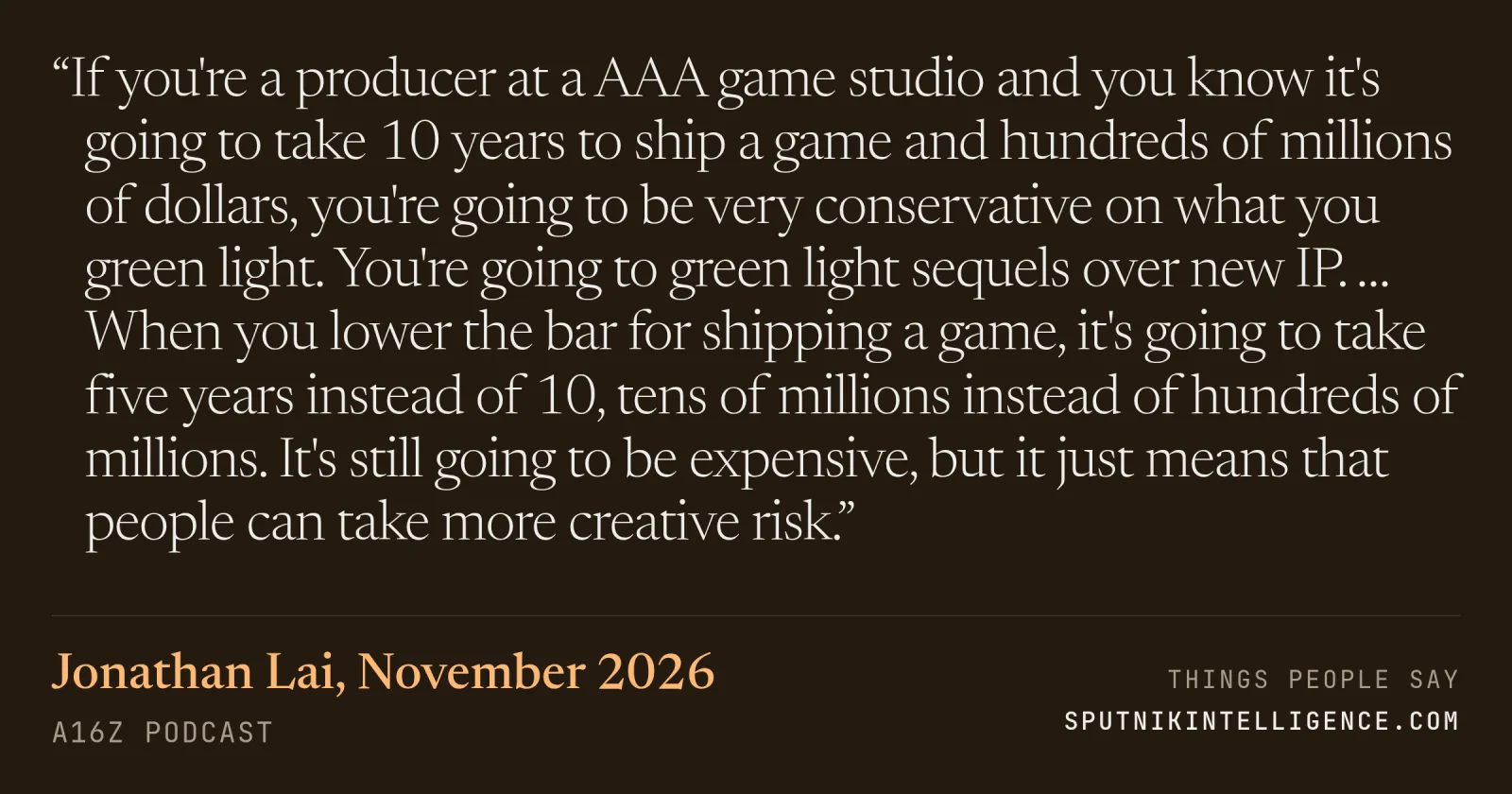
“If you're a producer at a AAA game studio and you know it's going to take 10 years to ship a game and hundreds of millions of dollars, you're going to be very conservative on what you green light. You're going to green light sequels over new IP. … When you lower the bar for shipping a game, it's going to take five years instead of 10, tens of millions instead of hundreds of millions. It's still going to be expensive, but it just means that people can take more creative risk.”
a16z Podcast · Startups & Venture · November 2026
Context
Discussing why games take so long to make, Lai argues the length of the cycle itself makes big studios play safe, which is why there are so many sequels. He says AI-shortened cycles would let studios back new ideas.
Transcript
…industry, is that the long dev cycles have a suffocating impact than just innovation. Because if you're a producer at a AAA game studio and you know it's going to take 10 years to ship a game and hundreds of millions of dollars, you're going to be very conservative on what you green light, right?
Interesting. Right. It's like
you're going to green light sequels over new IP. I think we're on the 20th Call of Duty installment. It's granted that that's six, right? Yes. It's not a new IP. You're going to skew toward genres that have established demand, right? Which is why we see so many first-person shooters, third-person shooters over some experimental genre. When you lower the bar for sort of shipping a game, right, it's going to take less time. It's going to take five years instead of 10. Instead of hundreds of millions of dollars, it's going to take tens of millions. It's still going to be expensive. I think it just means that people can take more creative risk. Totally. You can actually ship a new IP. You can take a bet on some game developers that have never actually shipped anything before. And you can green light them and get them a budget to make something. I think that's a really exciting story for the industry. And actually, it's going to unlock a lot of structural innovation.
Right. And the other actually way to explore this new capability, though, is to increase ambition. So imagine what the next 12-year game will look like. Like GTA 7, you were talking today about how intricate the city is in GTA 6. Yeah,
yeah. They have custom radio stations that they designed because they were just like, well, we have a year and this team isn't doing anything. Let's just record a bunch of radio stations and stuff like that. It's incredible,
right? But you imagine if they then spent 10 years with the current tools, forget about a city or even a world, you could build a universe with that level of detail. Why not? Yep.
More from a16z Podcast