 Claire Vo
Founder of ChatPRD, an AI tool for product managers, who writes and speaks about product management, AI agents and coding workflows.
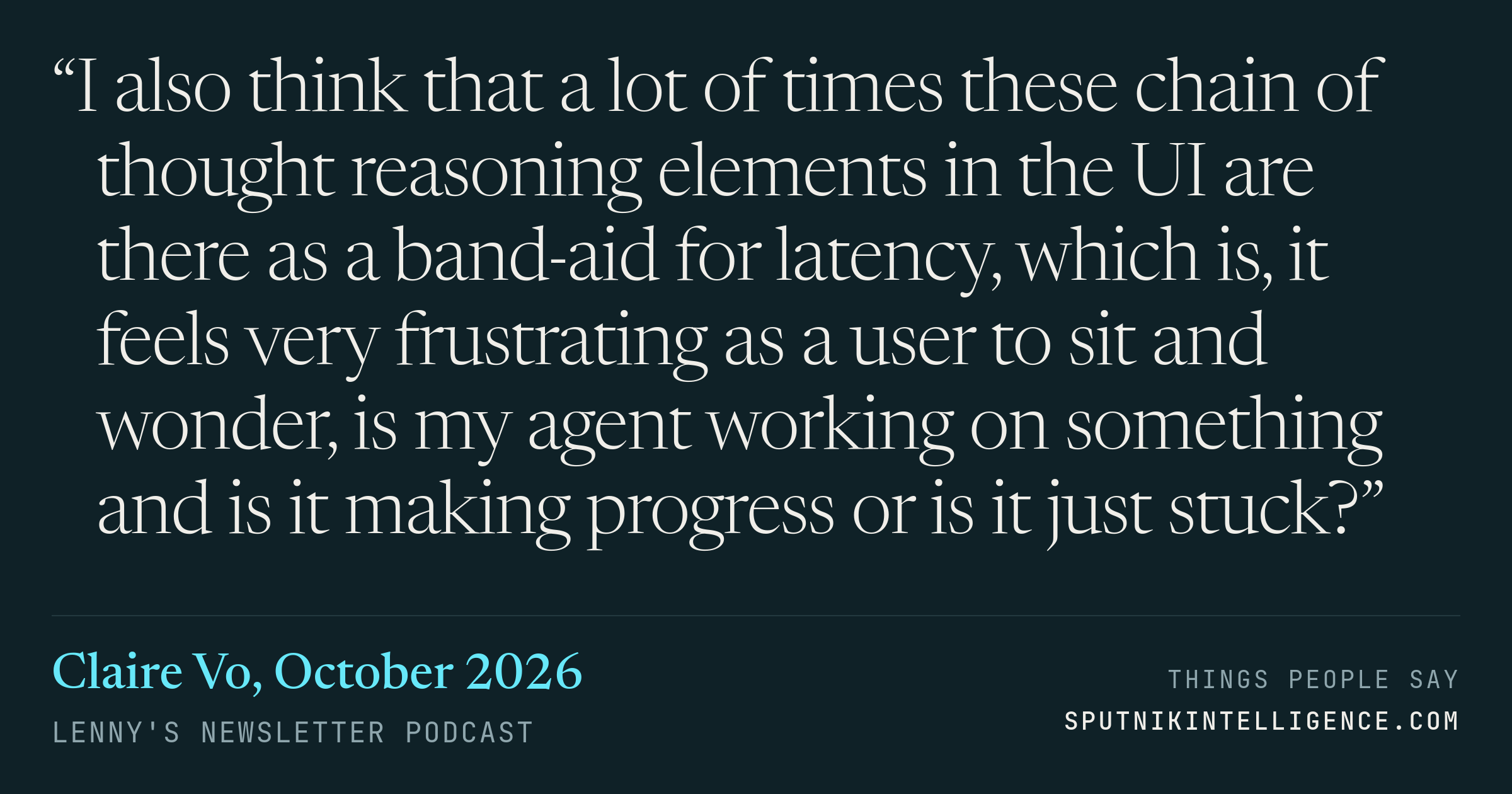
“I also think that a lot of times these chain of thought reasoning elements in the UI are there as a band-aid for latency, which is, it feels very frustrating as a user to sit and wonder, is my agent working on something and is it making progress or is it just stuck?”
Lenny's Newsletter · Product & Design · October 2026
Host Claire Vo is praising how Meta's Muse agent hides its reasoning unless you ask for it. Her argument is that much of the visible "thinking" in AI apps is there to distract from slowness, and that a fast model makes it unnecessary.
Transcript
…you have ideas, you know, you have these, you have your feed, like you've just chosen different aspects to elevate. Is that because you knew that this was going to be serving a different type of user with a different kind of like breadth of intention around what this agent could get done for them?
…really detailed in the core chat. And that's the kind of thing I think that like typically we would have just put that in there because that's like what you do these days in AI apps. But I think in this case, it was like, well, does it really need to be there for everybody? It's like, probably not.
I'll give you one other compliment because again, I am a Muse girl now, but I also think that a lot of times these chain of thought reasoning user elements in the UI are there as a band-aid for latency, which is, it feels very frustrating as a user to sit and wonder, is my agent working on something and is it making progress or is it just stuck? And so I think a lot of designers have struggled with how much do we narrate along the way, what is happening so it's quite obvious to the user so that latency doesn't feel so painful versus how much do we kind of like do progressive disclosure. And what I what I think is nice about my experience in the Muse app is I do like that progressive disclosure and is one of the things I called out in our review that I thought was quite nice, but also it's just fast. Like it is just fast. The model is just fast. Like I do think for especially something that's going to try to catch the eye of consumers, that latency really matters. And it's a zippy little agent.
Yeah, it is. And it's really, you know, it's interesting actually because it's one of those things where sometimes it's so. Fast that you are tempted to think, like, is it like, did it actually go do a thing? Like, cause it's, it's so quick. And I think, like, the nice thing is there are times…
Yeah. One other thing, just thinking about this status message, I want to talk about, which is this concept of generative UI. And I think a lot of people think, when they're thinking about generative UI, they think like every time I log into my dashboard, it's different, or every button I click is…
Right. Yeah. I think perhaps one day we'll get there, you know, but I think these days there's, it's definitely a little bit more on the rails in terms of like where we can apply it. The avatar is a great example. And I think people find a lot of delight. I have seen when they do make their own new…
More from Lenny's Newsletter