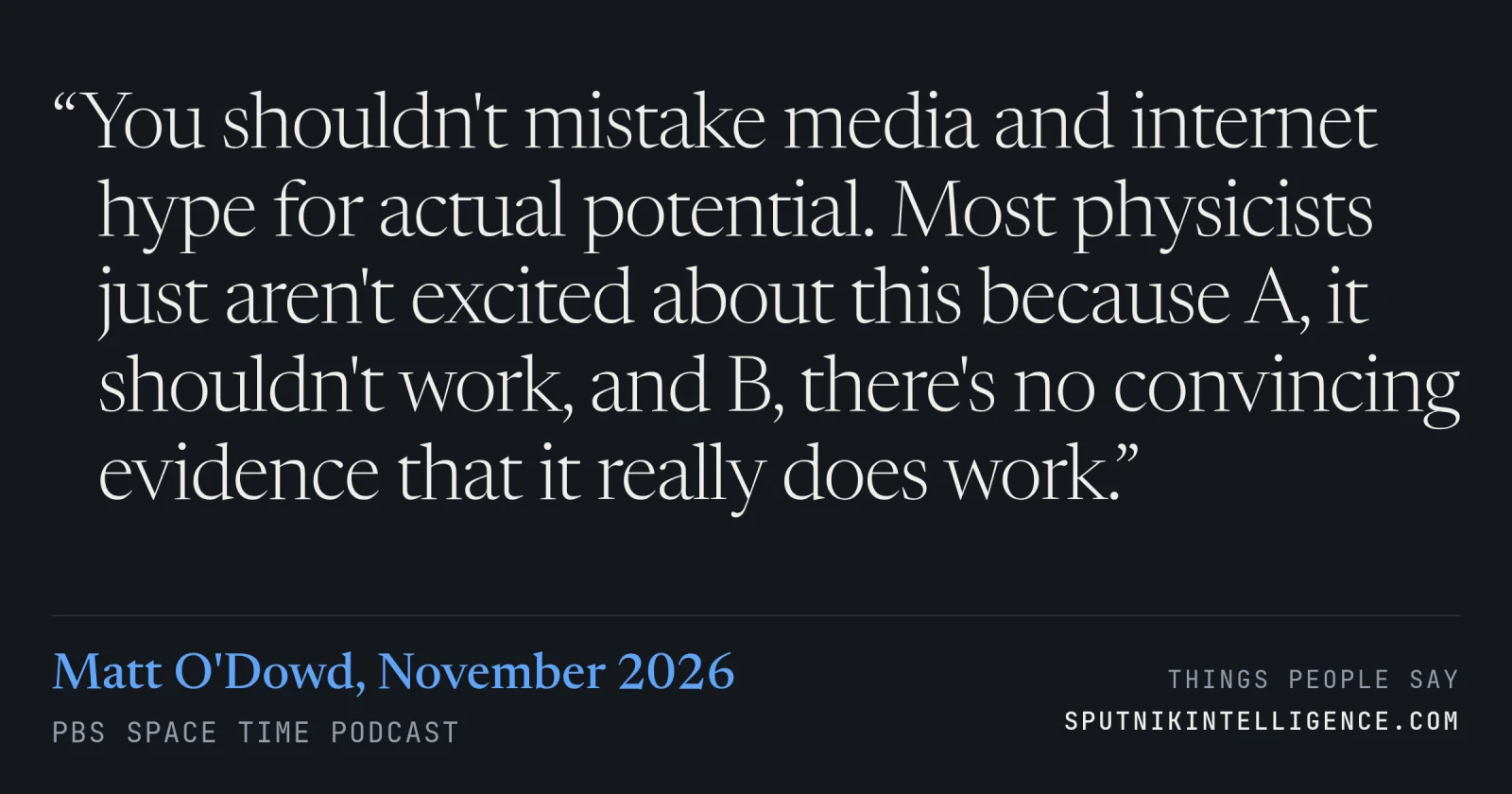
“You shouldn't mistake media and internet hype for actual potential. Most physicists just aren't excited about this because A, it shouldn't work, and B, there's no convincing evidence that it really does work.”
PBS Space Time · Ideas & Essays · November 2026
Context
Matt O'Dowd on why the EM drive gets so little lab time. Research needs money, space and people, and projects have to be promising to earn them.
Transcript
So you're saying Einstein is wrong? Blasphemy. Actually, Einstein himself agreed on this point. Guys, you should check out Kelsey's show Infinite Series, where she goes into much more depth on the nature of singularities. It's a math show, by the way, so it's sometimes about real stuff.
Mathematicians are lucky. Being limited by reality is so boring.
…an issue of resources. It costs a lot to do proper careful experimental research of any type. A scientist who decided to look into this has to devote grant money, lab space, personnel, and most critically, a lot of their own time and energy. All of these are scarce in the world of research. To warrant doing this sort of effort, a given project has to be promising. The EM drive is not promising. You shouldn't mistake media and internet hype for actual potential. Most physicists just aren't excited about this because A, it shouldn't work, and B, there's no convincing evidence that it really does work. There is at best the faintest of hints. I'll come back to that in a moment, but the amount of work being done on it currently is equal to or greater than what is warranted by its promise. Meanwhile, there are many extremely promising new technologies to work on, including propulsion tech, and we don't even have the resources to give these their due attention. Aaron Schofield points out that even…
More from PBS Space Time