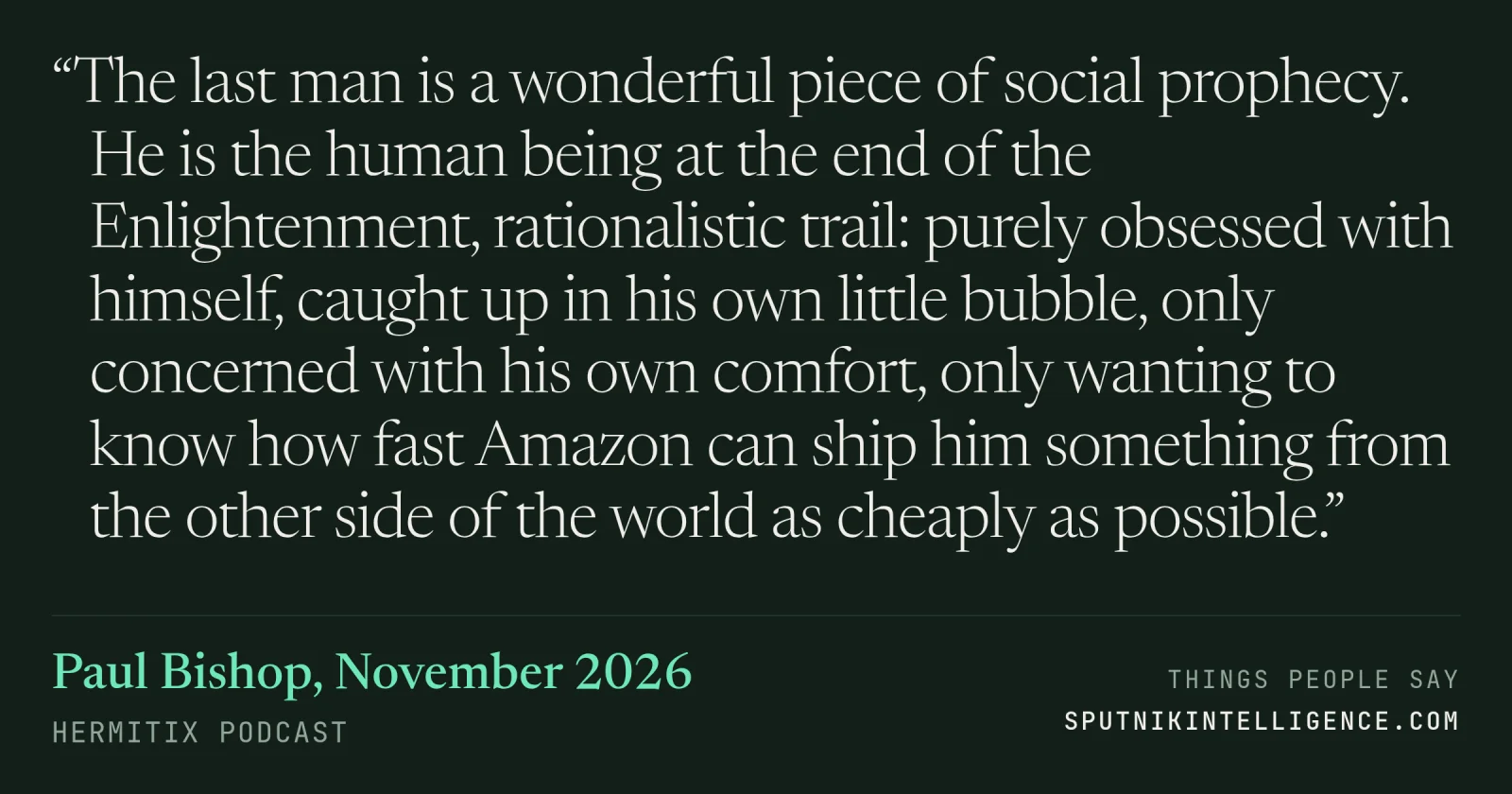
“The last man is a wonderful piece of social prophecy. He is the human being at the end of the Enlightenment, rationalistic trail: purely obsessed with himself, caught up in his own little bubble, only concerned with his own comfort, only wanting to know how fast Amazon can ship him something from the other side of the world as cheaply as possible.”
Hermitix · Ideas & Essays · November 2026
Context
Asked about Nietzsche's 'last man' from Thus Spoke Zarathustra, the scholar says the figure describes present-day tendencies, and reads it as a critique of complacency and comfort-seeking.
Transcript
…there's always going to be something beyond the stage that we're at. There is a kind of proto-ubermensch, which is the figure of Goethe, whom he interestingly chooses, but that's only an illustrative example. It's not we should all become like Goethe. That would obviously be an absurd proposition.
This inability to engage with symbols, allow them to truly work on us, let's say. Would you say this is a symptom of the last man?
I think that's absolutely part and parcel of what Der Letz de Mensch, the ultimate, the human being at the end of this enlightenment, rationalistic trail, this path which leads to individuals who are purely obsessed with themselves, caught up in their own little bubbles, only concerned with their own comfort, only wanting to know how fast Amazon can ship them something from the other side of the world as cheaply as possible. I think we see in the figure of Der Letztermensch, the last human being, it's a wonderful piece of social prophecy. And I think I'd be so bold as to say if we look around us, we can see all the sort of tendencies which are identified in this opening discourse by Zarathustra as what it's like not to be a superhuman. So yes, it's a critique of capitalism. It's a critique of an instrumental rationalism. It's a critique of complacency. There is a political dimension to Nietzsche, just as there is to Jung, but not in the negative nationalist way that it is, in my view, mistakenly portrayed as being.
And what about Jung on the last man? Is he in full agreement? Does he believe there's a redemptive hope there for the last man? That maybe something such as psychoanalysis could bring them out of their stupor?
I'm reminded of the conversation that. Max Bord has with Kafka, where Kafka says, yes, there's plenty of hope only for God, not for us. And I think that it's in that sense that Jung might have thought about it as well. I think Jung encourages us to look at things, if you like, from a kind of a…
Well, speaking, it's interesting you mentioned, you know, not to just become patched up so we can become another part of destructive machinery, because this does seem to relate to one of the sort of, I guess, historical textual facts that much of Jung's analysis of Zarathustra is happening during…
More from Hermitix