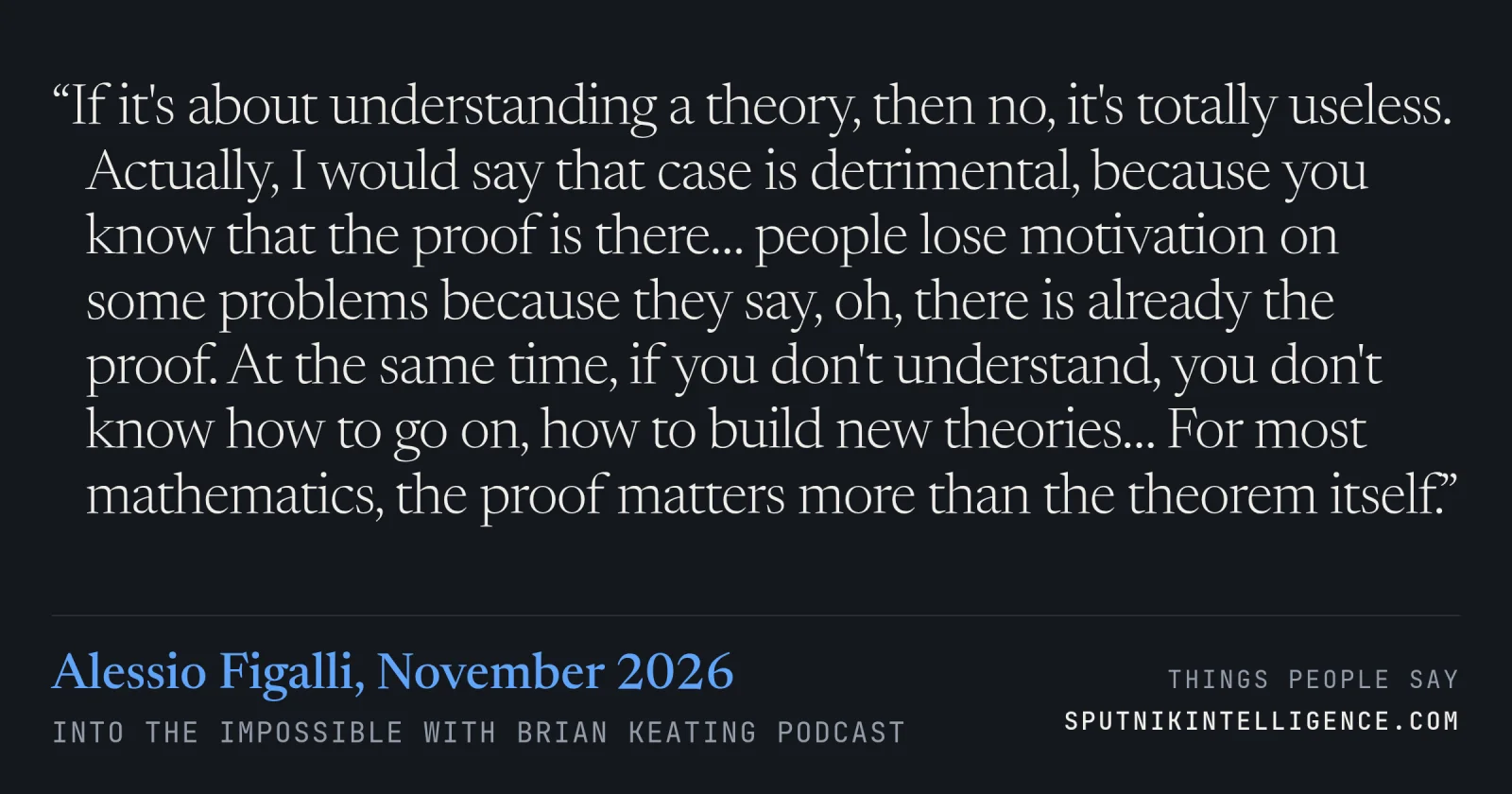
“If it's about understanding a theory, then no, it's totally useless. Actually, I would say that case is detrimental, because you know that the proof is there… people lose motivation on some problems because they say, oh, there is already the proof. At the same time, if you don't understand, you don't know how to go on, how to build new theories… For most mathematics, the proof matters more than the theorem itself.”
Into the Impossible With Brian Keating · Ideas & Essays · November 2026
Context
Asked whether a proof that an AI verifies but no mathematician can explain counts as an achievement, Alessio Figalli says that for building theory, the understanding is the whole point.
Transcript
…get the training and get everything they need to keep going, to be supported. They see the value of understanding. They're not damaged by spending time to understand. That's, I think, the most important thing. So we don't want them to feel that they need necessary to use AI themselves to speed up.
…it. Would that be an achievement or would it be evidence that we as human beings confuse proof for understanding? Does it matter if something is proven that we don't understand it? Is that a necessary and sufficient condition? Or is it okay to just have a proof that even no human can understand?
I mean, sometimes it depends on. I mean, for me, it depends on what the goal is, right? So if the theorem tells you, you don't know how you don't understand it, but it gives you the formula, pure cancer, who cares? I mean, then we just apply it and we build all the molecules we want, right? So I think the goal is there. But if it's about understanding a theory, then no, it's totally useless. Actually, it just, I would say, that case is detrimental, right? Because you know that the proof is there. So, you know, maybe, I don't know, it's a sense, you know that this hasn't been done. So it's a sense you lose, people lose motivation to what maybe on some problems because they say, oh, no, no, there is already the proof. At the same time, if you don't understand, you don't know how to go on, how to build new theories. You know, the proof sometimes it's the core. I mean, much more than the theorem by itself. I mean, usually, it really depends what your goal is, but I would say for most mathematics, the proof matters more than the theorem itself. And so that's why it's so important.
Very good. And it's important to get this right. I mean, we're living in a most rapidly, dynamically changing period in human history. And it seems like it's only going to get worse. Well, Olessio, I want to thank you so much for spending so much time with me. I hope we get to meet up again. And I…
That's a nile. That was really good. Thank you, Brian.
Thank you, Alessio.
More from Into the Impossible With Brian Keating